10-K: Annual report [Section 13 and 15(d), not S-K Item 405]
Published on February 19, 2026
UNITED STATES
SECURITIES AND EXCHANGE COMMISSION
Washington, D.C. 20549
______________________________
FORM 10-K
______________________________
| ANNUAL REPORT PURSUANT TO SECTION 13 OR 15(d) OF THE SECURITIES EXCHANGE ACT OF 1934 | |||||
For the fiscal year ended December 31 , 2025
or
| TRANSITION REPORT PURSUANT TO SECTION 13 OR 15(d) OF THE SECURITIES EXCHANGE ACT OF 1934 | |||||
For the transition period from to
Commission File Number: 001-38035
______________________________
(Exact name of registrant as specified in its charter)
______________________________
| (State or other jurisdiction of incorporation or organization) | (I.R.S. Employer Identification No.) | ||||
(Address of principal executive offices) (Zip Code)
Registrant’s telephone number, including area code: (432 ) 688-0012
Securities registered pursuant to Section 12(b) of the Act:
| Title of each class | Trading Symbol(s) | Name of each exchange on which registered | ||||||
Securities registered pursuant to Section 12(g) of the Act:
None
______________________________________________________
Indicate by check mark if the registrant is a well-known seasoned issuer, as defined in Rule 405 of the Securities Act. Yes ý No ¨
Indicate by check mark if the registrant is not required to file reports pursuant to Section 13 or Section 15(d) of the Act. Yes ¨ No ý
Indicate by check mark whether the registrant (1) has filed all reports required to be filed by Section 13 or 15(d) of the Securities Exchange Act of 1934 during the preceding 12 months (or for such shorter period that the registrant was required to file such reports), and (2) has been subject to such filing requirements for the past 90 days. Yes ý No ¨
Indicate by check mark whether the registrant has submitted electronically every Interactive Data File required to be submitted pursuant to Rule 405 of Regulation S-T (§ 232.405 of this chapter) during the preceding 12 months (or for such shorter period that the registrant was required to submit such files). Yes ý No ¨
Indicate by check mark whether the registrant is a large accelerated filer, an accelerated filer, a non-accelerated filer, smaller reporting company, or an emerging growth company. See the definitions of “large accelerated filer,” “accelerated filer,” “smaller reporting company” and "emerging growth company" in Rule 12b-2 of the Exchange Act.
| Large accelerated filer | ☐ | ý | ||||||||||||||||||
| Non-accelerated filer | ☐(Do not check if a smaller reporting company) | Smaller reporting company | ||||||||||||||||||
| Emerging growth company | ||||||||||||||||||||
If an emerging growth company, indicate by check mark if the registrant has elected not to use the extended transition period for complying with any new or revised financial accounting standards provided pursuant to Section 13(a) of the Exchange Act. ☐
Indicate by check mark whether the registrant has filed a report on and attestation to its management’s assessment of the effectiveness of its internal control over financial reporting under Section 404(b) of the Sarbanes-Oxley Act (15 U.S.C. 7262(b)) by the registered public accounting firm that prepared or issued its audit report. ☒
If securities are registered pursuant to Section 12(b) of the Act, indicate by check mark whether the financial statements of the registrant included in the filing reflect the correction of an error to previously issued financial statements. ☐
Indicate by check mark whether any of those error corrections are restatements that required a recovery analysis of incentive-based compensation received by any of the registrant’s executive officers during the relevant recovery period pursuant to §240.10D-1(b). ☐
Indicate by check mark whether the registrant is a shell company (as defined in Rule 12b-2 of the Exchange Act). Yes ☐ No ý
The aggregate market value of the Company’s Common Stock held by nonaffiliates on June 30, 2025, determined using the per share closing price on the New York Stock Exchange Composite tape of $5.97 on that date, was approximately $513.6 million.
The number of the registrant’s common shares, par value $0.001 per share, outstanding at February 13, 2026, was 122,024,047 .
Documents incorporated by reference: Portions of the registrant’s definitive proxy statement relating to the registrant’s 2026 Annual Meeting of Stockholders are incorporated by reference into Part III of this annual report.
TABLE OF CONTENTS
MARKET FOR REGISTRANT’S COMMON EQUITY, RELATED STOCKHOLDER MATTERS AND ISSUER PURCHASES OF EQUITY SECURITIES | |||||
i
FORWARD‑LOOKING STATEMENTS
This Annual Report on Form 10-K (the “Annual Report”) contains forward‑looking statements within the meaning of Section 27A of the Securities Act of 1933, as amended (the “Securities Act”), and Section 21E of the Securities and Exchange Act of 1934, as amended (the “Exchange Act”). All statements other than statements of historical facts contained in this Form 10-K are forward-looking statements. Forward-looking statements are all statements other than statements of historical fact, and give our expectations or forecasts of future events as of the effective date of this Form 10-K. Words such as “may,” “could,” “plan,” “project,” “budget,” “predict,” “pursue,” “target,” “seek,” “objective,” “believe,” “expect,” “anticipate,” “intend,” “estimate,” “will,” “should,” “continue” and similar expressions are generally used to identify forward-looking statements. These statements include, but are not limited to, statements about our business strategy, industry, future profitability, future capital expenditures, our fleet conversion strategy, our power generation business development strategy and our share repurchase program. Such statements are subject to risks and uncertainties, many of which are difficult to predict and generally beyond our control, that could cause actual results to differ materially from those implied or projected by the forward-looking statements. Factors that could cause our actual results to differ materially from the results contemplated by such forward‑looking statements include:
•changes in general economic and geopolitical conditions, including as a result of regulatory changes by the current presidential administration, higher interest rates, the rate of inflation, a potential economic recession and potential changes in the United States’ trade policy, including the imposition of tariffs and the resulting consequences;
•central bank policy actions and associated liquidity risks and other factors;
•the severity and duration of any world events and armed conflict, including the Russian-Ukraine war, conflicts in the Israel-Gaza region and continued hostilities in the Middle East, including those between Israel, Iran and the United States, recent events in Venezuela, and associated repercussions to supply and demand for oil and gas and the economy generally;
•the actions taken by the members of the Organization of the Petroleum Exporting Countries (“OPEC”) and Russia (together with OPEC and other allied producing countries, “OPEC+”) with respect to oil production levels and announcements of potential changes in such levels, including the ability of the OPEC+ countries to agree on and comply with supply limitations;
•governmental actions, such as executive orders or new regulations, including climate-related regulations, that may negatively impact the future production of oil and natural gas in the United States and may adversely affect our future operations;
•the level of production and resulting market prices for crude oil, natural gas and other hydrocarbons, including a potential increase in Venezuelan oil supply and any related impact on global oil prices and domestic oil production;
•the effects of existing and future laws and governmental regulations (or the interpretation thereof) on us, our suppliers and our customers;
•cost increases and supply chain constraints related to our services, including any delays and/or supply chain disruptions due to increased hostilities in the Middle East or increased tariffs;
•competitive conditions in our industry;
•our ability to attract and retain employees;
•changes in the long-term supply of, and demand for, oil and natural gas;
•actions taken by our customers, suppliers, competitors and third-party operators and the possible loss of customers or work to our competitors;
•technological changes, including lower emissions energy service equipment and similar advancements;
•changes in the availability and cost of capital that impact the price and availability of debt and equity financing (including higher interest rates) for us and our customers;
•our ability to successfully implement our business plan, including execution of potential mergers and acquisitions;
•large or multiple customer defaults, including defaults resulting from actual or potential insolvencies;
•the effects of consolidation on our customers or competitors;
•our ability to complete growth projects on time and on budget;
i
•increases in tax rates or types of taxes enacted that specifically impact exploration and production (“E&P”) and related operations resulting in changes in the amount of taxes owed by us;
•regulatory and related policy actions intended by federal, state and/or local governments to reduce fossil fuel use and associated carbon emissions, or to drive the substitution of renewable forms of energy for oil and gas, that may over time reduce demand for oil and gas and therefore the demand for our services;
•new or expanded regulations that materially limit our customers’ access to federal and state lands for oil and gas development, thereby reducing demand for our services in the affected areas;
•growing demand for electric vehicles that result in reduced demand for gasoline and therefore the demand for our services;
•our ability to successfully implement technological developments and enhancements, including our new Tier IV Dynamic Gas Blending (“DGB”) dual-fuel and FORCE® electric-powered hydraulic fracturing equipment, power generation equipment, and other lower-emissions equipment we may acquire or that may be sought by our customers;
•our ability to successfully grow our new power generation business line;
•the development of alternative power generation technologies or increased grid capacity that could reduce the demand for our services;
•the projected timing, purchase price and number of shares purchased under our share repurchase program, the sources of funds under the share repurchase program and the impacts of the share repurchase program;
•operating hazards, natural disasters, weather-related suspensions or delays, casualty losses and other matters beyond our control, such as fires, which risks may be self-insured, or may not be fully covered under our insurance programs;
•exposure to cyber-security events which could cause information theft, data corruption, operational disruptions, reputational harm and/or financial loss;
•acts of terrorism, war or political or civil unrest in the United States or elsewhere; and
•the effects of current and future litigation.
Readers are cautioned not to place undue reliance on our forward‑looking statements. Although forward‑looking statements reflect our good faith beliefs at the time they are made, forward‑looking statements involve known and unknown risks, uncertainties and other factors, including the factors described under "Item 1A. Risk Factors" of this Annual Report, which may cause our actual results, performance or achievements to differ materially from anticipated future results, performance or achievements expressed or implied by such forward‑looking statements. We do not undertake, and expressly disclaim, any duty to update or revise any forward‑looking statement, whether as a result of new information, future events, changed circumstances or otherwise, except as required by applicable securities laws.
Unless the context indicates otherwise, all references to “ProPetro Holding Corp.,” “the Company,” “we,” “our” or “us” or like terms refer to ProPetro Holding Corp. and its consolidated subsidiaries, ProPetro Services, Inc., Silvertip Completion Services Operating, LLC, Aqua Prop, LLC and ProPetro Energy Solutions, LLC.
ii
SUMMARY RISK FACTORS
Our business is subject to varying degrees of risk and uncertainty. Investors should consider the risks and uncertainties summarized below, as well as the risks and uncertainties discussed in Part I, “Item 1A. Risk Factors” of this Annual Report. Additional risks not presently known to us or that we currently deem immaterial may also affect us. If any of these risks occur, our business, financial condition or results of operations could be materially and adversely affected.
Our business is subject to the following principal risks and uncertainties:
Risks Inherent in Our Business and Industry
•Our business and financial performance depends on the historically cyclical oil and natural gas industry and particularly on the level of capital spending of E&P companies within the United States and in the Permian Basin, and a decline in prices for oil and natural gas may cause fluctuation in operating results or otherwise have an adverse effect on our revenue, cash flows, profitability and growth.
•Many of our power generation services involve long sales cycles.
•Our PROPWRSM business line exposes us to the significant risks and uncertainties associated with establishment of a new line of business, and such business line may not achieve the results we anticipate.
•The majority of our operations are located in the Permian Basin, making us vulnerable to risks associated with operating in one major geographic area.
•New technology may cause us to be less competitive.
•Our operations require substantial capital and we may be unable to obtain needed capital or financing on satisfactory terms, or at all, which could limit our ability to grow.
•Our indebtedness and liquidity needs could restrict our operations and adversely affect our financial condition.
•Restrictions in our current and future financing agreements may limit our ability to finance future operations or capital needs or capitalize on potential acquisitions and other business opportunities.
•Our operations are subject to unforeseen interruptions and hazards inherent in the oil and natural gas industry, for which we may not be adequately insured and which could cause us to lose customers and substantial revenue.
•We are subject to cyber security risks. A cyber incident could occur and result in information theft, data corruption, operational disruptions, reputational harm and/or financial loss.
•We may pursue acquisitions, internal expansions or other strategic transactions, and our failure to properly plan and manage such growth may adversely affect our performance.
Risks Related to Customers, Suppliers and Competition
•Reliance upon a few large customers may adversely affect our revenue and operating results.
•We expect to face significant competition in the future as the mobile and modular power industry evolves.
•Our customers may not continue to outsource their power generation needs.
•We are exposed to the credit risk of our customers, and any material nonpayment or nonperformance by our customers could adversely affect our business, results of operations and financial conditions.
•Our business depends upon the ability to obtain specialized equipment, parts and key raw materials, including sand and power generation assets, balance of plant components, power distribution equipment and associated ancillary equipment, from third‑party suppliers. We may be vulnerable to supply chain disruptions, delayed deliveries and future price increases, which could adversely impact our ability to provide our services.
iii
•We may be unable to adapt our power generation technologies to meet increasing customer needs and power loads, which could result in increased downtime of our power generation offering and disruptions to the power supply to our customers.
•Distributed power generation services in some applications compete with access to the grid.
Risks Related to Employees
•We rely on a few key employees whose absence or loss could adversely affect our business.
•If we are unable to employ a sufficient number of skilled and qualified workers, our capacity and profitability could be diminished and our growth potential could be impaired.
Risks Related to Regulatory Matters
•We are subject to environmental laws and regulations, and future compliance, claims, and liabilities relating to such matters may have a material adverse effect on our results of operations, financial position or cash flows.
•Federal and state legislative and regulatory initiatives relating to hydraulic fracturing could result in increased costs and additional operating restrictions or delays.
•Increasing trucking regulations may increase our costs and negatively impact our results of operations.
•Certain of our completion services, particularly our hydraulic fracturing services, are substantially dependent on the availability of water. Restrictions on our or our customers’ ability to obtain water may have an adverse effect on our financial condition, results of operations and cash flows.
Risks Related to Tax Matters
•Our ability to use our net operating loss carryforwards (“NOLs”) may be limited.
•Changes to applicable tax laws and regulations or exposure to additional tax liabilities could adversely affect our operating results and cash flows.
Risks Inherent to an Investment in our Common Stock
•Certain provisions of our certificate of incorporation, and bylaws, as well as Delaware law, may discourage acquisition bids or merger proposals, which may adversely affect the market price of our common stock.
•Our business could be negatively affected as a result of the actions of activist shareholders.
•The market price of our common stock is subject to volatility.
•There may be future sales or other dilution of our equity, which may adversely affect the market price of our common stock.
iv
PART I
Item 1. Business.
Our Company
We are a leading integrated energy service company, located in Midland, Texas, focused on providing innovative hydraulic fracturing, wireline, and other complementary energy and power generation services to leading upstream oil and gas companies engaged in the E&P of North American oil and natural gas resources. Our operations are primarily focused in the Permian Basin, where we have cultivated longstanding customer relationships with some of the region’s most active and well‑capitalized E&P companies. The Permian Basin is widely regarded as one of the most prolific oil and natural gas producing areas in the United States, and we believe we are one of the leading providers of energy services in the region.
In December 2024, we formed a new subsidiary, ProPetro Energy Solutions, LLC, doing business as PROPWR, which provides turnkey power generation services to oil and gas producers and for general industrial projects and data centers using mobile power generation equipment installed at customers’ sites. This subsidiary began revenue-generating activities during the third quarter of fiscal year 2025 and has entered into contractual arrangements with equipment manufacturers to purchase mobile natural gas-fueled power generation equipment, including turbine generator sets, reciprocating engines, auxiliary equipment and battery energy storage solution equipment.
On November 1, 2024, we sold our cementing business located in Vernal, Utah, to a business owned by a former employee as part of a strategic repositioning. We received a promissory note for $13.0 million as consideration, and recorded a gain on disposal of $8.2 million related to the sale of the business. The note receivable was fully repaid with interest in December 2025. The former employee was part of our cementing operations until November 1, 2024, and is no longer affiliated with the Company.
On May 31, 2024, we consummated the acquisition of all of the outstanding equity interests in Aqua Prop, LLC (“AquaProp”), which provides wet sand solutions for hydraulic fracturing at well sites (the “AquaProp Acquisition”). The consideration for the AquaProp Acquisition included $13.7 million of cash paid to the seller, $3.7 million of deferred cash consideration payable to the seller by May 31, 2025, the payoff of $7.2 million of the seller’s outstanding debt, the payment of $0.3 million of certain transaction costs and estimated contingent consideration of $10.9 million. As a result of the AquaProp Acquisition, we expanded our business to include wet sand services.
On December 1, 2023, we consummated the purchase of the assets and operations of Par Five Energy Services LLC (“Par Five”), which provides cementing services in the Delaware Basin in exchange for $25.4 million of cash, including deferred cash consideration of $3.1 million which was payable to Par Five or its beneficiary on June 1, 2025, with interest at 4.0% per annum. (the “Par Five Acquisition”). The Par Five Acquisition complemented our existing cementing business and enabled us to serve both the Midland and Delaware sub-basins of the Permian Basin.
Collectively, the AquaProp Acquisition, the Par Five Acquisition and our acquisition of Silvertip Completion Services Operating, LLC (“Silvertip”) in 2022 have positioned the Company as a more integrated and diversified completions-focused energy service provider. See “Note 4. Business Acquisitions” in the financial statements for additional disclosures.
We believe that our substantial market presence in the Permian Basin positions us well to capitalize on drilling, completion activity and power demand in the region. Our operational focus has primarily been in the Permian Basin's Midland sub-basin, where our customers have operated. However, we have increased our operations in the Delaware sub-basin and are well-positioned to support further increases in our activity in this area in response to demand from our customers. Over time, we expect the Permian Basin's Midland and Delaware sub-basins to continue to command a disproportionate share of future North American E&P spending.
Additionally, we believe the significant natural gas production in the Permian Basin will become a natural market for power-intensive businesses including data centers and other industrial businesses seeking alternative solutions for reliable and available electricity requirements which are not dependent on grid or public utility limitations.
We primarily provide hydraulic fracturing, wireline and cementing completion services to E&P companies in the Permian Basin and power generation services to oil and gas producers and non-oil and gas applications such as general industrial projects and data centers. Our completions equipment has been designed to handle the operating conditions commonly encountered in the Permian Basin and the region's increasingly high-intensity well completions (including simultaneous hydraulic fracturing
1
(“Simul-Frac”), which involves fracturing multiple wellbores at the same time), which are characterized by longer horizontal wellbores, more stages per lateral and increasing amounts of proppant per well.
Commodity Price and Other Economic Conditions
The oil and gas industry has traditionally been volatile and is characterized by a combination of long-term, short-term and cyclical trends, including domestic and international supply and demand for oil and gas, current and expected future prices for oil and gas and the perceived stability and sustainability of those prices, and capital investments of E&P companies toward their development and production of oil and gas reserves. The power generation services industry is impacted by prices and availability of electricity and power generation equipment including turbines, reciprocating engines and necessary ancillary equipment. Our power generation business will be negatively impacted if electricity prices decrease and grid power becomes widely available. The oil and gas industry and the power generation services industry are also impacted by general domestic and international economic conditions such as supply chain disruptions and inflation, war and political instability in oil producing countries, government regulations (both in the United States and internationally), levels of consumer demand, adverse weather conditions, and other factors that are beyond our control.
The geopolitical and macroeconomic consequences of military action in the Middle East, the Russian invasion of Ukraine, including the associated sanctions, recent events in Venezuela, and actions by OPEC+ have contributed to volatility in supply and demand dynamics for crude oil and associated volatility in crude oil pricing in recent years. More recently, the West Texas Intermediate (“WTI”) average crude oil price declined to approximately $65 per barrel in 2025 compared to approximately $76 per barrel in 2024 in response to tariff policies implemented by the United States government, an anticipated increase in global supply of crude oil and concerns of a potential global recession resulting from high inflation, interest rates, impacts of tariff policies on supply chains and increased costs as a whole. Additionally, we have recently experienced a decrease in the Permian Basin rig count to 304 at the end of 2024 and a further decrease to 247 at the end of 2025, according to the Baker Hughes Company (“Baker Hughes”), which resulted in a reduction in the demand for completion services and pressure on pricing of our services.
Sustained levels of high inflation likewise caused the U.S. Federal Reserve and other central banks to increase interest rates, and to the extent elevated inflation remains, we may experience further cost increases for our operations, including interest rates, labor costs and equipment. We cannot predict any future trends in the rate of inflation and crude oil prices. A significant increase in or continued high levels of inflation, to the extent we are unable to timely pass-through the cost increases to our customers, further declines in crude oil prices, or potential changes in the United States’ trade policy, including the imposition of tariffs and the resulting consequences, would negatively impact our business, financial condition and results of operations. See Part II, Item 1A. “Risk Factors—We may be adversely affected by the effects of inflation.”
Government regulations and investors are demanding the oil and gas industry transition to a lower emissions operating environment, including upstream and energy service companies. As a result, we are working with our customers and equipment manufacturers to transition our equipment into a lower emissions profile. Currently, a number of lower emission solutions for pumping equipment, including Tier IV DGB dual-fuel, FORCE® electric, direct drive gas turbine and other technologies have been developed, and we expect additional lower emission solutions will be developed in the future. We are continually evaluating these technologies and other investment and acquisition opportunities that would support our existing and new customer relationships. The transition to lower emissions equipment is quickly evolving and will be capital intensive. Over time, we may be required to convert substantially all of our conventional Tier II equipment to lower emissions equipment. To the extent any of our customers have certain expectations or requirements with respect to emissions reductions from their contractors, if we are unable to continue quickly transitioning to lower emissions equipment, the demand for our services could be adversely impacted.
If the Permian Basin rig count and market conditions improve, including improved pricing for our services and labor availability, and we are able to meet our customers' lower emissions equipment demands, we believe our operational and financial results will also improve. If the rig count or market conditions do not improve or decline in the future, and we are unable to increase our pricing or pass-through future cost increases for our customers, there could be a material adverse impact on our business, results of operations and cash flows.
Our results of operations have historically reflected seasonal tendencies, typically in the fourth quarter, relating to the holiday season, inclement winter weather and the exhaustion of our customers' annual budgets. As a result, we typically experience declines in our operating and financial results in November and December, even in a stable commodity price and operations environment.
2
Our Services
As of December 31, 2025, we conducted our business through four operating segments: Hydraulic Fracturing, Wireline, Cementing and Power Generation, all of which meet the criteria of a reportable segment. Prior to the third quarter of 2025, our Power Generation segment did not meet the quantitative thresholds for a reportable segment and prior to the fourth quarter of fiscal year 2024, our Cementing segment did not meet the quantitative thresholds for a reportable segment. Accordingly, they were shown in the “All Other” category. Effective as of the third quarter of fiscal year 2025 and the fourth quarter of fiscal year 2024, Power Generation and Cementing, respectively, are shown as reportable segments since they meet the criteria of a reportable segment. Additionally, our corporate administrative activities do not involve business activities from which we may earn revenues and its results are not regularly reviewed by the Company’s Chief Operating Decision Maker (the “CODM”) when making key operating and resource decisions. As a result, corporate administrative expenses have been included under “Reconciling Items.” For additional financial information on our reportable segment presentation, please see reportable segment information in Part II - Item 8, “Financial Statements and Supplementary Data.”
Hydraulic Fracturing
We provide hydraulic fracturing services to E&P companies in the Permian Basin. These services are intended to optimize hydrocarbon flow paths during the completion phase of horizontal shale wellbores. We have significant expertise in multi‑stage fracturing of horizontal oil‑producing wells in unconventional geological formations. Our total available hydraulic horsepower (“HHP”) at December 31, 2025, was 1,259,500 HHP, which was comprised of 445,000 HHP of our Tier IV Dynamic Gas Blending (“DGB”) dual-fuel equipment, 312,000 HHP of FORCE® electric-powered equipment and 502,500 HHP of conventional Tier II equipment. Our hydraulic fracturing fleets range from approximately 50,000 to 80,000 HHP depending on the job design and customer demand at the wellsite. Our completions equipment has been designed to handle the operating conditions commonly encountered in the Permian Basin and the region’s increasingly high-intensity well completions (including simultaneous hydraulic fracturing (“Simul-Frac”), which involves fracturing multiple wellbores at the same time), which are characterized by longer horizontal wellbores, more stages per lateral and increasing amounts of proppant per well. With the industry transition to lower emissions equipment and Simul-Frac, in addition to several other changes to our customers' job designs, we believe that our available fleet capacity could decline if we decide to reconfigure our fleets to increase active HHP and backup HHP at wellsites. In 2021, we began to transition our fleet from traditional equipment to Tier IV DGB dual-fuel equipment. In 2022, we entered into three-year electric fleet leases which commenced in 2023 and 2024 for four FORCE® electric-powered hydraulic fracturing fleets worth of equipment with 60,000 HHP per fleet, and in 2024, we entered into an additional three-year lease for one more FORCE® electric-powered hydraulic fracturing fleet worth of equipment with 72,000 HHP (collectively, the “Electric Fleet Leases”). As of December 31, 2025, we have received 312,000 HHP of FORCE® electric-powered equipment representing five fleets worth of equipment.
The hydraulic fracturing process consists of pumping fracturing fluid into a well at sufficient pressure to fracture the formation. Materials known as proppants, which in our business are comprised primarily of sand, are suspended in the fracturing fluid and are pumped into the fracture to prop it open. The fracturing fluid is designed to break, or loosen viscosity, and be forced out of the formation by its pressure, leaving the proppants suspended in the fractures created, thereby increasing the mobility of the hydrocarbons. As a result of the fracturing process, production rates are usually enhanced substantially, thus increasing the rate of return of hydrocarbons for the operator.
We own and operate a fleet of mobile hydraulic fracturing units and other auxiliary equipment to perform fracturing services. We also refer to all of our fracturing units, other equipment and vehicles necessary to perform a fracturing job as a “fleet” and the personnel assigned to each fleet as a “crew.” Our hydraulic fracturing units consist primarily of high pressure hydraulic pumps, diesel or dual gas engines, gas turbine generators, transmissions and various hoses, valves, tanks and other supporting equipment like blenders, irons, hoses and data vans. We also own and operate a fleet of trucks, trailers and other equipment that provide onsite storage and handling of wet sand used in the completion phase of shale wellbores.
We provide dedicated equipment, personnel and services that are tailored to meet each of our customers’ needs. Each fleet has a designated team of personnel, which allows us to provide responsive and customized services, such as project design, proppant and other consumables procurement, real-time data provision and post‑completion analysis for each of our jobs. Many of our hydraulic fracturing fleets and associated personnel have worked continuously with the same customer for the past several years promoting deep relationships and a high degree of coordination and visibility into future customer activity levels. Furthermore, in light of our substantial market presence and historically high fleet utilization levels, we have established a variety of trusted relationships with key equipment, sand and other downhole consumable suppliers. We believe these strategic relationships position us to acquire equipment, parts and materials on a timely and economic basis and allow our dedicated procurement and logistics team to support consistently safe and reliable operations.
3
Wireline
We provide wireline and ancillary services on new oil well completions in the Permian Basin. Wireline utilizes equipment with a drum of wireline to deploy perforating guns in the well to perforate the casing, cement, and formation. Once the well is perforated, it is ready to be fractured. Pumpdown utilizes pressure pumping equipment to pump water into the well to deploy or push the perforating guns attached to the wireline through the lateral section of a well.
We own and operate a fleet of mobile wireline units and other auxiliary equipment to perform well completion services. We also refer to our wireline units, pressure control equipment, other equipment and vehicles necessary to perform a job as a "spread" and the personnel assigned to the spread as a "crew." On average, one wireline spread consists of a wireline tractor truck with a large cab functioning as a mobile office where the engineer controls the wireline spooled drum along with associated pressure control iron and equipment, trailers and vehicles. We currently have 28 wireline units.
Cementing
We provide cementing services for completion of new wells and remedial work on existing wells. Cementing services use pressure pumping equipment to deliver a slurry of liquid cement that is pumped down a well between the casing and the borehole. Cementing provides isolation between fluid zones behind the casing to minimize potential damage to hydrocarbon bearing formations or the integrity of freshwater aquifers, and provides structural integrity for the casing by securing it to the earth. Cementing is also done when re-completing wells, where one zone is plugged and another is opened.
We believe that our Cementing segment provides an organic growth opportunity for us to expand our service offerings within our existing customer base. We currently have 29 cementing units.
Power Generation Services
In December 2024, we launched our PROPWRSM business line which provides turnkey power generation services to oil and gas producers and non-oil and gas applications, such as general industrial projects and data centers, using mobile power generation equipment installed at customers’ sites. These services are generally provided through contractual arrangements in which we set a price per unit of power generated or a price per period and a minimum quantity of power per period under our contracts. We are also paid cost plus a predetermined margin for other related services. This subsidiary began revenue generating activities during the third quarter of fiscal year 2025 and has entered into contractual arrangements with equipment manufacturers to purchase mobile natural gas-fueled power generation equipment, including turbine generator sets, reciprocating engines, auxiliary equipment and battery energy storage solution equipment. We have received certain units of this equipment and expect to receive the remaining units currently on order from the first quarter of fiscal year 2026 through year-end 2027. The total capacity of equipment under these contractual arrangements including equipment received through December 31, 2025 is approximately 550 megawatts, split approximately 70% and 30% between high-efficiency reciprocating engine generators and low emissions modular turbines, respectively. As of February 19, 2026, we had total committed capacity of approximately 240 megawatts.
Our Customers
Our customers consist primarily of oil and natural gas producers in North America. Our top five customers accounted for approximately 68.2%, 58.8% and 63.2% of our revenue, for the years ended December 31, 2025, 2024, and 2023, respectively. For the year ended December 31, 2025, Exxon Mobil Corporation (“ExxonMobil”), Occidental Petroleum Corporation, EOG Resources, Inc. and Permian Resources Corporation accounted for 24.9%, 13.7%, 12.1%, and 11.2%, respectively, of total revenue. No other customer accounted for more than 10% of our total revenue for the year ended December 31, 2025. There have been many recent mergers and acquisitions in the oil and gas industry. In May 2024, Pioneer Natural Resources USA, Inc. (“Pioneer”) merged with and into a wholly owned subsidiary of Exxon Mobil. We currently provide pressure pumping, wireline and other services to ExxonMobil and previously provided such services to Pioneer. Mergers and acquisitions involving our customers could negatively impact our future business with them or positively impact our business by providing us access to potential new customers.
On April 22, 2024, we entered into a sub-agreement for hydraulic fracturing services with XTO Energy Inc. (“XTO”), a wholly owned subsidiary of ExxonMobil, pursuant to which we agreed to provide hydraulic fracturing, wireline and pumpdown services with two committed FORCE® electric-powered hydraulic fracturing fleets and the option to add a third FORCE® fleet (also with wireline and pumpdown services) for a certain number of contracted hours with respect to each fleet, subject to certain termination and release rights. This agreement will expire in approximately late 2026. At this time, we do not expect
4
such agreement to be renewed or extended and, if we are not able to procure additional work from XTO, we will be required to seek to redeploy the equipment associated with the affected fleets with other customers.
Competition
We provide our services primarily in the Permian Basin, and we compete against different companies in each service and product line we offer. The markets in which we operate are highly competitive. To be successful, an energy service company must provide services and equipment that meet the specific needs of oil and natural gas E&P companies at competitive prices. Competitive factors impacting sales of our services are price, reputation, technical expertise, emissions profile, service and equipment design and quality, and health and safety standards. Although we believe our customers consider all of these factors, we believe price is a key factor in E&P companies’ criteria in choosing a service provider. However, we have recently observed the energy industry and our customers shift to lower emissions equipment, which we believe will be an increasingly important factor in an E&P company’s selection of a service provider. The transition to lower emissions equipment has been challenging for companies in the energy service industry because of the capital requirements, lack of large scale deployment of certain new technology such as electric-powered equipment, and the pricing of our services and expected return on invested capital. While we seek to price our services competitively, we believe many of our customers elect to work with us based on our operational efficiencies, productivity, equipment quality and technology, reliability, ability to manage multifaceted logistics challenges, commitment to safety and the ability of our people to handle the most complex Permian Basin well completions and power generation challenges.
Seasonality
Our results of operations have historically reflected seasonal tendencies, generally in the fourth quarter, relating to the conclusion of our customers’ annual capital expenditure budgets, the holidays and inclement winter weather which could result in suspension of services during which we may experience declines in our operating and financial results.
Operating Risks and Insurance
Our operations are subject to hazards inherent in the energy service industry, such as accidents, blowouts, explosions, fires and spills and releases that can cause personal injury or loss of life, damage or destruction of property, equipment, natural resources and the environment and suspension of operations.
In addition, claims for loss of oil and natural gas production and damage to formations can occur in the energy service industry. If a serious accident were to occur at a location where our equipment and services are being used, it could result in us being named as a defendant in lawsuits asserting large claims.
Our business involves the transportation of heavy equipment and materials, and as a result, we may also experience traffic accidents which may result in spills, property damage and personal injury.
Despite our efforts to maintain safety standards, we have suffered accidents from time to time in the past and anticipate that we could experience accidents in the future. In addition to the property damage, personal injury and other losses from these accidents, the frequency and severity of these incidents affect our operating costs and insurability and our relationships with customers, employees, regulatory agencies and other parties. Any significant increase in the frequency or severity of these incidents, or the general level of compensation awards, could adversely affect the cost of, or our ability to obtain workers’ compensation and other forms of insurance, and could have other material adverse effects on our financial condition and results of operations.
We maintain commercial general liability, workers’ compensation, business automobile, commercial property and equipment, excess liability, and directors and officers insurance policies providing coverages of risks and amounts that we believe to be customary in our industry. Our primary and excess liability insurance policies include liability coverage for sudden and accidental pollution incidents. Although we are insured for environmental pollution resulting from certain environmental accidents that occur on a sudden and accidental basis, we may not be insured against all environmental accidents or events that might occur.
We maintain directors and officers insurance; however, our insurance coverage is subject to certain exclusions (including, for example, any required United States Securities and Exchange Commission (“SEC”) disgorgement or penalties) and we are responsible for meeting certain deductibles under the policies. Moreover, we cannot assure you that our insurance coverage will adequately protect us from all future claims.
5
Although we maintain insurance coverage of types and amounts that we believe to be customary in the industry, we are not fully insured against all risks, either because insurance is not available or because of the high premium costs relative to perceived risk. Further, insurance rates have in the past been subject to wide fluctuation and changes in coverage could result in less coverage, increases in cost or higher deductibles and retentions. Liabilities for which we are not insured, or which exceed the policy limits of our applicable insurance, could have a material adverse effect on us. See “Risk Factors” for a description of certain risks associated with our insurance policies.
Environmental and Occupational Health and Safety Regulations
Our operations are subject to stringent laws and regulations governing the discharge of materials into the environment or otherwise relating to environmental protection, and occupational health and safety. Numerous federal, state and local governmental agencies issue regulations that often require difficult and costly compliance measures that could carry substantial administrative, civil and criminal penalties and may result in injunctive obligations for non-compliance. These laws and regulations may, for example, restrict the types, quantities and concentrations of various substances that can be released into the environment, limit or prohibit construction or drilling activities on certain lands lying within wilderness, wetlands, ecologically or seismically sensitive areas and other protected areas, or require action to prevent or remediate pollution from current or former operations. Moreover, it is not uncommon for neighboring landowners and other third parties to file claims for personal injury and property damage allegedly caused by the release of hazardous substances, hydrocarbons or other waste products into the environment. Changes in environmental, health and safety laws and regulations occur frequently, and any changes that result in more stringent and costly requirements could materially adversely affect our operations and financial position. We have not experienced any material adverse effect from compliance with current requirements; however, this trend may not continue in the future.
Below is an overview of some of the more significant environmental, health and safety requirements with which we must comply. Our customers’ operations are subject to similar laws and regulations. Any material adverse effect of these laws and regulations on our customers’ operations and financial position may also have an indirect material adverse effect on our operations and financial position.
Waste Handling. We handle, transport, store and dispose of wastes that are subject to the Resource Conservation and Recovery Act (“RCRA”) and comparable state laws and regulations, which affect our activities by imposing requirements regarding the generation, transportation, treatment, storage, disposal and cleanup of hazardous and non-hazardous wastes. With federal approval, the individual states administer some or all of the provisions of RCRA, sometimes in conjunction with their own, more stringent requirements. Although certain petroleum production wastes are exempt from regulation as hazardous wastes under RCRA, such wastes may constitute “solid wastes” that are subject to the less stringent requirements of non-hazardous waste provisions.
Administrative, civil and criminal penalties can be imposed for failure to comply with waste handling requirements. Moreover, the U.S. Environmental Protection Agency (“EPA”) or state or local governments may adopt more stringent requirements for the handling of non-hazardous wastes or recategorize some non-hazardous wastes as hazardous for future regulation. Indeed, legislation has been proposed from time to time in Congress to recategorize certain oil and natural gas exploration, development and production wastes as hazardous wastes. Several environmental organizations have also petitioned the EPA to modify existing regulations to recategorize certain oil and natural gas exploration, development and production wastes as hazardous. Any such changes in these laws and regulations could have a material adverse effect on our capital expenditures and operating expenses. Although we do not believe the current costs of managing our wastes, as presently classified, to be significant, any legislative or regulatory reclassification of oil and natural gas E&P wastes could increase our costs to manage and dispose of such wastes.
Remediation of Hazardous Substances. The Comprehensive Environmental Response, Compensation and Liability Act (“CERCLA”) and analogous state laws generally impose liability without regard to fault or legality of the original conduct, on classes of persons who are considered to be responsible for the release of a hazardous substance into the environment. These persons include the current owner or operator of a contaminated facility, a former owner or operator of the facility at the time of contamination and those persons that disposed or arranged for the disposal of the hazardous substance at the facility. Liability for the costs of removing or remediating previously disposed wastes or contamination, damages to natural resources, the costs of conducting certain health studies, amongst other things, is strict and joint and several. In the course of our operations, we use materials that, if released, would be subject to CERCLA and comparable state laws. Therefore, governmental agencies or third parties may seek to hold us responsible under CERCLA and comparable state statutes for all or part of the costs to clean up sites at which such hazardous substances have been released.
6
NORM. In the course of our operations, some of our equipment may be exposed to naturally occurring radioactive materials (“NORM”) associated with oil and gas deposits and, accordingly, may result in the generation of wastes and other materials containing NORM. NORM exhibiting levels of radiation in excess of established state standards are subject to special handling and disposal requirements, and any storage vessels, piping and work area affected by NORM may be subject to remediation or restoration requirements.
Water Discharges. The Clean Water Act, Safe Drinking Water Act, Oil Pollution Act and analogous state laws and regulations impose restrictions and strict controls regarding the unauthorized discharge of pollutants, including produced waters and other gas and oil wastes, into regulated waters. The discharge of pollutants into regulated waters is prohibited, except in accordance with the terms of a permit issued by the EPA or the state. Also, spill prevention, control and countermeasure plan requirements require appropriate containment berms and similar structures to help prevent the contamination of regulated waters.
Air Emissions. The Clean Air Act (“CAA”) and comparable state laws and regulations, regulate emissions of various air pollutants through the issuance of permits and the imposition of other emissions control requirements. The EPA has developed, and continues to develop, stringent regulations governing emissions of air pollutants from specified sources. New facilities may be required to obtain permits before work can begin, and existing facilities may be required to obtain additional permits and incur capital costs in order to remain in compliance. These and other laws and regulations may increase the costs of compliance for some facilities where we operate. Obtaining or renewing permits also has the potential to delay the development of oil and natural gas projects.
Climate Change. Notwithstanding the EPA’s recent rule revoking the “Endangerment Finding” (that greenhouse gas (“GHG”) emissions constitute a pollutant under the CAA), which supports the majority of the EPA’s GHG-related regulations, the EPA under previous presidential administrations adopted a number of regulations relating to GHG emissions that impact certain oil and gas facilities. However, the current EPA has announced numerous proposals and initiatives to repeal or revise many of its climate-change related rulemakings. As a result, there is significant uncertainty surrounding the future regulation of climate change at the federal level.
Additionally, various states and groups of states have adopted or are considering laws or other initiatives related to climate change. Litigation risks have also increased as a result of suits against certain oil and natural gas companies pertaining to alleged past or future damages resulting from climate change. Moreover, climate change may result in various physical risks, such as the increased frequency or intensity of extreme weather events or changes in the meteorological and hydrological patterns, that could adversely impact us, our customers’ and our suppliers’ operations. For more information, see our risk factor titled “Our and our customers’ operations are subject to a series of risks arising out of the threat of climate change that could result in increased operating costs, limit the areas in which oil and natural gas production may occur, and reduce demand for the products and services we provide.”
Endangered and Threatened Species. Environmental laws such as the Endangered Species Act (“ESA”) and analogous state laws may impact exploration, development and production activities in areas where we operate. The ESA provides broad protection for species of fish, wildlife and plants that are listed as threatened or endangered. Similar protections are offered to migratory birds under the Migratory Bird Treaty Act (“MBTA”) and various state analogs. Under the MBTA, the taking, killing or possessing of migratory birds is unlawful without a permit. In April 2025, the U.S. Department of the Interior issued a memorandum that reinstated the interpretation that the MBTA’s prohibition only applied to “affirmative actions that have as their purpose the taking or killing of migratory birds, their nests, or their eggs.” In addition, the U.S. Fish and Wildlife Service (“FWS”) may identify previously unidentified endangered or threatened species or may designate critical habitat and suitable habitat areas that it believes are necessary for survival of a threatened or endangered species. For example, the dunes sagebrush lizard, which is found only in the active and semi-stable shinnery oak dunes of southeastern New Mexico and adjacent portions of Texas (including areas where our customers operate), has, since May 2024, been listed as endangered under the ESA, although that decision has been challenged. To the extent any protections are implemented for this or any other species, it could cause us or our customers to incur additional costs or become subject to operating restrictions or operating bans in the affected areas.
Regulation of Hydraulic Fracturing and Related Activities. Our hydraulic fracturing operations are a significant component of our business. Hydraulic fracturing is an important and common practice that is used to stimulate production of hydrocarbons, particularly natural gas, from tight formations, including shales. The process, which involves the injection of water, sand and chemicals under pressure into formations to fracture the surrounding rock and stimulate production, is typically regulated by state oil and natural gas commissions. However, federal agencies have asserted regulatory authority over certain aspects of the process. For example, in April and May 2024, the U.S. Bureau of Land Management (“BLM”) finalized two rules increasing royalty rates, rentals, and minimum bids, and updating the agency’s interpretation of its mandate that conservation is a use of
7
federal land on par with mineral extraction and other uses (“Public Lands Rule”). In September 2025, the U.S. Department of the Interior announced its proposal to rescind the Public Lands Rule. Further, in May 2025, the BLM announced a policy designed to expedite the oil and gas leasing process on public lands. In addition, federal legislation to repeal the Safe Drinking Water Act exemption for hydraulic fracturing and require more stringent permitting of hydraulic fracturing has previously been proposed in Congress. This federal legislation has not passed. Elsewhere, several states and local jurisdictions in which we or our customers operate also have adopted or are considering adopting regulations that could restrict or prohibit hydraulic fracturing in certain circumstances, impose more stringent operating standards and/or require the disclosure of the composition of hydraulic fracturing fluids.
Federal and state governments have also investigated whether the disposal of produced water into underground injection wells has caused increased seismic activity in certain areas. In response to concerns regarding induced seismicity, regulators in some states, including Oklahoma and Texas, have imposed, or are considering imposing, additional requirements in the permitting of produced water disposal wells or otherwise to assess any relationship between seismicity and the use of such wells. For example, the Texas Railroad Commission (“TRRC”) has adopted rules restricting injection well operations following seismic activity exceeding certain magnitude and suspending all deep oil and gas produced water injection wells in certain geographical areas covered by the TRRC’s seismic response program.
Increased regulation of hydraulic fracturing and related activities could subject us and our customers to additional permitting and financial assurance requirements, more stringent construction specifications, increased monitoring, reporting and record keeping obligations, and plugging and abandonment requirements. New requirements could result in increased operational costs for us and our customers, and reduce the demand for our services. For more information on each of these items, see our risk factor titled “Federal and state legislative and regulatory initiatives relating to hydraulic fracturing could result in increased costs and additional operating restrictions or delays.”
OSHA Matters. The Occupational Safety and Health Act (“OSHA”) and comparable state statutes regulate the protection of the health and safety of workers. In addition, the OSHA hazard communication standard requires that information be maintained about hazardous materials used or produced in operations and that this information be provided to employees, state and local government authorities and the public.
Human Capital
Our employees are our key asset. Our primary human capital management objectives are to effectively engage, develop, retain and reward our employees. As of December 31, 2025, we employed approximately 1,700 people, and none of our employees are represented by a union. All of our employees work for or support our Hydraulic Fracturing, Wireline, Cementing and Power Generation operating segments. We believe that we have good relations with our employees. We believe that our employees are a key component of our ability to attract and retain customers as a result of their operational excellence in the field.
Some examples of significant programs and initiatives that support our objective of attracting, developing and retaining our workforce include:
•Opportunity and Engagement. We are an equal opportunity employer and prohibit discrimination against any employee and applicant on the basis of any legally protected characteristic. We believe that in order to attract and retain talent with the skill sets and expertise that can help to maximize our operational efficiencies across all levels in the Company, it is in our best interest to create a culture that is welcoming. We conducted a pulse employee engagement survey in 2025, which confirmed continued strong overall employee engagement results with improvement over the 2024 survey in the categories of future vision, leadership trust and belonging. The improvement in engagement scores is attributed to action planning undertaken by department leadership and improved communication and transparency by the senior leadership team. Attracting the right people to ProPetro remains top priority. Some examples of this effort to recruit and develop our team and culture include:
◦a commitment to conducting business in a manner that respects all human rights in compliance within the requirements of applicable laws;
◦a commitment within our business operations to promoting and encouraging respect and fundamental freedoms for all without unlawful discrimination on the basis of any protected characteristic, such as race, color, sex, religion, and national origin;
◦working with personnel, business partners and other parties directly linked to our operations that share our commitment to these same legal compliance principles;
8
◦maintaining employment policies reflecting our commitments, including our code of conduct, our equal employment opportunity employer policy, and our anti-harassment and anti-discrimination policy; and
◦providing an anonymous Ethics and Compliance hotline that is promoted internally and accessible from our intranet and website to make it easy for grievances regarding health and safety to be addressed early and remediated directly, in confidence and without fear of retaliation.
•Training and Safety. We offer in-depth, role-appropriate safety training upon hiring and as part of the continuous development of our employees. The safety of our employees, our customers, and the communities in which we operate is paramount. We track and evaluate safety incidents at wellsites and offices, and if an accident does occur, we aim to take actions to mitigate similar incidents from recurring in the future. The Company seeks to incentivize employees to focus on conducting operations in accordance with our strict safety standards, as well as to immediately report any breach of safety protocol, which is highly encouraged. Employees receive training to reinforce reporting rights and responsibilities, as well as non-retaliation policies. The weighting for safety performance was increased from ten percent in 2024 to twenty percent in 2025 in the executive officers’ annual incentive program. This change was intended to bring increased focus on safety performance. The 2025 safety incentive was based upon the Company’s achievement of certain safety goals, including targets for total recordable incident rate and lost time incident rate.
•Professional Development. In 2025, the Company continued its focus on leadership development, targeting leadership positions including frontline supervisors and above. Internal facilitators were trained and certified to deliver content to drive program efficiency and better associate the topics and importance of the training to the business. The Company launched the Workday Learning Management System (the “LMS”) in 2025 to support the leadership development program and make more resources available to employees to support general development. These materials are easy for employees to access from any device to drive their own development interests. Also, supervisors are able to assign specific training through the LMS during the annual performance appraisal process to emphasize position specific training to improve performance and support overall development.
•Compensation, Health, Wellness and Benefits. Our employee benefit offerings are designed to meet the varied and evolving needs of our entire workforce across the Company and we believe they are consistent with those provided by our peer companies with which we compete for talent. The Company provides employees with the ability to participate in health and welfare plans, including medical, dental, life, accidental death and dismemberment and short-term and long-term disability insurance plans.
In 2025, as part of our 401(k) plan, we continued to focus on financial wellness education and group and individual consultations for employees as well as encouraging participation in the program. The program opportunities included many crucial topics ranging from budgeting and debt management to understanding plan options and investment strategy. Concerning health benefits, in 2025 we continued our focus on emotional and mental health, as well as certain preventative health services related to the early detection of concerns including breast cancer, diabetes and cardiovascular disease.
We also strive to give back to the areas in which we conduct business operations, and in which our employees live and work. Our employees give generously and receive up to eight hours per year of paid time off to participate in community service. Our employee-led P.U.M.P. Committee also organizes or sponsors events in which employees can choose to participate in addition to our paid community service time benefit.
Availability of Filings
Our Annual Reports on Form 10-K, Quarterly Reports on Form 10-Q, Current Reports on Form 8-K and amendments to those reports filed or furnished pursuant to Section 13(a) or 15(d) of the Exchange Act, are made available free of charge on our internet website at www.propetroservices.com, as soon as reasonably practicable after we have electronically filed the material with, or furnished it to, the SEC. The SEC maintains an internet site that contains our reports, proxy and information statements and our other SEC filings. The address of that website is www.sec.gov. In addition to its reports filed or furnished with the SEC, the Company publicly discloses material information from time to time in its press releases, at the annual meeting of Shareholders, in publicly accessible conferences and Investor presentations, and through its website (principally in its Investor Relations page). Please note that references to the Company’s website in this Form 10-K are provided as a convenience and do not constitute, and should be deemed, an incorporation by reference of the information contained on, or available through the website, and such information should not be considered part of this Form 10-K.
9
Board of Directors and Executive Officers
Set forth below are the names, age and business experience of the Board of Directors of the company as of February 19, 2026.
Phillip A. Gobe, 73, began serving as our Chairman of the Board in July of 2019 and as Executive Chairman in October 2019. Mr. Gobe was appointed as our Chief Executive Officer on March 13, 2020 and served in that role until August 31, 2021, at which point he was re-appointed as Executive Chairman. Mr. Gobe stepped down as Executive Chairman on March 31, 2022, and continues serving the Company as Chairman of the Board. Mr. Gobe served as a director of Pioneer from July 2014 until Pioneer’s merger with ExxonMobil in May 2024. Mr. Gobe previously served as Chairman of the Board for Pantheon Resources PLC until his June 2023 retirement. He also previously served as a director of Scientific Drilling International and Pioneer Southwest Energy Partners L.P. Mr. Gobe joined Energy Partners, Ltd as Chief Operating Officer in December 2004 and became president in May 2005, and served in those capacities until his retirement in September 2007. Mr. Gobe also served as a director of Energy Partners, Ltd. from November 2005 until May 2008. Prior to that, Mr. Gobe served as Chief Operating Officer for Nuevo Energy Company from February 2001 until its acquisition by Plains Exploration & Production Company in May 2004. Prior to that time, he held numerous operations and human resources positions with Vastar Resources, Inc. and Atlantic Richfield Company (“ARCO”) and its subsidiaries. Mr. Gobe has a Bachelor of Arts degree from the University of Texas and a Master of Business Administration degree from the University of Louisiana in Lafayette. Mr. Gobe’s extensive experience in the energy industry, including service as a director to public corporations in the industry, makes him well suited to serve as Chairman of the Board.
Samuel D. Sledge, 39, has served as our Chief Executive Officer and as a member of our Board since August 31, 2021. Mr. Sledge previously served as the Company’s President from April 2021 to August 2021, and prior to that, he served as Chief Strategy and Administrative Officer beginning in March 2020. Mr. Sledge has significant experience with ProPetro having joined the Company in 2011. Mr. Sledge has served in various capacities throughout his tenure such as a Frac Technical Specialist and Technical Operations Manager where his duties included quality control, planning and logistics, and the development of the engineering program. Mr. Sledge has also served as ProPetro’s Vice President of Finance, Corporate Development, and Investor Relations where his responsibilities included financial planning and analysis, strategic initiatives, and investor relations. Mr. Sledge also serves on the Board of the Energy Workforce and Technology Council (“EWTC”), an industry association for energy service companies, and currently serves as the Chairman of the EWTC Board. Mr. Sledge received a Bachelor of Business Administration and a Master of Business Administration from Baylor University. We believe Mr. Sledge’s experience in the energy industry and his significant experience in management roles at the Company make him well suited to serve as a director.
Spencer D. Armour III, 72, has served as a member of our Board since February 2013. Mr. Armour has over 30 years of executive and entrepreneurial experience in the energy services industry. Mr. Armour served as President of PT Petroleum LLC in Midland, Texas from 2011 to 2018. He was the Vice President of Corporate Development for Basic Energy Services, Inc. from 2007 to 2008, which acquired Sledge Drilling Corp., a company Mr. Armour co-founded and served as Chief Executive Officer from 2005 to 2006. From 1998 through 2005, he served as Executive Vice President of Patterson-UTI Energy, Inc., which acquired Lone Star Mud, Inc., a company Mr. Armour founded and served as President from 1986 to 1997. Mr. Armour also served on the board of Patterson-UTI Energy, Inc. from 1999 to 2001. He currently serves on the boards of Viper Energy, Inc. and CES Energy Solutions Corp and is a partner at Geneses Investments. Mr. Armour received a Bachelor of Science in Economics from the University of Houston in 1977 and served on the University of Houston System Board of Regents from 2011 until 2018. We believe that Mr. Armour’s extensive experience in the energy services industry and his deep knowledge of industry dynamics within the Permian Basin make him well suited to serve as a director.
Mark S. Berg, 67, has served as a member of our Board since 2019. Mr. Berg is a senior energy industry executive with extensive commercial and operational experience, including leadership of strategic planning, business development, land, water management, completion and well services, environmental, sustainability, legal, government relations and communications. During his 20-year career with Pioneer, then an NYSE-listed independent oil and gas exploration and production company, first as Executive Vice President & General Counsel from 2005 to 2014 and then as Executive Vice President, Corporate Operations from 2014 until its merger with ExxonMobil in 2024, he played a key role in transforming the company into a major U.S. shale resource developer. He led the negotiating team for the $65 billion merger with ExxonMobil as well as multiple multibillion-dollar mergers, global divestitures, and cross-border joint ventures. Prior to joining Pioneer, Mr. Berg served from 2002 to 2004 as Senior Vice President, General Counsel & Secretary of Hanover Compressor Company, then an NYSE-listed company specializing in natural gas compression and processing, where he instituted disciplined internal controls, resolved an SEC investigation, and settled securities class action litigation. From 1997 to 2002 he served as Executive Vice President & General Counsel of American General Corporation, a Fortune 200 diversified financial services company, and oversaw its $27 billion merger with American International Group. Mr. Berg began his career with the Houston based law firm Vinson & Elkins L.L.P.
10
and served as a partner from 1990 through 1997, focused on mergers, acquisitions and international project development. From 2018 to 2020, he served on the board of directors of HighPoint Resources, an exploration and production company then listed on the NYSE. Mr. Berg currently serves as the Chairman of the Board of Crystal Clearwater Resources, a leading wastewater solutions company. Additionally, Mr. Berg serves on the boards of Oncor Electric Delivery Holdings Company LLC and Oncor Electric Delivery Company LLC, a regulated electricity transmission and distribution company. Mr. Berg also serves as the founding Vice Chairman of the Permian Strategic Partnership, a coalition of Permian Basin energy companies and higher education institutions focused on supporting public education, healthcare, road safety and workforce development in the Permian Basin region. Mr. Berg earned a Bachelor of Arts degree in Public Policy from Tulane University and a Juris Doctor from the University of Texas. We believe that Mr. Berg’s vast leadership experience in the energy industry makes him well suited to serve as a director.
Anthony J. Best, 76, has served as a member of our Board since January 2018 and was elected to serve as Lead Independent Director in October 2019. Mr. Best has over 40 years of experience in the energy industry. Mr. Best retired as the Chairman of the board of Newpark Resources in May 2023. He was previously a director with Quantum Energy Partners’ (“Quantum”) portfolio companies, ExL Petroleum and Middle Fork Energy Partners, and also served as Senior Advisor for Quantum. Prior to joining Quantum, Mr. Best served in various roles with SM Energy Company, an oil and gas exploration company, commencing in 2006 as its President and Chief Operating Officer, and as its Chief Executive Officer from February 2007 through January 2015. From 2003 to 2005, Mr. Best served as President and Chief Executive Officer of Pure Resources, Inc., a Unocal development and exploration company. From 2000 to 2003, Mr. Best served as an independent consultant offering leadership and oil and gas consultation to energy companies and volunteer organizations, and from 1979 through 2000, Mr. Best served in various roles of increasing responsibility at ARCO, culminating in the position of President, ARCO Latin America. Mr. Best holds a Master of Science in Engineering Management degree from the University of Alaska and a Bachelor of Science degree in Mechanical Engineering from Texas A&M University. Prior to beginning his business career, Mr. Best served five years as an engineering officer in the United States Air Force. We believe that Mr. Best’s experience in significant management roles with companies operating in the Permian Basin and his broad experience in the energy industry make him well suited to serve as a director.
G. Larry Lawrence, 74, was appointed to our Board in December 2020. Mr. Lawrence previously served as Audit Committee Chair of Legacy Reserves, LP’s Board of Directors, a role he held from 2006 to 2019. From January 2021 until June 2021, Mr. Lawrence served as the interim Chief Financial Officer of Natural Gas Services Group, a natural gas compression equipment provider, where he previously served as Chief Financial Officer for nine years. Prior to Natural Gas Services Group, Mr. Lawrence served as Chief Financial Officer for Lynx Operating Co. Inc., an oil and gas exploration company, for three years and as Chief Financial Officer for Pure Resources, Inc., an oil and gas E&P company, for two years. He has also held finance and management consulting positions for Parson Group, ARCO and Crescent Consulting. Mr. Lawrence earned his bachelor’s degree with an accounting major from Dillard University in New Orleans. We believe that Mr. Lawrence’s broad experience in the energy industry, including his service as a director and executive officer with various companies, makes him well suited to serve as a director.
Mary P. Ricciardello, 70, has served as a member of our Board since January 2023. Ms. Ricciardello currently serves as a director, Audit Committee member and Corporate Governance, Nominating and Sustainability Committee member at Eagle Materials Inc. Ms. Ricciardello previously served as a director at Devon Energy from 2008 to 2021, Noble Corporation from 2003 to 2020, Enlink Midstream from 2014 to 2018, Midstates Petroleum from 2010 to 2013 and U.S. Concrete from 2003 to 2010. Beginning in 1982, Ms. Ricciardello enjoyed a distinguished, two-decade career at Reliant Energy Inc. (“Reliant”) and its predecessor, Houston Lighting & Power Company, an electricity generation and retail services company, where she held several roles of increasing responsibility in the financial services and treasury functions. In 1996, Ms. Ricciardello was appointed as Reliant’s Vice President and Comptroller and she served as its Senior Vice President and Chief Accounting Officer from 1999 until her retirement in 2002. Ms. Ricciardello earned a Bachelor of Science degree in Business Administration from the University of South Dakota and a Master of Business Administration from the University of Houston. She is also a Texas licensed Certified Public Accountant and earned a CERT Certificate in Cybersecurity from Carnegie Mellon University. We believe that Ms. Ricciardello is well suited to serve as a director based on her accounting and financial expertise and public company board and committee experience.
Michele Vion, 66, was appointed to our Board in February 2020. Ms. Vion previously served as Vice President, Human Resources at HighPoint Resources Corporation, a successor to the Bill Barrett Corporation, an oil and gas E&P company, from August 2010 to September 2019. Ms. Vion was previously employed at Level 3 Communications, Inc., an international communications company, starting in 2006 and ultimately as Group Vice President of Human Resources up to January 2010. Ms. Vion also previously served as Vice President of Human Resources for Sun Microsystems, Inc., a computer networking company, for seven years. She also previously held senior human resource and client account management positions at
11
Prudential Financial, Inc., an insurance and investment management company and JP Morgan, a global financial services firm. Prior to joining JP Morgan, Ms. Vion served in an accounting position as a Regional Controller for the Eastern Region at Sony Corporation of America. Ms. Vion previously served as Compensation Committee Chair and as a member of the Audit Committee of Boingo Wireless, Inc.’s Board of Directors, roles she held from 2018 until Boingo’s acquisition by Digital Colony Management, LLC in June 2021. Ms. Vion also served on the board and as Chair of the Compensation Committee and as member of the Audit Committee and Nominating and Corporate Governance Committee of Callidus Software Inc., a publicly-traded, cloud-based software company, from 2005 to 2016. Currently, Ms. Vion serves as Chief Human Resources Officer for Stored Energy Systems, a privately held company based in Longmont, CO. Ms. Vion holds a Bachelor of Arts in East Asian Studies and Economics from Wesleyan University, has attended Stanford University’s Director’s College, and participated in the Financial Times’ Director Exchange. We believe that Ms. Vion is well suited to serve as a director based on her executive leadership experience in human resources and accounting and public company board and committee experience.
Alex V. Volkov, 53, has served as a member of our Board since May 2024. Mr. Volkov has almost three decades of experience in various roles within ExxonMobil. Since 1997, Mr. Volkov’s roles have spanned marketing, business development, supply chain logistics, and strategy development. His international experience includes serving as Vice President of Exxon Neftegas Limited in Moscow, overseeing commercial activities in Russia and later moving to the United Kingdom to lead international natural gas marketing and trading efforts. In 2019, Mr. Volkov transitioned to Houston as Vice President, Global LNG Marketing, overseeing ExxonMobil’s LNG portfolio globally, a position he held until 2021. Between 2021 and 2023, he held positions as Vice President, Commercial & Power and then as Vice President, Strategy and Business Development, culminating in his current role, the Vice President of Commercial & Integration overseeing unconventional business development, land management, and midstream infrastructure activities. Mr. Volkov is a graduate of the University of Nizhni Novgorod, Russia, and holds a Master of Business Administration from the University of Alabama. We believe Mr. Volkov’s broad experience in the energy industry, including various business development roles at ExxonMobil, makes him well suited to serve as a director.
Set forth below are the name, age, position and description of the business experience of our executive officers (other than those who are also Directors and included above) as of February 19, 2026.
Caleb L. Weatherl, 38, has served as our Chief Financial Officer since July 2025. Mr. Weatherl has over a decade of experience in senior level positions in private companies. Before joining the Company, Mr. Weatherl served as Chief Executive Officer, and as a Board Member of Garrison Energy Holdings LLC, a Midland, Texas-based oil and gas exploration and production company, from May 2023 until September 2024. Prior to that, he served as the President and Chief Financial Officer of Stronghold Energy II Holdings, LLC, a Midland, Texas-based oil and gas exploration and production company, from December 2017 to October 2022, and as a Board Member from October 2021 to October 2022. His work history also includes serving as Chief Financial Officer for Desert Royalty Company, L.L.C. from June 2016 to December 2017, Vice President, Co-Founder and Board Member of Stronghold Energy Partners, L.P. from May 2014 to June 2016 and Vice President of Weatherl Energy Investments, L.P. from August 2013 to June 2016. Earlier in his career, Mr. Weatherl held positions at Bain Capital and McKinsey & Company. Mr. Weatherl earned his Bachelor of Arts degree in economics from Harvard College, and his Master’s of Business Administration from Harvard Business School.
Adam Muñoz, 43, has served as our President and Chief Operating Officer since August 2021, and prior to that, he served as Chief Operating Officer since January 2021 and served as Senior Vice President of Operations since March 2020. Mr. Muñoz joined the Company in 2010 to initiate ProPetro’s Permian Basin pressure pumping operation. Prior to joining the Company, Mr. Muñoz held sales and operations roles at Frac Tech Services and Weatherford International. Since joining the Company, Mr. Muñoz has served as the Director of Business Development and Technical Services where he was responsible for overseeing the growth of the hydraulic fracturing operations as well as managing the department’s day-to-day technical services. Mr. Muñoz has most recently served as the Vice President of Frac Services where his duties included leading the hydraulic fracturing division through specific efforts to increase operational efficiencies and maximize financial productivity. Mr. Muñoz received a Bachelor of Business Marketing from The University of Texas at the Permian Basin.
John J. “Jody” Mitchell, 43, has served as our General Counsel and Corporate Secretary of the Company since January 2023. Prior to his appointment as General Counsel, Mr. Mitchell served as the Company’s Vice President and Deputy General Counsel since April 2021. Before joining the Company, Mr. Mitchell served in various roles at Concho Resources Inc., a hydrocarbon exploration company acquired by ConocoPhillips in 2021 (“Concho”), from 2014 to 2021, including Director of Marketing and Midstream and, prior to that, Associate General Counsel. Before joining Concho, Mr. Mitchell served as counsel supporting the upstream and midstream businesses at Petrohawk Energy Corporation (“Petrohawk”) and at BHP Billiton following BHP Billiton’s acquisition of Petrohawk. Mr. Mitchell began his career as an associate at Locke Lord Bissell & Liddell LLP, where he concentrated on oil, gas and energy litigation and construction litigation. Mr. Mitchell holds a Bachelor of Arts from the University of Texas and a Juris Doctor from the University of Houston Law Center.
12
Shelby K. Fietz, 44, has served as our Chief Commercial Officer of the Company since November 2023. Mr. Fietz joined ProPetro in 2012, and prior to his appointment as Chief Commercial Officer, Mr. Fietz served as the Company’s Vice President of Commercial, leading the business development, sales, supply chain, and marketing functions. He also previously held the position of Vice President of Business Development, Sales and Marketing, while also leading our supply chain organization. Prior to his appointment as an officer, Mr. Fietz held roles of increasing responsibility within ProPetro in both operations and business development. Mr. Fietz also serves in a leadership capacity with the Permian Basin Chapter of the Energy Workforce and Technology Council. Mr. Fietz holds a Bachelor of Science from Angelo State University.
Celina A. Davila, 45, has served as our Chief Accounting Officer since November 2023. Prior to her appointment as Chief Accounting Officer, Ms. Davila served as the Company’s Director of Accounting and Corporate Controller since August 2022 and as Corporate Controller since October 2019. Ms. Davila joined the Company in January 2019 as Hydraulic Fracturing Controller. Prior to joining the Company, Ms. Davila served in various roles at Pioneer, a leading independent natural resources company, from 2012 to 2018, including Accounting Manager and, prior to that, Accounting Supervisor. Ms. Davila began her career as a Senior Auditor at Johnson, Miller, and Co. Ms. Davila is a Certified Public Accountant and holds a Bachelor of Arts in Accounting and a Master’s in Business Administration degree from Texas Tech University.
13
Item 1A. Risk Factors.
The following is a description of significant factors that could cause actual results to differ materially from those contained in forward-looking statements made in this Annual Report and presented elsewhere by management from time to time. Such factors may have a material adverse effect on our business, financial condition and results of operations. It is not possible to predict or identify all such factors. Consequently, you should not consider any such list to be a complete statement of all our potential risks or uncertainties. Due to these, and other factors, past performance should not be considered an indication of future performance.
Risks Inherent in Our Business and Industry
Our business and financial performance depends on the historically cyclical oil and natural gas industry and particularly on the level of capital spending and E&P activity within the United States and in the Permian Basin, and a decline in prices for oil and natural gas may cause fluctuation in operating results or otherwise have an adverse effect on our revenue, cash flows, profitability and growth.
Demand for most of our services depends substantially on the level of capital expenditures in the Permian Basin by companies in the oil and natural gas industry Activity levels and spending by our customers and, correspondingly, demand for our services, is largely dependent on oil and natural gas prices, our customers’ well completion budgets and rig count. Prolonged low oil and natural gas prices would generally depress the level of oil and natural gas exploration, development, production, and well completion activity and would result in a corresponding decline in the demand for the completion services that we provide. Historically, oil prices and markets have been extremely volatile. Prices are affected by many factors beyond our control. The average WTI oil price per barrel was approximately $65, $76 and $78 for the years ended December 31, 2025, 2024, and 2023, respectively. In 2025, price volatility continued and crude oil prices generally declined, contributing to reductions in our customers’ spending and associated drilling and completion activities, which has had and may continue to have an adverse effect on our revenue and cash flows, if the WTI oil price remains highly volatile or declines further in the future. Such trends are expected to continue in 2026. In addition, such volatility and reduction in our customers’ spending and associated drilling and completion activities could also reduce the prices we receive for our services and impact the number of fleets that we are able to deploy, which would also have an adverse effect on our revenue and cash flows. See “The cyclical nature of the oil and natural gas industry may cause our operating results to fluctuate.”
Many factors over which we have no control affect the supply of, and demand for our services, and our customers’ willingness to explore, develop and produce oil and natural gas, and therefore, influence prices for our services, including:
•the actions by the members of OPEC+ with respect to oil production levels and announcements of potential changes in such levels, including the ability of the OPEC+ countries to agree on and comply with supply limitations;
•the domestic and foreign supply of, and demand for, oil and natural gas;
•the level of prices, and expectations about future prices, of oil and natural gas, including a potential increase in Venezuelan oil supply and any related impact on global oil prices and domestic oil production;
•the level of global oil and natural gas E&P;
•the cost of exploring for, developing, producing and delivering oil and natural gas;
•the supply of and demand for drilling and hydraulic fracturing and wireline equipment, including the supply and demand for lower emissions hydraulic fracturing and wireline equipment;
•cost increases and supply chain constraints related to our services;
•the expected decline in rates of current production;
•the price and quantity of foreign imports;
•political and economic conditions in oil and natural gas producing countries and regions, including the United States, the Middle East, Africa, South America and Russia;
•the actions taken by the United States and other countries on climate change or to transition away from fossil fuels;
14
•the severity and duration of world health events and related economic repercussions;
•speculative trading in crude oil and natural gas derivative contracts;
•the level of consumer product demand;
•the discovery rates of new oil and natural gas reserves;
•contractions in the credit market;
•the strength or weakness of the U.S. dollar;
•available pipeline and other transportation capacity;
•the levels of oil and natural gas storage;
•weather conditions and other natural disasters;
•domestic and foreign tax policy;
•domestic and foreign governmental approvals and regulatory requirements and conditions, including tighter emissions standards in the energy industry and proposed or existing tariffs;
•the continued threat of terrorism and the impact of military and other action, including military action in the Middle East;
•political or civil unrest in the United States or elsewhere, including the Russia-Ukraine war and the conflict in the Israel-Gaza region and related instability in the Middle East, including tensions with Iran, and U.S. intervention in Venezuela;
•technical advances affecting energy consumption, including resulting from artificial intelligence (“AI”);
•the proximity and capacity of oil and natural gas pipelines and other transportation facilities;
•the price and availability of alternative fuels;
•the ability of oil and natural gas producers to raise equity capital and debt financing;
•merger and divestiture activity among oil and natural gas producers; and
•overall domestic and global economic conditions.
These factors and the volatility of the energy markets make it extremely difficult to predict future oil and natural gas price movements with any certainty.
The cyclical nature of the oil and natural gas industry may cause our operating results to fluctuate.
We derive substantially all of our revenues from companies in the oil and natural gas E&P industry, a historically cyclical industry with levels of activity that are significantly affected by the levels and volatility of oil and natural gas prices. We have experienced, and may in the future experience, significant fluctuations in operating results as a result of the reactions of our customers to changes in oil and natural gas prices. For example, during 2025 and into early 2026, price volatility has continued and crude oil prices have generally declined. If such prices do not improve or decline further, E&P companies may reduce their capital budgets and drilling activity. This could result in a significant decline in demand for energy services and could adversely impact the prices we can charge for our services and impact the number of fleets that we are able to deploy. These factors have in the past materially and adversely affected our business, results of operations and financial condition and may do so in the future. In addition, a material portion of the service revenue we earn is based upon a charge for a relatively short period of time (for example, a day, a week or a month) for the actual period of time our service is provided to our customers. Across our businesses, we consider contracts with term length of twelve months or more to be long-term contracts. We occasionally obtain longer-term contractual arrangements for certain of our hydraulic fracturing services and our PROPWRSM business line typically contracts for services on a long-term basis.
15
Many of our power generation services involve long sales cycles.
The sales cycle for our power generation services, from initial contact with potential customers to the commencement of field deployment, may be lengthy. Customers generally consider a wide range of solutions before making a decision to contract for power generation services. Before a customer commits to a contract for power generation services, it often requires a significant technical review, assessment of competitive offerings and approval at a number of management levels within its organization. During the time our customers are evaluating our offerings, we may incur substantial sales and marketing, engineering and research and development expenses, which we may ultimately be unable to offset with recognized profits.
Our PROPWRSM business line exposes us to the significant risks and uncertainties associated with establishment of a new line of business, and such business line may not achieve the results we anticipate.
The mobile power business is developing and evolving rapidly, and we and others are seeking to procure equipment and enter into contracts with customers for the deployment of such equipment. Procurement of mobile power equipment requires that we make long lead-time commitments to purchase such equipment from the manufacturer and a corresponding increased capital expenditure commitment. Customer demand for our power equipment may be lower than we project, which could result in an inability or delay in deploying equipment, less growth in such business than we are projecting and reduced financial returns from such business. In addition, changes in customer demand or an excess supply of mobile power equipment could result in a supply and demand imbalance that depresses prices.
There are limited manufacturers of mobile power equipment, and we may experience delays or difficulties in procuring the specialized equipment required to support this business line. Such delays or difficulties in procuring equipment could be caused by increasing demand and orders by our competitors and limitations on the manufacturers’ ability to timely deliver such equipment. In addition, such equipment requires the expenditure of significant capital, much of which we have in the past and will in the future obtain through debt or other financing structures. Such financing may not be available at all or on attractive terms. In addition, financing the procurement of such equipment exposes us to the risks associated with greater financial leverage on our business. See “—Our indebtedness and liquidity needs could restrict our operations and adversely affect our financial condition.”
In addition, market prices for the products or services offered in this new business line may decline due to competitive pressures, technological changes or other factors, any of which would reduce our projected growth in the power business and our financial returns. The mobile power equipment we acquire could fail to meet customer expectations or become obsolete due to competition, such as from the installation of utility power, changing customer preferences or the introduction of new technologies. Additionally, our PROPWRSM business could fail to meet operational requirements in contracts with customers in the field. The failure of our PROPWRSM business to become established and grow as we are projecting for any of the foregoing reasons, or for reasons we cannot currently anticipate, could materially and adversely affect our financial condition and results of operations.
The majority of our operations are located in the Permian Basin, making us vulnerable to risks associated with operating in one major geographic area.
Our operations are geographically concentrated in the Permian Basin. For the years ended December 31, 2025, 2024 and 2023, approximately 100.0%, 98.5% and 98.1%, respectively, of our revenues were attributable to our operations in the Permian Basin. As a result of this concentration, we may be disproportionately exposed to the impact of regional supply and demand factors, delays or interruptions of production from or drilling and completions activity with respect to wells in the Permian Basin caused by weather, significant governmental regulation, processing or transportation capacity constraints, market limitations, curtailment of production or interruption of the processing or transportation of oil and natural gas produced from the wells in these areas. For example, winter weather conditions in January 2026 across the Permian Basin have resulted in a multi-day suspension of substantially all of our operations, which may negatively impact our results of operations in the first quarter of 2026. In addition, the effect of fluctuations on supply and demand may become more pronounced within specific geographic oil and natural gas producing areas such as the Permian Basin, which may cause these conditions to occur with greater frequency or magnify the effects of these conditions. Due to the concentrated nature of our operations, we could experience any of the same conditions at the same time, resulting in a relatively greater impact on our revenue than they might have on other companies that have more geographically diverse operations.
Our business may be adversely affected by a deterioration in general economic conditions or a weakening of the broader energy industry.
16
A prolonged economic slowdown or recession in the United States, adverse events relating to the energy industry or regional, national and global economic conditions and factors, particularly a slowdown in the E&P industry, could negatively impact our operations and therefore adversely affect our results. The risks associated with our business are more acute during periods of economic slowdown or recession because such periods may be accompanied by decreased exploration and development spending by our customers, decreased demand for oil and natural gas and decreased prices for oil and natural gas. For example, decreases in prices of oil and natural gas and/or our customers’ spending and activity levels could reduce the prices we receive for our services and impact the number of fleets that we are able to deploy, which would have an adverse effect on our revenue, cash flows, profitability and growth.
New technology may cause us to become less competitive.
The energy service industry is subject to the introduction of new drilling and completion techniques and services using new technologies, including AI, some of which may be subject to patent or other intellectual property protections. As competitors and others use or develop new or comparable technologies in the future, we may lose market share or be placed at a competitive disadvantage. For example, many E&P companies, including our customers, are transitioning to a lower emissions operating environment and may require us to invest in equipment with lower emissions profiles. The transition to lower emissions equipment is capital intensive and could require us to convert all our conventional Tier II equipment to lower emissions equipment. If we are unable to quickly transition to lower emissions equipment, the demand for our services could be adversely impacted. Further, we may face competitive pressure to further develop, implement or acquire and deploy certain technology improvements at a substantial cost, such as additional FORCE® electric-powered hydraulic fracturing fleets. The cost of deploying additional FORCE® fleets may be substantially higher than anticipated, and we may not be able to successfully implement the technologies. In fiscal year 2024, we recorded a property and equipment impairment charge of $188.6 million on our conventional Tier II diesel-only hydraulic fracturing pumps and associated conventional assets (“Tier II Units”) because we determined that the marketability of our Tier II Units had declined due to decreasing customer demand for and related pricing pressures on such equipment, among other factors. Some of our competitors have greater financial, technical and personnel resources that may allow them to enjoy technological advantages and develop and implement new products on a timely basis or at an acceptable cost. We cannot be certain that we will be able to develop and implement new technologies or products on a timely basis or at an acceptable cost. Limits on our ability to develop, effectively use and implement new and emerging technologies could have a material adverse effect on our business, financial condition, prospects or results of operations.
Our operations require substantial capital, and we may be unable to obtain needed capital or financing on satisfactory terms, or at all, which could limit our ability to grow.
The energy service industry is capital intensive. In conducting our business and operations, we have made, and expect to continue to make, substantial capital expenditures, including capital expenditures to maintain our fleet and costs related to purchase options under certain leases. Our total capital expenditures incurred were approximately $281.2 million, $133.4 million and $310.0 million during the years ended December 31, 2025, 2024, and 2023. Moreover, our PROPWRSM business has required us to make substantial capital expenditures for new power generation units, and these expenditures are expected to increase as we order and deploy additional units, among other business related expenditures. During the year ended December 31, 2025, we incurred approximately $198.4 million of capital expenditures for our PROPWRSM business. We have historically financed capital expenditures primarily with funding from cash on hand, cash flow from operations, equipment and vendor financing and borrowings under our credit facility. Approximately $81.1 million of our PROPWRSM capital expenditures incurred in fiscal year 2025 were financed through vendor financing. We may be unable to generate sufficient cash from operations and other capital resources to maintain planned or future levels of capital expenditures which, among other things, may prevent us from acquiring new equipment (including power generation equipment or hydraulic fracturing equipment with a lower emissions profile) or properly maintaining our existing equipment. Any disruptions or volatility in the global financial markets may lead to an increase in interest rates or a contraction in credit availability impacting our ability to finance our operations. Our Borrowing Base (as defined below) was $167.7 million as of December 31, 2025. If our customer activity levels decline in the future resulting in a decrease in our eligible accounts receivable, our Borrowing Base could decline. This could put us at a competitive disadvantage or interfere with our growth plans. Further, our actual capital expenditures incurred could exceed our capital expenditure budget. In the event our capital expenditure requirements at any time are greater than the amount of liquidity we have available, we could be required to seek additional sources of capital, which may include debt financing, joint venture partnerships, sales of assets, offerings of debt or equity securities or other means. We may not be able to obtain any such alternative source of capital. We may be required to curtail or eliminate contemplated activities. If we can obtain alternative sources of capital, the terms of such alternative may not be favorable to us. In particular, the terms of any debt financing may include covenants that significantly restrict our operations. Our inability to grow as planned may reduce our chances of maintaining and improving profitability.
17
Concerns over general economic, business or industry conditions may have a material adverse effect on our results of operations, liquidity and financial condition.
Concerns over global economic conditions, geopolitical issues (including the Russia-Ukraine war and conflicts in the Middle East, including tensions with Iran), public health crises, interest rates, inflation, the availability and cost of credit in the United States, foreign financial markets and potential changes in U.S. trade policy, including the imposition of tariffs and the resulting consequences, have contributed to increased economic uncertainty and diminished expectations for the global economy. These factors, combined with volatility in commodity prices, business and consumer confidence and unemployment rates, could precipitate an economic slowdown. Concerns about global economic growth have had a significant adverse impact on global financial markets and commodity prices. In addition, there is currently significant uncertainty about the future relationship between the United States and various other countries, including changes arising as a result of the current presidential administration, with respect to trade policies, treaties, tariffs, taxes, and other limitations on cross-border operations. The historically unpredictable nature of oil and natural gas prices, and particularly the volatility over the past two years have caused a reduction in our customers’ spending and associated drilling and completion activities, which had and may continue to have an adverse effect on our revenue and cash flows. For example, decreases in commodity prices and/or our customers’ spending and activity levels could reduce the prices we receive for our services and impact the number of fleets that we are able to deploy, which would have an adverse effect on our revenue, cash flows, profitability and growth. If the economic climate in the United States or abroad deteriorates or remains uncertain, worldwide demand for petroleum products could diminish, which could impact the price at which oil, natural gas and natural gas liquids can be sold, which could affect the ability of our customers to continue operations and adversely impact our results of operations, liquidity and financial condition.
Changes in U.S. trade policy and the impact of tariffs and other trade measures may have a material adverse effect on our business and results of operations.
Our business and results of operations may be adversely affected by uncertainty and changes in U.S. trade policies, including tariffs, trade agreements or other trade restrictions imposed by the United States or other governments. For example, on March 12, 2025, the U.S. government imposed a 25% tariff on steel imports, and on April 2, 2025, the U.S. government announced a 10% tariff on product imports from almost all foreign countries and individualized higher tariffs on certain other countries. Additionally, tariffs have been placed on the import of certain materials. Several tariff announcements have been followed by announcements of limited exemptions and temporary pauses. These actions are unprecedented, have caused substantial uncertainty and volatility in financial markets and may result in retaliatory measures on U.S. goods.
Any imposition of or increase in tariffs on imports of steel or other materials, as well as corresponding price increases for such materials available domestically, could increase our material input costs and our costs to maintain our assets. It remains unclear to what extent, upon which countries, and upon which terms, tariffs may be levied. There also remains uncertainty regarding the full scope of tariffs, if the tariffs will be increased, decreased or eliminated altogether. To the extent that we are unable to pass all or any such cost increases on to our customers, such cost increases could adversely affect our returns on investment.
The imposition of further tariffs by the United States on a broader range of imports, or further retaliatory trade measures taken in response to additional tariffs or uncertainty regarding such potential impacts, could increase costs in our supply chain or reduce demand for our customers’ products, either of which could adversely affect our results of operations. The ultimate impact of these trade measures on our business operations and financial results is uncertain and may be affected by various factors, including whether and when such trade measures are implemented, the timing when such measures may become effective, the amount, scope, or nature of such trade measures, and our ability to execute strategies to mitigate any negative impacts.
Our indebtedness and liquidity needs could restrict our operations and adversely affect our financial condition.
Our business is capital intensive and we are employing debt and other financing arrangements to fund many of our capital expenditures, particularly those associated with the expansion of our PROPWRSM business and the acquisition and deployment of our FORCE® electric fleets. For example, we are a party to the Caterpillar Equipment Loan Agreement (as defined below), and we entered into an Interim Funding Agreement and Master Lease Agreement (together, the “Stonebriar Equipment Lease Facility”) with Stonebriar Commercial Finance LLC (“Stonebriar”) for the right, but not the obligation, to fund up to $350.0 million of purchases of power generator equipment and entered into an amendment to our revolving credit facility (as amended, the “ABL Credit Facility”) to increase the debt basket for capital leases, purchase money debt and other similar financing facilities to $425.0 million. We expect the Caterpillar Equipment Loan Agreement, the Stonebriar Equipment Lease Facility, and the ABL Credit Facility to provide us with additional access to capital, if needed, to facilitate the growth of our PROPWRSM business line.
18
Our existing and future indebtedness, whether incurred to fund such capital expenditures or to fund acquisitions, operations or otherwise, may adversely affect our operations and limit our growth, and we may have difficulty making debt service payments on such indebtedness as payments become due. Our level of indebtedness may affect our operations in several ways, including the following:
• increasing our vulnerability to general adverse economic and industry conditions;
•the covenants that are contained in the agreements governing our indebtedness could limit our ability to borrow funds, dispose of assets, pay dividends and make certain investments;
•our debt covenants could also affect our flexibility in planning for, and reacting to, changes in the economy and in our industry;
•any failure to comply with the financial or other debt covenants, including covenants that impose requirements to maintain certain financial ratios, could result in an event of default, which could result in some or all of our indebtedness becoming immediately due and payable;
•our level of debt could impair our ability to obtain additional financing, or obtain additional financing on favorable terms in the future for working capital, capital expenditures, research and development efforts, potential strategic acquisitions or other general corporate purposes;
•placing us at a competitive disadvantage relative to competitors that have less debt; and
•our business may not generate sufficient cash flow from operations to enable us to meet our obligations under our indebtedness.
Furthermore, interest rates on future indebtedness could be higher than current levels, causing our financing costs to increase accordingly. Changes in interest rates, either positive or negative, may affect the yield requirements of investors who invest in our shares, and a rising interest rate environment could have an adverse impact on the price of our shares and our ability to issue equity or incur debt.
Restrictions in our ABL Credit Facility, our Caterpillar Equipment Loan Agreement, our Stonebriar Equipment Lease Facility, and any future financing agreements may limit our ability to finance future operations or capital needs or capitalize on potential acquisitions and other business opportunities.
The operating and financial restrictions and covenants in our credit facility, Caterpillar Equipment Loan Agreement, Stonebriar Equipment Lease Facility and any future financing agreements could restrict our ability to finance future operations or capital needs or to expand or pursue our business activities. For example, our ABL Credit Facility restricts or limits our ability to:
•grant liens;
•incur additional indebtedness;
•engage in a merger, consolidation or dissolution;
•enter into transactions with affiliates;
•sell or otherwise dispose of assets, businesses and operations;
•materially alter the character of our business as currently conducted; and
•make acquisitions, investments and capital expenditures.
Furthermore, our ABL Credit Facility contains certain other operating and financial covenants. Our ability to comply with the covenants and restrictions contained in the ABL Credit Facility may be affected by events beyond our control, including prevailing economic, financial and industry conditions. If market or other economic conditions deteriorate, our ability to comply with these covenants may be impaired. If we violate any of the restrictions, covenants, ratios or tests in our ABL Credit Facility, a significant portion of our indebtedness may become immediately due and payable and our lenders’ commitment to make further loans to us may terminate. Further, our borrowing base, as redetermined monthly, has a borrowing base of the sum of 85% to 90% of eligible accounts receivable and 80% of eligible unbilled accounts (up to a maximum of 25% of the
19
borrowing base), in each case, depending on the credit ratings of our accounts receivable counterparties and subject to certain customer concentration limits, less customary reserves (the “Borrowing Base”). Changes to our operational activity levels or customer concentration levels have an impact on our total eligible accounts receivable, which could result in significant changes to our borrowing base and therefore our availability under our ABL Credit Facility. If our customer activity declines in the future, our borrowing base could decline. If our borrowing base is reduced below the amount of our outstanding borrowings, we will be required to repay the excess borrowings immediately on demand by the lenders. We might not have, or be able to obtain, sufficient funds to make these accelerated payments. Any subsequent replacement of our ABL Credit Facility or any new indebtedness could have similar or greater restrictions.
Our Master Loan and Security Agreement and our First Amendment to Master Loan and Security Agreement with Caterpillar Financial Services Corporation (collectively, the “Caterpillar Equipment Loan Agreement”) also contains certain operating and financial covenants. Our ability to comply with such covenants may be affected by events beyond our control, including prevailing economic, financial and industry conditions. If market or other economic conditions deteriorate, our ability to comply with these covenants may be impaired. If we violate any of the restrictions or covenants in our Caterpillar Equipment Loan Agreement, a significant portion of our indebtedness may become immediately due and payable, our lender’s commitments to make further loans to us may terminate, and our lender will be able to foreclose on the equipment that was financed through the Caterpillar Equipment Loan Agreement. We might not have, or be able to obtain, sufficient funds to make these accelerated payments. Any subsequent replacement of the Caterpillar Equipment Loan Agreement or any new financing agreements could have similar or greater restrictions. The Stonebriar Equipment Lease Facility contains restrictions similar to those set forth in the Caterpillar Equipment Loan Agreement, and if we violate those restrictions, Stonebriar would be entitled to accelerate required lease payments and obtain control over the lease equipment, among other remedies.
We may record losses or impairment charges related to goodwill and long-lived assets including intangible assets.
Changes in future market conditions and prolonged periods of low utilization, changes in technology or the sale of assets below their carrying value may cause us to experience losses in our results of operations. These events could result in the recognition of impairment charges or losses from asset sales that negatively impact our financial results. Significant impairment charges or losses from asset sales as a result of a decline in market conditions or otherwise could have a material adverse effect on our results of operations in future periods. For example, in fiscal year 2024, we recorded property and equipment impairment charges of $188.6 million in connection with our Tier II Units and $23.6 million in connection with the goodwill in our Wireline operating segment. If oil and natural gas prices trade at depressed price levels, and our equipment remains idle or under-utilized, the estimated fair value of such equipment may decline, which will result in additional impairment expense in the future.
Our operations are subject to unforeseen interruptions and hazards inherent in the oil and natural gas and mobile power generation industries, for which we may not be adequately insured, and which could cause us to lose customers and substantial revenue.
Our operations are exposed to the risks inherent to our industry, such as equipment defects, vehicle accidents, worksite injuries to our or third-party personnel, fires, explosions, blowouts, surface cratering, uncontrollable flows of gas or well fluids, pipe or pipeline failures, abnormally pressured formations and various environmental hazards, such as oil spills and releases of, and exposure to, hazardous substances. For example, our operations are subject to risks associated with hydraulic fracturing, including any mishandling, surface spillage or potential underground migration of fracturing fluids, including hydrochloric acid and other chemical additives. In addition, our operations are exposed to potential natural disasters, including blizzards, tornadoes, storms, floods, other adverse weather conditions and earthquakes. The occurrence of any of these events could result in substantial losses to us due to injury or loss of life, severe damage to or destruction of property, natural resources and equipment, pollution or other environmental damage, cleanup responsibilities, regulatory investigations and penalties or other damage resulting in curtailment or suspension of our operations or the loss of customers. For example, in January 2025, we experienced an accident at a customer site that resulted in one fatality and injured two others, which temporarily halted operations and resulted in our being issued a citation by the Occupational Safety and Health Administration. The cost of managing such risks may be significant. The frequency and severity of such incidents will affect operating costs, insurability and relationships with customers, employees and regulators. In particular, our customers may elect not to purchase our services if they view our environmental or safety record as unacceptable, which could cause us to lose customers and substantial revenues.
Our insurance may not be adequate to cover all losses or liabilities we may suffer. We are also self-insured up to $10 million per occurrence for certain losses. Furthermore, we may be unable to maintain or obtain insurance of the type and amount we desire at reasonable rates. As a result of market conditions, premiums and deductibles for certain of our insurance policies have
20
increased and could escalate further. In addition, sub‑limits have been imposed for certain risks. In some instances, certain insurance could become unavailable or available only for reduced amounts of coverage. If we were to incur a significant liability for which we are not fully insured, it could have a material adverse effect on our business, results of operations and financial condition. In addition, we may not be able to secure additional insurance or bonding that might be required by new governmental regulations. This may cause us to restrict our operations, which might severely impact our financial position.
Since hydraulic fracturing activities are part of our operations, they are covered by our insurance against claims made for bodily injury, property damage and cleanup costs stemming from a sudden and accidental pollution event. However, we may not have coverage if we are unaware of the pollution event and unable to report the "occurrence" to our insurance company within the time frame required under our insurance policy. In addition, these policies do not provide coverage for all liabilities, and the insurance coverage may not be adequate to cover claims that may arise, or we may not be able to maintain adequate insurance at rates we consider reasonable. A loss not fully covered by insurance could have a material adverse effect on our financial position, results of operations and cash flows.
A terrorist attack, armed conflict or political or civil unrest could harm our business.
Terrorist activities, anti‑terrorist efforts, other armed conflicts and political or civil unrest, including the Russia-Ukraine war and conflicts in the Middle East, could adversely affect the U.S. and global economies and could prevent us from meeting financial and other obligations. We could experience loss of business, delays or defaults in payments from payors or disruptions of fuel supplies and markets if pipelines, production facilities, processing plants, refineries or transportation facilities are direct targets or indirect casualties of an act of terror or war. Such activities could reduce the overall demand for oil and natural gas and power generation, which, in turn, could also reduce the demand for our services. Terrorist activities, the threat of potential terrorist activities, political or civil unrest and any resulting economic downturn could adversely affect our results of operations, impair our ability to raise capital or otherwise adversely impact our ability to realize certain business strategies.
We may be subject to claims for personal injury and property damage, which could materially adversely affect our financial condition and results of operations.
Outside of our mobile power business, we operate with most of our customers under master service agreements (“MSAs”). We endeavor to allocate potential liabilities and risks between the parties in the MSAs. Generally, under our MSAs, including those relating to our hydraulic fracturing services, we assume responsibility for, including control and removal of, pollution or contamination which originates above surface and originates from our equipment or services. In our power business, we typically operate under power purchase agreements or power-as-a-service agreements and these agreements typically have liability allocation provisions that are similar to our MSAs. Our customer assumes responsibility for, including control and removal of, all other pollution or contamination which may occur during operations, including that which may result from seepage or any other uncontrolled flow of drilling fluids. We may have liability in such cases if we are negligent or commit willful acts. Generally, our customers also agree to indemnify us against claims arising from their employees’ personal injury or death to the extent that, in the case of our hydraulic fracturing operations, their employees are injured or their properties are damaged by such operations, unless resulting from our gross negligence or willful misconduct. Similarly, we generally agree to indemnify our customers for liabilities arising from personal injury to or death of any of our employees, unless resulting from gross negligence or willful misconduct of the customer. In addition, our customers generally agree to indemnify us for loss or destruction of customer‑owned property or equipment and in turn, we agree to indemnify our customers for loss or destruction of property or equipment we own. Losses due to catastrophic events, such as blowouts, are generally the responsibility of the customer. However, despite this general allocation of risk, we might not succeed in enforcing such contractual allocation, might incur an unforeseen liability falling outside the scope of such allocation or may be required to enter into an MSA with terms that vary from the above allocations of risk. Litigation arising from a catastrophic occurrence at a location where our equipment and services are being used may result in us being named as a defendant in lawsuits asserting large claims. As a result, we may incur substantial losses which could materially and adversely affect our financial condition and results of operation.
We are subject to cyber security risks. A cyber incident could occur and result in information theft, data corruption, operational disruptions, reputational harm and/or financial loss.
Our and our customers’ businesses have become increasingly dependent on digital technologies to conduct certain processing activities. For example, we depend on digital technologies to perform many of our services and process and record operational and accounting data. At the same time, cyber incidents, including deliberate attacks or unintentional events, have increased.
The frequency and magnitude of cybersecurity attacks is increasing and attackers have become more sophisticated. Cybersecurity attacks are similarly evolving and include, without limitation, use of malicious software, surveillance, credential stuffing, spear phishing, social engineering, use of deepfakes (i.e., highly realistic synthetic media generated by AI), attempts to
21
gain unauthorized access to data, and other electronic security breaches that could lead to disruptions in critical systems, unauthorized release of confidential, personally identifiable or otherwise protected information and corruption of data. We may be unable to anticipate, detect or prevent future attacks, particularly as the methodologies used by attackers change frequently or are not identifiable until deployed. We may also be unable to investigate or remediate incidents as attackers are increasingly using techniques and tools designed to circumvent controls, to avoid detection, and to remove or obfuscate forensic evidence.
The U.S. government has issued public warnings indicating that energy assets might be specific targets of cyber security threats. Our technologies, systems and networks, and those of our vendors, suppliers and other business partners, may become the target of cyberattacks or information security breaches that could result in the unauthorized release, gathering, monitoring, misuse, loss or destruction of proprietary and confidential information, personally identifiable information and other data, or other disruption of our business operations. In addition, certain cyber incidents, such as unauthorized surveillance, may remain undetected for an extended period. Our systems and insurance coverage (if any) for protecting against cyber security risks, including cyberattacks, may not be sufficient and may not protect against or cover all of the losses (including potential reputational loss) we may experience as a result of the realization of such risks. As cyber incidents continue to evolve, we may be required to expend additional resources to continue to modify or enhance our protective measures or to investigate and remediate the effects of cyber incidents.
We utilize technologies, controls and procedures, as well as internal staff and external service providers, to protect our systems and data, to identify and remediate vulnerabilities and to monitor and respond to threats. However, there can be no assurance that such measures will be sufficient to prevent security breaches from occurring. No security measure is infallible. If we or the third parties with whom we interact were to experience a successful attack, the potential consequences to our business, workforce and the communities in which we operate could be significant, including financial losses, regulatory fines or penalties, loss of business, an inability to settle transactions or maintain operations, litigation costs, compliance and remediation costs, disruptions related to investigation, and significant damage to our reputation.
We may pursue acquisitions, internal expansions or other strategic transactions, and our failure to properly plan and manage such growth may adversely affect our performance.
We have completed and may in the future pursue asset acquisitions, acquisitions of businesses or other strategic transactions. We have internally expanded and may in the future expand into new lines of business, such as our new PROPWRSM business. Any acquisition of assets or businesses, expansion into new lines of business or other strategic transactions involves potential risks, including the failure to realize expected profitability, growth or accretion; environmental or regulatory compliance matters or liability; title or permit issues; the incurrence of significant charges, such as impairment of goodwill, property and equipment, intangible assets or restructuring charges; and the incurrence of unanticipated liabilities and costs for which indemnification is unavailable or inadequate. The process of upgrading acquired assets to our specifications and integrating acquired assets or businesses may also involve unforeseen costs and delays or other operational, technical and financial difficulties and may require a significant amount of time and resources and may divert management’s attention from existing operations or other priorities. For example, since 2023, we acquired the assets and operations of Par Five Energy Services LLC and Aqua Prop, LLC, which required fully integrating all parts of the acquired business into our operations.
We must plan and manage any acquisitions, expansions or other strategic transactions effectively to achieve revenue growth and maintain profitability in our evolving market. Any failure to manage acquisitions, expansions or other strategic transactions effectively or integrate acquired assets or businesses into our existing operations successfully, or to realize the expected benefits from such transactions or minimize any unforeseen operational difficulties, could have a material adverse effect on our business, financial condition, prospects or results of operations.
We may be adversely affected by the effects of inflation.
The U.S. inflation rate steadily increased in 2022 before decreasing to a moderate level in 2023 through 2025. Inflation in wages, materials, parts, equipment and other costs has the potential to adversely affect our results of operations, cash flows and financial position by increasing our overall cost structure, particularly if we are unable to achieve commensurate increases in the prices we charge our customers for our products and services. In addition, the existence of inflation in the economy has the potential to result in higher interest rates, which could result in higher borrowing costs, supply shortages, increased costs of labor, weakening exchange rates and other similar effects. Sustained levels of high inflation have likewise caused the U.S. Federal Reserve and other central banks to increase interest rates in 2023 followed by decreases in 2024 and 2025, and the U.S. Federal Reserve may maintain high benchmark interest rates throughout 2026 in an effort to curb inflationary pressure on the costs of goods and services across the U.S., which could have the effects of raising the cost of capital and depressing economic growth, either of which—or the combination thereof—could hurt the financial and operating results of our business. To the extent elevated inflation remains, and as a result potential changes in U.S. trade policy, including the imposition of tariffs and
22
the resulting consequences, we may experience further cost increases for our operations, including labor costs and equipment. We cannot predict any future trends in the rate of inflation and a significant increase in inflation, to the extent we are unable to timely pass-through the cost increases to our customers, would negatively impact our business, financial condition and results of operations.
Risks Related to Customers, Suppliers and Competition
Reliance upon a few large customers may adversely affect our revenue and operating results.
The majority of our revenue is generated from our hydraulic fracturing services. Due to the large percentage of our revenue historically derived from our hydraulic fracturing services with recurring customers and the limited availability of our fracturing units, we have had some degree of customer concentration. Our top ten customers represented approximately 84.5%, 75.3% and 85.5% of our consolidated revenue for the years ended December 31, 2025, 2024 and 2023, respectively. It is likely that we will depend on a relatively small number of customers for a significant portion of our revenue in the future. If we cease to do work for a customer, our operating results and financial condition would be adversely affected unless we successfully redeploy the equipment. Our inability to redeploy our equipment at similar utilization or pricing levels and such loss could have an adverse effect on our business until the equipment is redeployed at similar utilization or pricing levels. Similarly, if a major customer fails to pay us, our revenue would be impacted and our operating results and financial condition could be harmed. ExxonMobil, Occidental Petroleum Corporation, EOG Resources, Inc. and Permian Resources Corporation accounted for 24.9%, 13.7%, 12.1%, and 11.2%, respectively, of our revenue for the year ended December 31, 2025. Two of our fleets that currently perform services for ExxonMobil’s subsidiary XTO are governed by an agreement that will expire in approximately late 2026. At this time, we do not expect such agreement to be renewed or extended and, if we are not able to procure additional work from XTO, we will be required to redeploy the equipment associated with the affected fleets with other customers, exposing us to the risks described below associated with a delay or inability to redeploy our equipment.
Finally, there have been many recent mergers and acquisitions in the oil and gas industry. Mergers and acquisitions involving our customers could negatively impact our future business with them or positively impact our business by providing us access to potential new customers.
We face significant competition that may cause us to lose market share, and competition in our industry has intensified as a result of customer consolidation and industry downturns.
The energy service industry is highly competitive and has relatively few barriers to entry. The principal competitive factors impacting sales of our services are price, reputation and technical expertise, equipment and service quality and health and safety standards. The market is also fragmented and includes numerous small companies capable of competing effectively in our markets on a local basis, as well as several large companies that possess substantially greater financial and other resources than we do. Our larger competitors’ greater resources could allow those competitors to compete more effectively than we can. For instance, our larger competitors may offer services at below‑market prices or bundle ancillary services at no additional cost to our customers. We compete with large national and multi‑national companies that have longer operating histories, greater financial, technical and other resources and greater name recognition than we do. Several of our competitors provide a broader array of services and have a stronger presence in more geographic markets. In addition, we compete with several smaller companies capable of competing effectively on a regional or local basis.
Some jobs are awarded on a bid basis, which further increases competition based on price. Pricing is often the primary factor in determining which qualified contractor is awarded a job. The competitive environment may be further intensified by tighter emissions standards in the energy industry and mergers and acquisitions among oil and natural gas companies or other events that have the effect of reducing the number of available customers. As a result of competition, we may lose customers or customer work and lose market share or be unable to maintain or increase prices for our present services or to acquire additional business opportunities, which could have a material adverse effect on our business, financial condition, results of operations and cash flows.
Our competitors may be able to respond more quickly to new or emerging technologies and services and changes in customer requirements. The amount of equipment available may exceed demand, which could result in active price competition. In addition, from time to time, our customers and potential customers acquire equipment and utilize their own personnel to perform services similar or equivalent to the services we offer. Any increase in the development and utilization of such in-house services by our customers or potential customers could decrease the demand for our services and have a material adverse impact on our business.
23
Pressure on pricing for our services resulting from the industry downturn has impacted, and may continue to impact, our ability to maintain utilization and pricing for our services or implement price increases. During periods of declining pricing for our services, we may not be able to reduce our costs accordingly, which could further adversely affect our results of operations. Also, we may not be able to successfully increase prices without adversely affecting our utilization levels. The inability to maintain our utilization and pricing levels, or to increase our prices as costs increase, could have a material adverse effect on our business, financial condition and results of operations.
Furthermore, competition among energy service and equipment providers is affected by each provider’s reputation for safety and quality. We cannot assure that we will be able to maintain our competitive position.
We expect to face significant competition in the future as the mobile and modular power industry evolves.
The power generation industry is evolving rapidly, driven by increased demand from numerous end-markets, including those in the data center, industrial, utility and energy businesses. As a result, increased competition from within the mobile and modular power industry can likely be expected to occur. Should this materialize, the portion of the total addressable market that we could capture with our power generation services could be lower than expected, which could translate to lower than expected revenues, which in turn could have a material adverse effect on our business, financial condition and results of operations.
Our customers may not continue to outsource their power generation needs.
Our customers have a wide range of applications and equipment to address power generation needs. As a result of the significant resources and expertise required to develop these systems, certain of these customers have chosen to outsource the provision of power generation to us. To a significant extent, we will depend on customers continuing to outsource their power generation needs. Customers may not continue to outsource as much or any of their power generation needs in the future or may seek alternative solutions.
We are exposed to the credit risk of our customers, and any material nonpayment or nonperformance by our customers could adversely affect our business, results of operations and financial condition.
We are subject to the risk of loss resulting from nonpayment or nonperformance by our customers. Our credit procedures and policies may not be adequate to fully eliminate customer credit risk. If we fail to adequately assess the creditworthiness of existing or future customers or experience unanticipated deterioration in their creditworthiness, any resulting increase in nonpayment or nonperformance by them and our inability to re‑market or otherwise use the production could have a material adverse effect on our business, results of operations and financial condition. In weak economic environments, we may experience increased delays and failures to pay due to, among other reasons, a reduction in our customers’ cash flow from operations and their access to the credit markets or other sources of capital. The unpredictable nature of oil and gas prices in recent years and other factors may have negatively impacted the financial condition and liquidity of some of our customers, and future declines or continued volatility could impact their ability to meet their financial obligations to us. If our customers delay paying or fail to pay us a significant amount of our outstanding receivables, it could have a material adverse effect on our liquidity, results of operations, and financial condition.
Our business depends upon the ability to obtain specialized equipment, parts and key raw materials, including power generation assets, balance of plant components, power distribution equipment and associated ancillary equipment, from third‑party suppliers. We may be vulnerable to supply chain disruptions, delayed deliveries and future price increases, which could adversely impact our ability to provide our services.
We purchase specialized equipment, parts and raw materials (including, for example, power generation assets, balance of plant components, power distribution equipment, gas processing equipment and associated ancillary equipment) from third party suppliers and affiliates. In some cases, our customers, particularly customers for our hydraulic fracturing services, are responsible for supplying necessary raw materials (including frac sand), parts and/or equipment. Our power generation business, and the power generation industry in general, is especially dependent upon foreign supply chains and rare earth minerals as raw materials for power generation assets. Our suppliers use multiple forms of transportation to bring their products to market, including truck, ocean and air-cargo shipments. At times during the business cycle, there is a high demand for hydraulic fracturing, power generation and other energy services and extended lead times to obtain equipment and raw materials needed to provide these services. For example, in 2021 and 2022, there was significant disruption in supply chains around the world caused by the COVID-19 pandemic that impacted our operations. In addition, the ongoing war in Ukraine and conflicts in the Middle East, and related international sanctions and restrictions have impacted supply chains, and in some cases, global shipping routes. Should our current suppliers (or our customers’ suppliers where applicable) be unable or unwilling to provide the necessary equipment, parts or raw materials or otherwise fail to deliver the products timely and/or in the quantities
24
required, whether as a result of a disruption to the timely supply of raw materials, parts and finished goods, or increases in the cost of transportation services (including due to general inflationary pressures, potential or increased tariffs, cost of fuel and labor, labor disputes, governmental regulation or restrictions), any resulting delays in the provision of our services could have a material adverse effect on our business, financial condition, results of operations and cash flows. In addition, future price increases (including as a result of potential or increased tariffs) for this type of specialized equipment, parts and raw materials could negatively impact our ability to purchase new equipment, including new power generation assets, to update or expand our existing fleets, to timely repair equipment in our existing fleets or meet the current demands of our customers.
We may be required to pay fees to certain of our sand suppliers based on minimum volumes under long-term contracts regardless of actual volumes received.
We enter into purchase agreements with our sand suppliers to secure supply of sand in the normal course of our business. The agreements with the sand suppliers typically require that we purchase minimum volumes of sand, based primarily on a certain percentage of our sand requirements from our customers or in certain situations based on predetermined fixed minimum volumes, otherwise certain penalties (shortfall fees) may be charged. The shortfall fee represents liquidated damages and is either a fixed percentage of the purchase price for the minimum volumes or a fixed price per ton of unpurchased volumes. Our existing agreements with sand suppliers expire on May 31, 2029.
We may be unable to adapt our power generation technologies to meet increasing customer needs and power loads, which could result in increased downtime of our power generation offering and disruptions to the power supply to our customers.
Demand for power has continued to significantly outpace available power generation supply from the grid, with the oil and natural gas industry requiring increasing amounts of power, as an example, exceeding existing generation capacity, requiring additional transmission and distribution infrastructure and straining aging power grids. Further, the expanding use of AI has led to additional demand for electricity as a result of the expansion of existing data centers and plans for new data centers that support AI.
As we expand our power generation services, our current offering may not be able to effectively manage future power loads or otherwise satisfy evolving customer service demands, which could result in potential downtimes and disruptions for our customers and may lead to reputational damage and loss of customers. In addition, we are typically required to commit and install more generating capacity than is required under our power supply contracts in order to meet the reliability standards under those contracts, which increases the capital cost to us of the installed equipment. If we are unable to adapt our power generation technologies to meet future demand and customer needs as they evolve, or otherwise unable to meet their reliability requirements, our business and operating results may be adversely affected.
Distributed power generation services in some applications compete with access to the grid.
Distributed power generation services are an alternative for customers to consider when grid access is unavailable, costly or delayed. Our distributed power generation services offering could be affected in the event that large-scale utility projects are completed and the associated transmission and distribution networks are established. In this case, customers may only use our service offering as backup power or bridge power until line power is received.
Risks Related to Employees
We rely on a few key employees whose absence or loss could adversely affect our business.
Many key responsibilities within our business have been assigned to a small number of employees. The loss of their services could adversely affect our business. In particular, the loss of the services of one or more members of our executive team, such as our Chief Executive Officer, President and Chief Operating Officer, Chief Financial Officer, Chief Accounting Officer, Chief Commercial Officer, and General Counsel could disrupt our operations. We do not maintain “key person” life insurance policies on any of our employees. As a result, we are not insured against any losses resulting from the death of our key employees.
25
If we are unable to employ a sufficient number of skilled and qualified workers, our capacity and profitability could be diminished and our growth potential could be impaired.
The delivery of our services requires skilled and qualified workers with specialized skills and experience who can perform physically demanding work. As a result of the volatility of the energy service industry and the demanding nature of the work, workers may choose to pursue employment in fields that offer a less challenging work environment at wage rates that are competitive. Our ability to be productive and profitable will depend upon our ability to employ and retain skilled workers. In addition, our ability to expand our operations depends in part on our ability to increase the size of our skilled workers. As a result of the physical nature of our operations, we have experienced difficulties in attracting and retaining skilled workers. If demand for our services increases, we may experience difficulty in hiring or re-hiring skilled and unskilled workers in the future to meet that demand. At times, the demand for skilled workers in our geographic areas of operations is high, and the supply is limited. As a result, competition for experienced energy service personnel is intense, and we face significant challenges in competing for crews and management with large and well‑established competitors. A significant increase in the wages paid by competing employers could result in a reduction of our skilled labor force, increases in the wage rates that we must pay, or both. Furthermore, if we are unable to adjust wages to account for rapidly rising inflationary cost, there could be a reduction in the available skilled labor force we could attract or retain. If any of these events were to occur, our capacity and profitability could be diminished and our growth potential could be impaired.
Risks Related to Regulatory Matters
We are subject to environmental laws and regulations, and future compliance, claims, and liabilities relating to such matters may have a material adverse effect on our results of operations, financial position or cash flows.
The nature of our operations, including the handling, storing, transporting and disposing of a variety of fluids and substances, including hydraulic fracturing fluids, which can contain substances such as hydrochloric acid, and other regulated substances, air emissions, urea and ammonia, glycol, oil and coolant, consumables and wastewater discharges exposes us to some risks of environmental liability, including the release of pollutants from oil and natural gas wells and associated equipment to the environment, emissions or releases from our power generating equipment including air emissions, consumables which require disposal and contribute to waste storage with little to no recyclability, and potential spills from gas processing equipment. The cost of compliance with these laws can be significant. Failure to properly handle, transport or dispose of these materials or otherwise conduct our operations in accordance with these and other environmental laws could expose us to substantial liability for administrative, civil and criminal penalties, cleanup and site restoration costs and liability associated with releases of such materials, damages to natural resources and other damages, as well as potentially impair our ability to conduct our operations. Such liability is commonly on a strict, joint and several liability basis, without regard to fault. Liability may be imposed as a result of our conduct that was lawful at the time it occurred or the conduct of, or conditions caused by, prior operators or other third parties. Neighboring landowners and other third parties may file claims against us for personal injury or property damage allegedly caused by the release of pollutants into the environment. Environmental laws and regulations have changed in the past, and they may change in the future and become more stringent. Separately, current and future claims and liabilities may have a material adverse effect on us because of potential adverse outcomes, defense costs, diversion of management resources, unavailability of insurance coverage and other factors. The ultimate costs of these liabilities are difficult to determine and may exceed any reserves we may have established. If existing environmental requirements or enforcement policies change, we may be required to make significant unanticipated capital and operating expenditures.
Our and our customers’ operations are subject to a series of risks arising out of the threat of climate change that could result in increased operating costs, limit the areas in which oil and natural gas production may occur, and reduce demand for the products and services we provide.
Our operations as well as the operations of our oil and natural gas E&P customers are subject to a series of regulatory, political, litigation, and financial risks associated with the production and processing of fossil fuels and, relatedly, emission of GHG. Numerous proposals have been made and certain laws have been enacted at the international, national, and state level to monitor and limit GHG emissions. Theses efforts have included consideration of GHG cap and trade programs, carbon taxes, climate-related financial risks and emissions reporting and tracking programs, and restriction of emissions. These initiatives could increase our operating costs and lead to reputational harm to the extent our disclosures or efforts do not align with expectations of regulators, investors or other parties. Further, certain laws, like the Inflation Reduction Act of 2022, include various incentives for lower carbon activities and impose a fee on excess methane emissions from certain oil and natural gas facilities, though Congress has taken action to delay implementation of this fee until 2034.
Additionally, notwithstanding the EPA’s recent final rule revoking the “Endangerment Finding”, which supports the majority of the EPA’s GHG-related regulations, the EPA under previous presidential administrations has adopted a number of regulations
26
aiming to reduce GHG emissions, including those from facilities in the oil and natural gas sector. However, the EPA is currently in the process of attempting to repeal, revise, or otherwise take action with respect to many of its regulations involving GHG emissions and climate change. As a result, there is significant uncertainty with respect to the future regulation of climate change at the federal level, and whether or how the current presidential administration will take further action with respect to climate change cannot be predicted at this time.
Litigation risks have also increased as a number of parties seek to bring suit against certain oil and natural gas companies operating in the United States in state or federal court, alleging among other things, that such companies created public nuisances by producing fuels that contributed to climate change or that such companies have been aware of the adverse effects of climate change but failed to adequately disclose those impacts to their investors or customers. Consequently, we may also be exposed, directly or indirectly, to such increased litigation risks relating to alleged climate-related damages, reports, or disclosures.
Financial risks have also increased for companies in the fossil fuel sector as certain shareholders or institutional lenders that provide financing may limit their investments in fossil fuels companies, though this trend has waned in recent years. Any limitation of investments in and financings for fossil fuel energy companies could result in the restriction, delay or cancellation of drilling programs or development or production activities. We also cannot predict how financial institutions and investors might consider any information disclosed under any state climate reporting requirements, and as a result it is possible that we could face increases with respect to the costs of, or restrictions imposed on, our access to capital.
Climate change may result in various physical risks, such as the increased frequency or intensity of extreme weather events or changes in the meteorological and hydrological patterns, that could adversely impact us, our customers’ and our suppliers’ operations. Such physical risks may result in damage to our customers’ facilities or otherwise adversely impact our operations, our suppliers, or demand for our customers’ products, which may ultimately increase costs, affect our ability to provide our products and services or reduce the demand for them.
Federal and state legislative and regulatory changes relating to air permits could result in increased costs and additional operating restrictions or delays.
Our power generation equipment requires us to obtain air permits and we have assumed responsibility in obtaining such permits in some of our agreements. We believe obtaining air permits has been a competitive advantage. If the rules or regulations change that negatively affect our ability to obtain such permits or increase our costs, it could adversely impact our business.
Federal and state legislative and regulatory initiatives relating to hydraulic fracturing could result in increased costs and additional operating restrictions or delays.
Our hydraulic fracturing operations are a significant component of our business, and it is an important and common practice that is used to stimulate production of hydrocarbons, particularly oil and natural gas, from tight formations, including shales. The process, which involves the injection of water, sand and chemicals under pressure into formations to fracture the surrounding rock and stimulate production, is typically regulated by state oil and natural gas commissions. However, federal agencies have asserted regulatory authority over certain aspects of the process. For example, the EPA has previously issued a series of rules under the CAA that establish new emission control requirements for emissions of volatile organic compounds and methane from certain oil and natural gas production and natural gas processing operations and equipment. Additionally, in April and May 2024, the U.S. Bureau of Land Management (“BLM”) finalized two rules increasing royalty rates, rentals, and minimum bids, and updating the agency’s interpretation of its mandate that conservation is a use of federal land on par with mineral extraction and other uses (“Public Lands Rule”). In September 2025, the U.S. Department of the Interior announced its proposal to rescind the Public Lands Rule. Further, in May 2025, the BLM announced a policy designed to expedite the oil and gas leasing process on public lands. In addition, federal legislation to repeal the Safe Drinking Water Act exemption for hydraulic fracturing and require more stringent permitting of hydraulic fracturing has previously been proposed in Congress. This federal legislation has not passed. Elsewhere, several states and local jurisdictions in which we or our customers operate also have adopted or are considering adopting regulations that could restrict or prohibit hydraulic fracturing in certain circumstances, impose more stringent operating standards and/or require the disclosure of the composition of hydraulic fracturing fluids.
Federal and state governments have also investigated whether the disposal of produced water into underground injection wells has caused increased seismic activity in certain areas. In response to concerns regarding induced seismicity, regulators in some states, including Oklahoma and Texas, have imposed, or are considering imposing, additional requirements in the permitting of produced water disposal wells or otherwise to assess any relationship between seismicity and the use of such wells. For example, the Texas Railroad Commission (“TRRC”) has suspended produced water handling permits and introduced injection
27
volume curtailment within the boundaries of certain seismic response areas. While we cannot predict the ultimate outcome of these actions, any action that temporarily or permanently restricts the availability of disposal capacity for produced water or other oilfield fluids may increase our customers’ costs or require them to suspend operations, which may adversely impact demand for our products and services.
Increased regulation of hydraulic fracturing and related activities could subject us and our customers to additional permitting and financial assurance requirements, more stringent construction specifications, increased monitoring, reporting and recordkeeping obligations, and plugging and abandonment requirements. New requirements could result in increased operational costs for us and our customers, and reduce the demand for our services.
Increasing trucking regulations may increase our costs and negatively impact our results of operations.
In connection with our business operations, including the transportation and relocation of our hydraulic fracturing and power generation equipment and shipment of frac sand, we operate trucks and other heavy equipment. As such, we operate as a motor carrier in providing certain of our services and therefore are subject to regulation by the DOT and by various state agencies. These regulatory authorities exercise broad powers, governing activities such as the authorization to engage in motor carrier operations, driver licensing, insurance requirements, financial reporting and review of certain mergers, consolidations and acquisitions, and transportation of hazardous materials. Our trucking operations are subject to possible regulatory and legislative changes that may increase our costs. Some of these possible changes include increasingly stringent environmental regulations, changes in the hours of service regulations which govern the amount of time a driver may drive or work in any specific period, onboard black box recorder device requirements or limits on vehicle weight and size.
Interstate motor carrier operations are subject to safety requirements prescribed by the DOT. To a large degree, intrastate motor carrier operations are subject to state safety regulations that mirror federal regulations. Matters such as the weight and dimensions of equipment are also subject to federal and state regulations. From time to time, various legislative proposals are introduced, including proposals to increase federal, state, or local taxes, including taxes on motor fuels, which may increase our costs or adversely impact the recruitment of drivers. We cannot predict whether, or in what form, any increase in such taxes applicable to us will be enacted.
Certain motor vehicle operators require registration with the DOT. This registration requires an acceptable operating record. The DOT periodically conducts compliance reviews and may revoke registration privileges based on certain safety performance criteria that could result in a suspension of operations.
Increased attention to sustainability matters, conservation measures, commercial development and technological advances could reduce demand for oil and natural gas, power generation and our services.
Fuel conservation measures, alternative fuel requirements, increasing consumer demand for alternatives to oil and natural gas, increased attention to climate change and other sustainability-related matters, and technological advances in fuel economy and energy generation devices could reduce demand for oil and natural gas, resulting in reduced demand for energy services. The impact of the changing demand for oil and natural gas services and products may have a material adverse effect on our business, financial condition, results of operations and cash flows.
While we may create and publish voluntary or mandatory disclosures regarding sustainability-related matters from time to time, certain statements in those disclosures may be based on expectations and assumptions or hypothetical scenarios that are necessarily uncertain and may or may not be representative of current or actual risks or events or forecasts of expected risks or events, including the costs associated therewith. Additionally, we may announce various targets or product and service offerings in an attempt to improve our sustainability profile. However, such targets are often aspirational and we cannot guarantee that we will be able to meet or make progress against any such targets or that such targets or offerings will have the intended results on our sustainability profile, including but not limited to as a result of unforeseen costs, inaccurate forecasts, consequences or technical difficulties.
Also, despite any voluntary actions, we may receive pressure from certain investors, lenders or other groups to adopt more aggressive climate or other sustainability-related goals or policies, but we cannot guarantee that we will be able to pursue or implement such goals because of potential costs or technical or operational obstacles.
Additionally, certain statements or initiatives with respect to sustainability-related matters that we may pursue or assert are increasingly subject to heightened scrutiny from the public and governmental authorities, as well as other parties, who may allege that such statements or initiatives are misleading, false or otherwise deceptive (sometimes referred to as “greenwashing”). Additionally, certain employment or business practices and social initiatives are the subject of scrutiny by
28
both those calling for the continued advancement of such policies, as well as those who believe they should be curbed, including government actors, and the complex regulatory and legal frameworks applicable to such initiatives continue to evolve. More recent political developments could mean that we face increasing criticism or litigation risks from certain “anti-ESG” parties, including various governmental agencies. Such sentiment may focus on our environmental commitments (such as reducing GHG emissions) or our pursuit of certain employment or business practices or social initiatives that are alleged to be political or polarizing in nature or are alleged to violate laws based, in part, on changing priorities of, or interpretations by, federal agencies or state governments, which could adversely affect our reputation, business, financial performance, market access and growth. Accordingly, there may be increased costs related to reviewing, implementing and managing such policies, as well as compliance and litigation risks based both on positions we do or do not take, or work we do or do not perform. The complex regulatory and legal frameworks applicable to such initiatives continue to evolve. We cannot be certain of the impact of such regulatory, legal and other developments on our business. To the extent any enforcement actions or other litigation is brought against us a result of emerging viewpoints and legal interpretations, our business, financial condition and access to financing may be materially and adversely affected.
Certain of our completion services, particularly our hydraulic fracturing services, are substantially dependent on the availability of water. Restrictions on our or our customers’ ability to obtain water may have an adverse effect on our financial condition, results of operations and cash flows.
Water is an essential component of unconventional shale oil and natural gas production during both the drilling and hydraulic fracturing processes. Over the past several years, certain of the areas in which we and our customers operate have experienced extreme drought conditions and competition for water in such areas is growing. In addition, some state and local governmental authorities have begun to monitor or restrict the use of water subject to their jurisdiction for hydraulic fracturing to ensure adequate local water supply. For instance, some states require E&P companies to report certain information regarding the water they use for hydraulic fracturing and to monitor the quality of groundwater surrounding some wells stimulated by hydraulic fracturing. Generally, our water requirements are met by our customers from sources on or near their sites, but there is no assurance that our customers will be able to obtain a sufficient supply of water from sources in these areas. Our or our customers’ inability to obtain water from local sources or to effectively utilize flowback water could have an adverse effect on our financial condition, results of operations and cash flows.
Certain aspects of our power generation services business are dependent on the availability of specific resources. Inability to obtain those resources could adversely impact our business.
Several resources are essential components of certain aspects of our power generation services business. For example, water and ammonia fluids are essential to reciprocating engines and turbines, respectively, which are utilized in exhaust systems to meet emissions regulations. Glycol, which is utilized for gas processing equipment, is a consumable fluid used in heating baths, which regulate temperatures of other fluids used in power generation equipment, helping to ensure performance and uptime. The inability to obtain these and other key resources in the future could result in decreased performance or the inability to perform our services and meet our obligations to our customers, which would adversely impact our business and results of operations.
Risks Related to Tax Matters
Our ability to use our net operating loss carryforwards (“NOLs”) may be limited.
As of December 31, 2025, we had approximately $138.0 million of U.S. federal NOLs, all of which have an unlimited carryforward. As of December 31, 2025, our state NOLs were approximately $42.8 million, all of which are fully offset by valuation allowance.
Utilization of these NOLs depends on many factors, including our future income, which cannot be assured. In addition, Section 382 of the Internal Revenue Code of 1986, as amended (“Section 382”), generally imposes an annual limitation on the amount of taxable income that may be offset by U.S. federal NOLs when a corporation has undergone an “ownership change” (as determined under Section 382). Generally, a change of more than 50% in the ownership of a corporation’s stock, by value, over a three year period constitutes an ownership change for U.S. federal income tax purposes. Any unused annual limitation may, subject to certain limitations, be carried over to later years. We may experience ownership changes in the future as a result of shifts in our stock ownership, which may result in an annual limitation under Section 382 determined by multiplying the value of our stock at the time of the ownership change by the applicable long term tax exempt rate as defined in Section 382, which may be increased under certain circumstances as a result of recognizing built in gains in our assets existing at the time of the ownership change. Similar provisions of state tax law may also apply to limit our use of accumulated state NOLs. The limitations arising from ownership changes may prevent utilization of our NOLs prior to their expiration. Future ownership
29
changes or regulatory changes could further limit our ability to utilize our NOLs. To the extent we are not able to offset our future income with our NOLs, this could adversely affect our operating results and cash flows if we attain profitability.
Changes to applicable tax laws and regulations or exposure to additional tax liabilities could adversely affect our operating results and cash flows.
We are subject to various complex and evolving U.S. federal, state and local tax laws. U.S. federal, state and local tax laws, policies, statutes, rules, regulations or ordinances could be interpreted, changed, modified or applied adversely to us, in each case, possibly with retroactive effect. Any significant variance in our interpretation of current tax laws or a successful challenge of one or more of our tax positions by the Internal Revenue Service or other tax authorities could increase our future tax liabilities and adversely affect our operating results and cash flows.
Risks Inherent to an Investment in our Common Stock
We are subject to certain requirements of Section 404. If we or our auditors identify and report material weaknesses in internal control over financial reporting, our investors may lose confidence in our reported information and our stock price may be negatively affected.
We are required to comply with certain provisions of Section 404, which requires that we document and test our internal control over financial reporting and issue our management’s assessment of our internal control over financial reporting. This section also requires that our independent registered public accounting firm issue an attestation report on such internal control.
Effective internal controls are necessary for us to provide reliable financial reports and prevent fraud. If we or our auditors identify and report material weaknesses in internal controls over financial reporting or if we fail to maintain an effective system of internal controls, such instances may result in material misstatements of our financial statements, cause us to fail to meet our reporting obligations, investors may lose confidence in our financial reporting, and our stock price may decline as a result.
Certain provisions of our certificate of incorporation, and bylaws, as well as Delaware law, may discourage acquisition bids or merger proposals, which may adversely affect the market price of our common stock.
Our certificate of incorporation authorizes our board of directors (the “Board”) to issue preferred stock without shareholder approval. If our Board elects to issue preferred stock, it could be more difficult for a third party to acquire us. In addition, some provisions of our certificate of incorporation and bylaws could make it more difficult for a third party to acquire control of us, even if the change of control would be beneficial to our shareholders, including:
•limitations on the removal of directors;
•limitations on the ability of our shareholders to call special meetings;
•advance notice provisions for shareholder proposals and nominations for elections to the Board to be acted upon at meetings of shareholders;
•providing that the Board is expressly authorized to adopt, or to alter or repeal our bylaws; and
•establishing advance notice and certain information requirements for nominations for election to our Board or for proposing matters that can be acted upon by shareholders at shareholder meetings.
Our business could be negatively affected as a result of the actions of activist shareholders.
Publicly traded companies have increasingly become subject to campaigns by investors seeking to increase shareholder value by advocating corporate actions such as financial restructuring, increased borrowing, special dividends, stock repurchases, sales of assets or even a sale of the entire company. Given our shareholder composition and other factors, it is possible such shareholders or future activist shareholders may attempt to effect such changes or acquire control over us. Responding to proxy contests and other actions by such activist shareholders or others in the future would be costly and time-consuming, disrupt our operations and divert the attention of our Board and senior management from the pursuit of business strategies, which could adversely affect our results of operations and financial condition. Additionally, perceived uncertainties as to our future direction as a result of shareholder activism or changes to the composition of the Board may lead to the perception of a change in the direction of our business, instability or lack of continuity which may be exploited by our competitors, cause concern to our current or potential customers, and make it more difficult to attract and retain qualified personnel. If customers choose to delay,
30
defer or reduce transactions with us or transact with our competitors instead of us because of any such issues, then our business, financial condition, revenues, results of operations and cash flows could be adversely affected.
Our certificate of incorporation designates the Court of Chancery of the State of Delaware as the sole and exclusive forum for certain types of actions and proceedings that may be initiated by our shareholders, which could limit our shareholders’ ability to pursue actions in another judicial forum for disputes with us or our directors, officers, employees or agents.
Our certificate of incorporation provides that, unless we consent in writing to the selection of an alternative forum, the Court of Chancery of the State of Delaware will, to the fullest extent permitted by applicable law, be the sole and exclusive forum for (i) any derivative action or proceeding brought on our behalf, (ii) any action asserting a claim of breach of a fiduciary duty owed by any of our directors, officers, employees or agents to us or our shareholders, (iii) any action asserting a claim arising pursuant to any provision of the Delaware General Corporation Law, our certificate of incorporation or our bylaws, or (iv) any action asserting a claim against us that is governed by the internal affairs doctrine, in each such case, subject to the Court of Chancery having personal jurisdiction over the indispensable parties named as defendants therein.
The exclusive forum provision would not apply to suits brought to enforce any liability or duty created by the Securities Act or the Exchange Act or any other claim for which the federal courts have exclusive jurisdiction. To the extent that any such claims may be based upon federal law claims, Section 27 of the Exchange Act creates exclusive federal jurisdiction over all suits brought to enforce any duty or liability created by the Exchange Act or the rules and regulations thereunder. Furthermore, Section 22 of the Securities Act creates concurrent jurisdiction for federal and state courts over all suits brought to enforce any duty or liability created by the Securities Act or the rules and regulations thereunder.
The enforceability of similar choice of forum provisions in other companies’ certificates of incorporation or similar governing documents has been challenged in legal proceedings, and it is possible that a court could find the choice of forum provisions contained in our certificate of incorporation to be inapplicable or unenforceable, including with respect to claims arising under the U.S. federal securities laws.
Any person or entity purchasing or otherwise acquiring any interest in shares of our capital stock will be deemed to have notice of, and consented to, the provisions of our certificate of incorporation regarding exclusive forum. This choice of forum provision may limit a shareholder’s ability to bring a claim in a judicial forum that it finds favorable for disputes with us or our directors, officers, employees or agents, which may discourage such lawsuits against us and such persons. Alternatively, if a court were to find these provisions of our certificate of incorporation inapplicable to, or unenforceable in respect of, one or more of the specified types of actions or proceedings, we may incur additional costs associated with resolving such matters in other jurisdictions, which could adversely affect our business, financial condition or results of operations.
The market price of our common stock is subject to volatility.
The stock markets in general, and particularly in the past year, have experienced extreme volatility that has often been unrelated to the operating performance of particular companies. As a result, the market price of our common stock could be subject to wide fluctuations in response to, and the level of trading of our common stock may be affected by, numerous factors, many of which are beyond our control. These factors include, among other things, our limited trading volume, the concentration of holdings of our common stock, actual or anticipated variations in our operating results and cash flow, the nature and content of our earnings releases, announcements or events that impact our products, customers, competitors or markets, business conditions in our markets and the general state of the securities markets, volatility in oil and gas prices and the market for energy-related stocks, as well as general economic and market conditions and other factors that may affect our future results, including those described herein. Significant sales of our common stock, or the expectation of these sales, by significant shareholders, officers or directors could materially and adversely affect the market price of our common stock.
Securities class action litigation has often been instituted against companies following periods of volatility in the overall market and in the market price of a company’s securities. Such litigation, if instituted against us, could result in substantial costs, divert our management’s attention and resources and harm our business, operating results and financial condition.
There may be future sales or other dilution of our equity, which may adversely affect the market price of our common stock.
We are not restricted from issuing additional common stock, including securities that are convertible into or exchangeable for, or that represent a right to receive, common stock. In addition, we may issue common stock as consideration in future mergers and acquisitions, as we did in the acquisition of Silvertip. Any issuance of additional shares of our common stock or convertible securities will dilute the ownership interest of our common stockholders. Sales of a substantial number of shares of our common stock or other equity-related securities in the public market, or the perception that these sales could occur, could
31
depress the market price of our common stock and impair our ability to raise capital through the sale of additional equity securities. We cannot predict the effect that future sales of our common stock or other equity-related securities would have on the market price of our common stock.
We are a party to a registration rights agreement with a subsidiary of Exxon Mobil Corporation. That agreement requires us to effect the registration of its shares of common stock in certain circumstances. Any sales of shares of our common stock by such holder, or expectations thereof, could similarly have the effect of depressing the market price of our common stock.
There can be no assurance that we will purchase all the shares authorized under our share repurchase program or that such program will enhance the long-term value of our share price.
In May 2025, our Board approved a further extension of the share repurchase program initially authorized on May 17, 2023. As extended, the program permits the repurchase of up to an additional $200.0 million of the Company’s common stock through December 31, 2026. There is no obligation for us to continue to repurchase or to repurchase any specific dollar amount of stock and the program may be suspended, modified or discontinued at any time without prior notice. The timing, as well as the number and value of shares repurchased under the program, will be determined by the Company at its discretion and will depend on a variety of factors, including management's assessment of the intrinsic value of our common stock, the market price of the our common stock, general market and economic conditions, available liquidity, compliance with the Company's debt and other agreements, applicable legal requirements, and other considerations. The share repurchase program could affect the price of our stock and increase volatility in the market. We cannot guarantee that we will purchase all of the shares authorized under the share repurchase program or that such program will enhance the long-term value of our share price. In addition, repurchase regulations and taxes may add additional payment burden to the Company from our share repurchase program. In the past, there have been proposals to increase the amount of the U.S. federal stock repurchase excise tax from 1% to 4%; however, it is unclear whether such a change in the amount of the excise tax will be enacted and, if enacted, how soon any such change could take effect.
If securities or industry analysts adversely change their recommendations regarding our common stock or if our operating results do not meet their expectations, our stock price could decline.
The trading market for our common stock will be influenced by the research and reports that industry or securities analysts publish about us or our business. If one or more of these analysts cease coverage of our company or fail to publish reports on us regularly, we could lose visibility in the financial markets, which in turn could cause our stock price or trading volume to decline. Moreover, if one or more of the analysts who cover our company downgrades our common stock or if our operating results do not meet their expectations, our stock price could decline.
32
Item 1B. Unresolved Staff Comments.
None.
Item 1C. Cybersecurity.
Risk Management and Strategy
Our cybersecurity strategy focuses on implementing controls, technologies, and other processes to assess, identify, and manage material cybersecurity risks. We have processes in place designed to assess, identify, manage, and address material cybersecurity threats and incidents, including: annual security awareness training for employees, mechanisms designed to detect and monitor unusual network activity, and containment and incident response tools. Our ISMS is designed to help us identify and manage material risks from cybersecurity threats, and as part of our ISMS, we engage a range of third-party service providers , including assessors, consultants, and auditors, to assist us in these processes. Our risk assessment framework involves an information security risk assessment procedure that helps us oversee and identify potential cybersecurity threats and vulnerabilities (including relating to the use of third-party service providers) and then determine strategies to mitigate or counter the threats. As part of this process, we aim to conduct annual penetration testing utilizing a third-party service provider. We have implemented controls designed to identify and mitigate cybersecurity threats associated with our use of third-party service providers. Such providers are subject to security risk assessments at the time of onboarding, contract renewal, and upon detection of an increase in risk profile. We use a variety of inputs in such risk assessments, including information supplied by providers and third parties. In addition, we require our providers to meet appropriate security requirements, controls and responsibilities and investigate security incidents that have impacted our third-party providers, as appropriate. Our Information Technology Director also works with third-party service providers to assess potential cybersecurity threats, determines risk scores based on the likelihood of threats and the potential impacts of the threats, prioritizes risk and determines and recommends to our management controls aimed to counter such threats. We assess third-party cybersecurity controls through a cybersecurity questionnaire and aim to include security and privacy addenda to our contracts where applicable.
We also maintain procedures designed to protect the security of personally identifiable information, and our Privacy Policy provides details regarding the collection, storage, usage, and destruction of data. We require all employees to engage in data-security training upon hire and receive ongoing training thereafter. In the event of an incident, we intend to follow our incident response plan, which outlines the steps to be followed from incident detection to mitigation, recovery and notification, including notifying functional areas (e.g., legal), as well as senior leadership and the Board, as appropriate.
Governance
Management is responsible for assessing, identifying, and managing risks from cybersecurity threats. Our cybersecurity risk management and oversight are led by our Information Technology Director and our Chief Financial Officer , who are responsible for evaluating cybersecurity risks, reviewing incident trends, and overseeing the effectiveness of security controls. Our current Information Technology Director and Chief Financial Officer have served in our cybersecurity risk management and oversight function since the second half of fiscal year 2025. Our Information Technology Director brings extensive experience in information systems, cybersecurity and enterprise technology leadership. His background includes driving our digital transformation, leading the development of the Company’s modern data platform, establishing enterprise-wide data governance, and implementing analytics and core infrastructure strategies to optimize the Company’s business and operations. He has successfully aligned technology architecture with business objectives and executed strategic technology initiatives. Our Chief Financial Officer was formerly the Chief Executive Officer of a private company and ultimately responsible for managing cybersecurity risks in that role. Our Information Technology Director and Chief Financial Officer operate within established governance frameworks defined in the Company’s policies and supported by independent third-party assessments aligned with the U.S. National Institute of Standards and Technology Cybersecurity Framework. The Information Technology Director directs the information security program, assesses operational risks, and prioritizes mitigation activities, while the Chief Financial Officer participates in enterprise level risk oversight. They hold regular discussions to review all operational matters, including cybersecurity posture, emerging threats, and ongoing initiatives. To ensure continuous improvement of the Company's cybersecurity posture, they work throughout the year with external cybersecurity experts to evaluate the Company's security maturity, monitor evolving risks, and support the development of annual cybersecurity roadmaps. The Information
33
The audit committee of our Board is responsible for oversight of risks from cybersecurity threats. The Information Technology Director presents an update on cybersecurity risk management to the audit committee of our Board during quarterly meetings and the audit committee provides relevant updates to the Board.
Impact of Risks from Cybersecurity Threats
Item 2. Properties.
Our corporate headquarters is located at One Marienfeld Place, 110 N. Marienfeld Street, Suite 300, Midland, Texas 79701. In addition to our headquarters, we also own and lease other properties that are used for field offices, yards, or storage in the Permian Basin. We believe that our facilities are adequate for our current operations.
Item 3. Legal Proceedings.
Disclosure concerning legal proceedings is incorporated by reference to “Note 18. Commitments and Contingencies— Contingent Liabilities” of our Consolidated Financial Statements contained in this Annual Report.
From time to time, we may be subject to various other legal proceedings and claims incidental to or arising in the ordinary course of our business.
Item 4. Mine Safety Disclosures.
None.
PART II
Item 5. Market for Registrant’s Common Equity, Related Stockholder Matters and Issuer Purchases of Equity Securities.
Market Information
On March 22, 2017, we consummated our initial public offering of our common stock at a price of $14.00 per share. Our common stock is traded on the New York Stock Exchange under the symbol “PUMP.”
Holders
As of December 31, 2025, there were 104,310,266 shares of common stock outstanding, held of record by seven holders. The number of record holders of our common stock does not include Depository Trust Company participants or beneficial owners holding shares through nominee names.
Dividends
We do not anticipate declaring or paying any cash dividends to holders of our common stock in the foreseeable future. We currently intend to retain future earnings, if any, to finance the growth of our business and repay borrowings under our ABL Credit Facility, our Caterpillar Equipment Loan Agreement and any other financing arrangements. Our future dividend policy is within the discretion of our Board and will depend upon then‑existing conditions, including our results of operations, financial condition, capital requirements, investment opportunities, statutory restrictions on our ability to pay dividends and other factors
34
our Board may deem relevant. In addition, our ABL Credit Facility places certain restrictions on our ability to pay cash dividends.
Share Repurchase Program
The following sets forth information with respect to our repurchases of shares of common stock during the three months ended December 31, 2025:
| Period | Total number of shares purchased | Average price paid per share | Total number of shares purchased as part of publicly announced plans or programs (1) | Approximate dollar value of shares that may yet be purchased under the plans or programs (1) | ||||||||||||||||||||||
| October 1, 2025 to October 31, 2025 | — | $ | — | — | $ | 89,152,858 | ||||||||||||||||||||
| November 1, 2025 to November 30, 2025 | — | $ | — | — | $ | 89,152,858 | ||||||||||||||||||||
| December 1, 2025 to December 31, 2025 | — | $ | — | — | $ | 89,152,858 | ||||||||||||||||||||
| Total | — | $ | — | — | $ | 89,152,858 | ||||||||||||||||||||
(1)In May 2025, the Board approved a further extension of the share purchase program initially authorized on May 17, 2023. As extended, the program permits the repurchase of up to $200 million of the Company’s common stock through December 31, 2026. The shares may be repurchased from time to time in open market transactions, block trades, accelerated share repurchases, privately negotiated transactions, derivative transactions or otherwise, certain of which may be made pursuant to a trading plan meeting the requirements of Rule 10b5-1 under the Exchange Act, as amended, in compliance with applicable state and federal securities laws.
Performance Graph
The annual changes for the periods shown in the following graph are based on the assumption that $100 had been invested in our common stock, the Russell 2000 Index (“Russell 2000”) and a self-constructed peer group index of comparable companies (“Peer Group”) on December 31, 2020, and that all dividends were reinvested at the closing prices of the dividend payment dates. The relevant companies included in our Peer Group consists of Liberty Energy Inc., Patterson-UTI Energy, Inc., RPC, Inc., Calfrac Well Services Ltd., Mammoth Energy Services, Inc. and ProFrac Holding Corp. The total cumulative dollar returns shown in the graph represent the value that such investments would have had on the last trading date of 2025. The calculations exclude trading commissions and taxes. The stock price performance on the following graph and table is not necessarily indicative of future stock price performance.
35
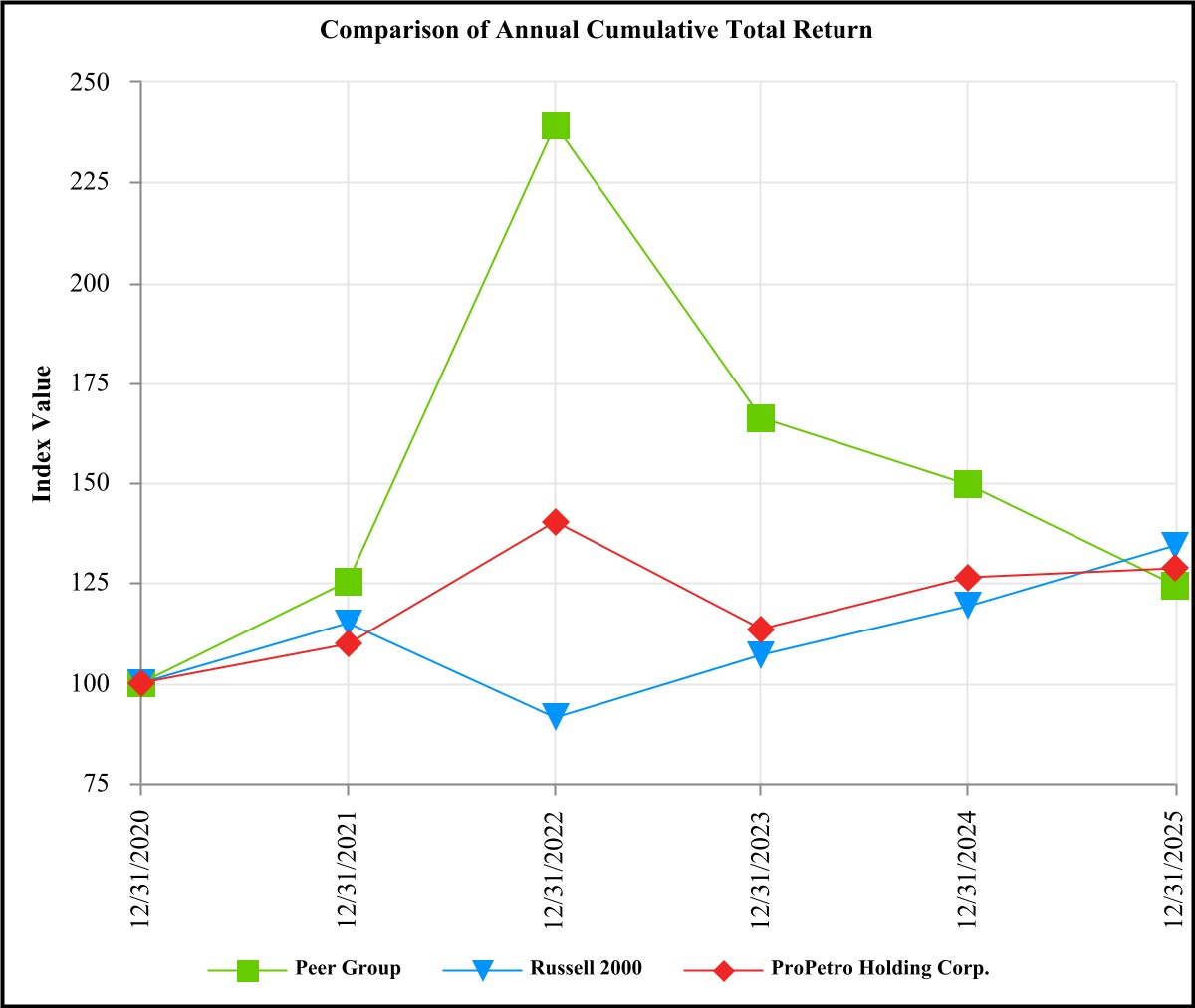
| Date | Peer Group | Russell 2000 | ProPetro Holding Corp. | ||||||||
| 12/31/2020 | $ | 100.0 | $ | 100.0 | $ | 100.0 | |||||
| 12/31/2021 | $ | 125.4 | $ | 114.8 | $ | 109.6 | |||||
| 12/31/2022 | $ | 239.1 | $ | 91.4 | $ | 140.3 | |||||
| 12/31/2023 | $ | 166.2 | $ | 106.8 | $ | 113.4 | |||||
| 12/31/2024 | $ | 149.5 | $ | 119.1 | $ | 126.3 | |||||
| 12/31/2025 | $ | 124.4 | $ | 134.4 | $ | 128.7 | |||||
Item 6. [Reserved]
36
Item 7. Management’s Discussion and Analysis of Financial Condition and Results of Operations.
You should read the following discussion and analysis of our financial condition and results of operations together with our audited consolidated financial statements and the related notes included in this Annual Report. Some of the information contained in this discussion and analysis or set forth elsewhere in this Annual Report, including information with respect to our plans and strategy for our business and related financing, includes forward‑looking statements that involve risks and uncertainties. You should read the "Risk Factors" section of this Annual Report for a discussion of important factors that could cause actual results to differ materially from the results described in or implied by the forward‑looking statements contained in the following discussion and analysis.
Basis of Presentation
This discussion of our results omits our results of operations and cash flows for the year ended December 31, 2023, and the comparison of our results of operations for the years ended December 31, 2024, and 2023, which may be found in our Annual Report on Form 10-K for the year ended December 31, 2024, filed with the SEC on February 20, 2025.
Unless otherwise indicated, references in this “Management’s Discussion and Analysis of Financial Condition and Results of Operations” to “ProPetro Holding Corp.,” “the Company,” “we,” “our,” “us” or like terms refer to ProPetro Holding Corp. and its subsidiaries.
Overview
Our Business
We are a leading integrated energy service company, located in Midland, Texas, focused on providing innovative hydraulic fracturing, wireline and other complementary energy and power generation services to leading upstream oil and gas companies engaged in the exploration and production (“E&P”) of North American oil and natural gas resources. Our operations are primarily focused in the Permian Basin, where we have cultivated longstanding customer relationships with some of the region’s most active and well‑capitalized E&P companies. The Permian Basin is widely regarded as one of the most prolific oil‑producing areas in the United States, and we believe we are one of the leading providers of completion services in the region.
Our completion services includes our operating segments comprised of hydraulic fracturing, wireline and cementing operations. Our hydraulic fracturing operations account for approximately 73.2% of our total revenues and operations. Our total available hydraulic horsepower (“HHP”) at December 31, 2025, was 1,259,500 HHP, which was comprised of 445,000 HHP of our Tier IV Dynamic Gas Blending (“DGB”) dual-fuel equipment, 312,000 HHP of FORCE® electric-powered equipment and 502,500 HHP of conventional Tier II equipment. Our hydraulic fracturing fleets range from approximately 50,000 to 80,000 HHP depending on the job design and customer demand at the wellsite. Our equipment has been designed to handle the operating conditions commonly encountered in the Permian Basin and the region’s increasingly high-intensity well completions (including simultaneous hydraulic fracturing ("Simul-Frac"), which involves fracturing multiple wellbores at the same time), which are characterized by longer horizontal wellbores, more stages per lateral and increasing amounts of proppant per well. With the industry transition to lower emissions equipment and Simul-Frac, in addition to several other changes to our customers' job designs, we believe that our available fleet capacity could decline if we decide to reconfigure our fleets to increase active HHP and backup HHP at wellsites. In 2021, we began to transition our fleet from traditional equipment to Tier IV DGB dual-fuel equipment. In 2022, we entered into three-year electric fleet leases which commenced in 2023 and 2024 for four FORCE® electric-powered hydraulic fracturing fleets worth of equipment with 60,000 HHP per fleet and in 2024, we entered into an additional three-year lease for one more FORCE® electric-powered hydraulic fracturing fleet worth of equipment with 72,000 HHP (collectively the “Electric Fleet Leases”). As of December 31, 2025, we have received 312,000 HHP of FORCE® electric-powered equipment representing five fleets worth of equipment.
In December 2024, we formed a new subsidiary, ProPetro Energy Solutions, LLC, (“PROPWR”), which provides turnkey power generation services to oil and gas producers and non-oil and gas applications such as general industrial projects and data centers using mobile power generation equipment installed at customers’ sites. This subsidiary began revenue-generating activities during the third quarter of fiscal year 2025 and has entered into contractual arrangements with equipment manufacturers to purchase mobile natural gas-fueled power generation equipment, including turbine generator sets, reciprocating engines, auxiliary equipment and battery energy storage solution equipment. As of February 19, 2026 we had total committed capacity of approximately 240 megawatts and total delivered or on-order generation capacity of approximately 550 megawatts, split approximately 70% and 30% between high-efficiency reciprocating engine generators and low emissions modular turbines, respectively. We anticipate all ordered units will be delivered by year-end 2027. We continue to actively
37
negotiate additional contracts amid increasing demand for power solutions and to explore various financing alternatives for our power equipment.
On November 1, 2024, we sold our cementing business located in Vernal, Utah, to a business owned by a former employee as part of a strategic repositioning. We received a promissory note for $13.0 million as consideration, and recorded a gain on disposal of $8.2 million related to the sale of the business. The note receivable was secured by substantially all assets of the divested operations and the former employee’s ownership interests in and distributions from the business. The note receivable was to be paid to the Company in quarterly installments with interest of 10% per annum from March 31, 2025, to December 31, 2029, but was fully repaid with interest in December 2025. The former employee was part of our cementing operations until November 1, 2024, and is no longer affiliated with the Company.
On May 31, 2024, we consummated the acquisition of all of the outstanding equity interests in Aqua Prop, LLC (“AquaProp”), which provides wet sand solutions for hydraulic fracturing sand requirements at oil well sites (the “AquaProp Acquisition”). The cash consideration for the AquaProp Acquisition includes $13.7 million paid to the seller, $7.2 million paid to settle the seller’s outstanding debt, and $0.3 million paid for the seller’s transaction expenses. As a result of the AquaProp Acquisition, we expanded our operations into the wet sand service business unit.
On December 1, 2023, we consummated the purchase of the assets and operations of Par Five Energy Services LLC (“Par Five”), which provides cementing services in the Delaware Basin, in exchange for $25.4 million of cash, including deferred cash consideration of $3.1 million which is payable to Par Five or its beneficiary on June 1, 2025, with interest of 4.0% per annum (the “Par Five Acquisition”). The Par Five Acquisition complemented our existing cementing business and enabled us to serve both the Midland and Delaware sub-basins of the Permian Basin.
We believe that our substantial market presence in the Permian Basin positions us well to capitalize on drilling and completion activity in the region. Primarily, our operational focus has been in the Permian Basin's Midland sub-basin, where our customers have operated. However, we have increased our operations in the Delaware sub-basin and are well-positioned to support further increases to our activity in this area in response to demand from our customers. Over time, we expect the Permian Basin's Midland and Delaware sub-basins to continue to command a disproportionate share of future North American E&P spending.
As of December 31, 2025, we conducted our business through four operating segments: Hydraulic Fracturing, Wireline, Cementing and Power Generation, all of which meet the criteria of a reportable segment. Prior to the third quarter of fiscal year 2025, our Power Generation segment did not meet the quantitative thresholds for a reportable segment and prior to the fourth quarter of fiscal year 2024, our Cementing segment did not meet the quantitative thresholds for a reportable segment. Accordingly, they were shown in the “All Other” category. Effective as of the third quarter of fiscal year 2025 and the fourth quarter of fiscal year 2024, Power Generation and Cementing, respectively, are shown as reportable segments since they meet the criteria of a reportable segment. Additionally, our corporate administrative activities do not involve business activities from which it may earn revenues and its results are not regularly reviewed by the Company’s Chief Operating Decision Maker (the “CODM”) when making key operating and resource decisions. As a result, corporate administrative expenses have been included under “Reconciling Items.” For additional financial information on our reportable segments presentation, please see reportable segment information in Part II - Item 8, “Financial Statements and Supplementary Data.”
Pioneer Pressure Pumping Acquisition
On December 31, 2018, we consummated the purchase of certain pressure pumping assets and real property from Pioneer Natural Resources USA, Inc. (“Pioneer”) and Pioneer Pumping Services, LLC in the Pioneer Pressure Pumping Acquisition in exchange for 16.6 million shares of our common stock and $110.0 million in cash. In May 2024, Pioneer merged with and into a wholly owned subsidiary of ExxonMobil after which ExxonMobil became the owner of these shares. The Company currently provides pressure pumping, wireline and other services to ExxonMobil and previously provided such services to Pioneer.
On April 22, 2024, we entered into a sub-agreement for hydraulic fracturing services with XTO, a wholly owned subsidiary of ExxonMobil, pursuant to which we will provide hydraulic fracturing, wireline and pumpdown services with two committed FORCE® electric-powered hydraulic fracturing fleets and the option to add a third FORCE® fleet (also with wireline and pumpdown services) for a certain number of contracted hours with respect to each fleet, subject to certain termination and release rights. This agreement will expire in approximately late 2026. At this time, we do not expect such agreement to be renewed or extended and, if we are not able to procure additional work from XTO, we will be required to redeploy the equipment associated with the affected fleets with other customers.
38
Commodity Price and Other Economic Conditions
The oil and gas industry has traditionally been volatile and is characterized by a combination of long-term, short-term and cyclical trends, including domestic and international supply and demand for oil and gas, current and expected future prices for oil and gas and the perceived stability and sustainability of those prices, and capital investments of E&P companies toward their development and production of oil and gas reserves. The oil and gas industry is also impacted by general domestic and international economic conditions such as supply chain disruptions and inflation, war and political instability in oil producing countries, government regulations (both in the United States and internationally), levels of consumer demand, adverse weather conditions, and other factors that are beyond our control.
The geopolitical and macroeconomic consequences of military action in the Middle East, the Russian invasion of Ukraine, including the associated sanctions, and actions taken by the Organization of the Petroleum Exporting Countries (“OPEC”) and Russia (together with OPEC and other allied producing countries, “OPEC+”) have contributed to volatility in supply and demand dynamics for crude oil and associated volatility in crude oil pricing in recent years. More recently, the WTI average crude oil price declined to approximately $65 per barrel in 2025 compared to approximately $76 per barrel in 2024 in response to tariff policies implemented by the United States government, an anticipated increase in global supply of crude oil and concerns of a potential global recession resulting from high inflation, interest rates, impacts of tariff policies on supply chains and increased costs as whole. Additionally, we have recently experienced a decrease in the Permian Basin rig count to 304 at the end of 2024 and a further decrease to 247 at the end of 2025, according to the Baker Hughes Company (“Baker Hughes”), which resulted in a reduction in the demand for completion services and pressure on pricing of our services.
Sustained levels of high inflation likewise caused the U.S. Federal Reserve and other central banks to increase interest rates, and to the extent elevated inflation remains, we may experience further cost increases for our operations, including interest rates, labor costs and equipment. We cannot predict any future trends in the rate of inflation and crude oil prices. A significant increase in or continued high levels of inflation, to the extent we are unable to timely pass-through the cost increases to our customers, further declines in crude oil prices, or potential changes in the United States’ trade policy, including the imposition of tariffs and the resulting consequences, would negatively impact our business, financial condition and results of operations. See Part II, Item 1A. “Risk Factors—We may be adversely affected by the effects of inflation.”
Government regulations and investors are demanding the oil and gas industry transition to a lower emissions operating environment, including upstream and energy service companies. As a result, we are working with our customers and equipment manufacturers to transition our equipment into a lower emissions profile. Currently, a number of lower emission solutions for pumping equipment, including Tier IV DGB dual-fuel, FORCE® electric, direct drive gas turbine and other technologies have been developed, and we expect additional lower emission solutions will be developed in the future. We are continually evaluating these technologies and other investment and acquisition opportunities that would support our existing and new customer relationships. The transition to lower emissions equipment is quickly evolving and will be capital intensive. Over time, we may be required to convert substantially all of our conventional Tier II equipment to lower emissions equipment. To the extent any of our customers have certain expectations or requirements with respect to emissions reductions from their contractors, if we are unable to continue quickly transitioning to lower emissions equipment, the demand for our services could be adversely impacted.
If the Permian Basin rig count and market conditions improve, including improved pricing for our services and labor availability, and we are able to meet our customers' lower emissions equipment demands, we believe our operational and financial results will also improve. If the rig count or market conditions do not improve or decline in the future, and we are unable to increase our pricing or pass-through future cost increases to our customers, there could be a material adverse impact on our business, results of operations and cash flows.
Our results of operations have historically reflected seasonal tendencies, typically in the fourth quarter, relating to the holiday season, inclement winter weather and the exhaustion of our customers' annual budgets. As a result, we typically experience declines in our operating and financial results in November and December, even in a stable commodity price and operations environment.
39
2025 Operational Highlights
Over the course of the year ended December 31, 2025:
•we maintained operational and financial stability during a challenging operating environment faced by the broader energy markets and the completions market in the Permian Basin through our disciplined approach to cost and fleet management and focusing on consistent performance;
•our active hydraulic fracturing fleet count declined from 15 active fleets at the beginning of the year to 11 at the end of the year as we idled certain fleets to preserve them for more favorable market conditions, rather than run them at sub-economic levels; and
•we secured contracts with multiple customers for our PROPWRSM power generation business and deployed our first mobile power generation equipment in the field during the third quarter of fiscal year 2025 and ended the year with total delivered or on-order generation capacity of approximately 550 megawatts, split approximately 70% and 30% between high-efficiency reciprocating engine generators and low emissions modular turbines, respectively. We anticipate all ordered units will be delivered by year-end 2027. As of February 19, 2026, we had total committed capacity of approximately 240 megawatts.
2025 Financial Highlights
Financial highlights for the year ended December 31, 2025:
•net income was $0.8 million, compared to net loss of $137.9 million for the year ended December 31, 2024. Diluted net income per common share was $0.01, compared to diluted net loss of $1.31 for the year ended December 31, 2024. Net loss for the year ended December 31, 2024 included property and equipment impairment expense of $188.6 million related to our conventional Tier II diesel-only hydraulic fracturing pumping units and associated conventional assets (“Tier II Units”) and goodwill impairment expense of $23.6 million related to the goodwill in our Wireline operating segment. Adjusted EBITDA of approximately $208.4 million decreased 26.4%, compared to $283.2 million for the year ended December 31, 2024 (see reconciliation of Adjusted EBITDA to net income in the subsequent section “How We Evaluate Our Operations”);
•capital expenditures incurred increased to $281.2 million, an increase of 111% as compared to 2024. Capital expenditures incurred included $198.4 million related to equipment orders for our Power Generation operating segment;
•secured a financing arrangement with Caterpillar Financial Services Corporation (“Caterpillar”) for a maximum total available amount of $103.7 million to support the purchase of certain natural gas-fueled power generation equipment;
•secured a lease facility described in “Note 17. Leases” with Stonebriar Commercial Finance LLC for the right, but not the obligation, to fund up to $350.0 million of purchases of power generator equipment;
•net cash provided by operating activities less net cash used in investing activities declined by $15.4 million compared to 2024; and
•our total liquidity was $205.4 million as of December 31, 2025. consisting of cash and cash equivalents of $91.3 million and remaining availability of $114.1 million under our ABL Credit Facility; we had total outstanding debt of $122.6 million as of December 31, 2025, comprising of $45.0 million of borrowings under our ABL Credit Facility and $77.6 million of equipment financing interim and term loans under the Caterpillar Equipment Loan Agreement (as defined below).
Recent Developments
In January 2026, the Company sold 17.3 million shares of its common stock in an underwritten public offering for $10.00 per share, pursuant to an effective shelf registration statement on Form S-3 filed with the SEC, including shares sold pursuant to the option granted to the underwriters to purchase up to an additional 2.3 million shares of our common stock (the “2026 Common Stock Offering”). The Company received approximately $163.3 million in net proceeds from this sale after deducting underwriting discounts and commissions and estimated offering expenses. The Company intends to use the net proceeds from this sale for general corporate purposes, including to fund growth capital for additional power generation equipment.
40
In February 2026, the Company entered into an amendment to the Caterpillar Equipment Loan Agreement, under which Caterpillar increased the availability of funds by $53.6 million, which resulted in a maximum total available amount of $157.3 million to support the purchase of certain natural gas-fueled power generation equipment.
Our Assets and Operations
Completion services include our hydraulic fracturing, wireline and cementing operations. We primarily provide these services to E&P companies in the Permian Basin. We also provide turnkey power generation services to oil and gas producers and non-oil and gas applications such as general industrial projects and data centers. During the year ended December 31, 2025, our hydraulic fracturing, wireline, cementing and power generation operations accounted for approximately 73.2%, 16.5%, 10.3%, and 0% of our total revenue, respectively. Our completion services equipment has been designed to handle Permian Basin specific operating conditions and the region’s increasingly high‑intensity well completions, which are characterized by longer horizontal wellbores, more frac stages per lateral and increasing amounts of proppant per well. Our power generation operations consist of mobile natural gas-fueled power generation equipment, including turbine generator sets, reciprocating engines, auxiliary equipment and battery energy storage solution equipment. We plan to continually reinvest in our equipment to ensure optimal performance and reliability.
How We Generate Revenue
We generate revenue predominantly through our completion services, and more specifically, by providing hydraulic fracturing services to our customers. We operate a fleet of mobile hydraulic fracturing, wireline and cementing units and other auxiliary equipment to perform completion services to E&P companies. Additionally, we generate revenue through our PROPWRSM power generation business by providing turnkey power generation services to oil and gas producers and non-oil and gas applications such as general industrial projects and data centers using mobile power generation equipment installed at customers’ sites. These services are generally provided through contractual arrangements in which we set a price per unit of power generated or a price per period and a minimum quantity of power per period under our contracts. We also provide personnel and services that are tailored to meet each of our customers’ needs.
Hydraulic fracturing operations account for a significant portion of our total revenue. We charge our customers on a per‑job basis, in which we set pricing terms after receiving full specifications for the requested job, including the lateral length of the customer’s wellbore, the number of frac stages per well, the amount of proppant and chemicals to be used and other parameters of the job.
In addition to hydraulic fracturing services, we generate revenue through other completion services that we provide to our customers, including wireline, cementing and other related services. These completion services are complementary to each other and are undertaken in unison with hydraulic fracturing services. They are provided through various contractual arrangements, including on a turnkey contract basis, in which we set a price to perform a particular job, or a daywork contract basis, in which we are paid a set price per day for our services. We are also sometimes paid by the hour for these complementary services.
Demand for our completion services is largely dependent on oil and natural gas prices, and our customers’ well completion budgets and rig count. Our revenue, profitability and cash flows are highly dependent upon prevailing crude oil prices and expectations about future prices. For many years, oil prices and markets have been extremely volatile. Prices are affected by many factors beyond our control. The average WTI oil price per barrel was approximately $65, $76, and $78 for the years ended December 31, 2025, 2024, and 2023, respectively. In January 2026, the WTI oil price was approximately $60 per barrel. If the WTI oil price declines in the future or remains highly volatile, demand for our services may be negatively impacted, which could result in a significant decrease in our future profitability and cash flows. We monitor oil and natural gas prices and the Permian Basin rig count to enable us to more effectively plan our business and forecast the demand for our services.
The historical weekly average Permian Basin rig count based on Baker Hughes rig count information was as follows:
| Year Ended December 31, | ||||||||||||||||||||
| Drilling Rig Type (Permian Basin) | 2025 | 2024 | 2023 | |||||||||||||||||
| Directional | 10 | 3 | 3 | |||||||||||||||||
| Horizontal | 257 | 296 | 323 | |||||||||||||||||
| Vertical | 5 | 10 | 9 | |||||||||||||||||
| Total | 272 | 309 | 335 | |||||||||||||||||
| Average Permian Basin rig count to U.S. rig count | 48.5 | % | 51.6 | % | 48.7 | % | ||||||||||||||
41
Costs of Conducting our Business
The principal direct costs involved in operating our business are direct labor, expendables and other direct costs.
Direct Labor Costs. Payroll and benefit expenses related to our crews and other employees that are directly or indirectly attributable to the effective delivery of services are included in our operating costs. Direct labor costs amounted to 28.5% and 30.2% of total costs of service for the years ended December 31, 2025, and 2024, respectively. The decrease in our direct labor costs percentage is driven by the implementation of reactive cost reductions to align our costs with the decrease in customer activity experienced in fiscal year 2025.
Expendables. Expendables include the product and freight costs associated with proppant, chemicals and other consumables used in our completion services and other operations. These costs comprise a substantial variable component of our service costs, particularly with respect to the quantity and quality of sand and chemicals demanded when providing hydraulic fracturing services. Expendable product costs comprised approximately 26.8% and 25.7% of total costs of service for the years ended December 31, 2025, and 2024, respectively. The percentage increase in our expendables was primarily attributable to the impact of general cost inflation.
Other Direct Costs. We incur other direct expenses related to our service offerings, including the costs of fuel, repairs and maintenance, general supplies, equipment rental, lease costs on our FORCE® electric-powered hydraulic fracturing fleets, and other miscellaneous operating expenses. Fuel is consumed both in the operation and movement of our equipment. Repairs and maintenance costs are expenses directly related to upkeep of equipment, which have been amplified by the demand for higher horsepower jobs. Capital expenditures to upgrade or extend the useful life of equipment are capitalized and are not included in other direct costs. Other direct costs were 44.7% and 44.1% of total costs of service for the years ended December 31, 2025, and 2024, respectively. The percentage increase in our expendables was primarily attributable to the impact of general cost inflation.
How We Evaluate Our Operations
Our management uses Adjusted EBITDA or Adjusted EBITDA margin to evaluate and analyze the performance of our various operating segments.
Adjusted EBITDA and Adjusted EBITDA Margin
We view Adjusted EBITDA and Adjusted EBITDA margin as important indicators of performance. We define EBITDA as our earnings, before (i) interest expense, (ii) income taxes and (iii) depreciation and amortization. We define Adjusted EBITDA as EBITDA, plus (i) loss/(gain) on disposal of assets and businesses, (ii) stock-based compensation, (iii) business acquisition contingent consideration adjustments, (iv) other expense/(income), (v) other unusual or nonrecurring (income)/expenses, such as impairment expenses, costs related to asset acquisitions, insurance recoveries, one-time professional fees and legal settlements and (vi) retention bonuses and severance expense. Adjusted EBITDA margin reflects our Adjusted EBITDA as a percentage of our revenues.
Adjusted EBITDA and Adjusted EBITDA margin are supplemental measures utilized by our management and other users of our financial statements such as investors, commercial banks, and research analysts, to assess our financial performance because it allows us and other users to compare our operating performance on a consistent basis across periods by removing the effects of our capital structure (such as varying levels of interest expense), asset base (such as depreciation and amortization), nonrecurring expenses/(income) and items outside the control of our management team (such as income taxes). Adjusted EBITDA and Adjusted EBITDA margin have limitations as analytical tools and should not be considered as an alternative to net income (loss), operating income (loss), cash flow from operating activities or any other measure of financial performance presented in accordance with accounting principles generally accepted in the United States of America (“GAAP”).
Note Regarding Non‑GAAP Financial Measures
Adjusted EBITDA and Adjusted EBITDA margin are not financial measures presented in accordance with GAAP (“non-GAAP”), except when specifically required to be disclosed by GAAP in the financial statements. We believe that the presentation of Adjusted EBITDA and Adjusted EBITDA margin provide useful information to investors in assessing our financial condition and results of operations because it allows them to compare our operating performance on a consistent basis across periods by removing the effects of our capital structure, asset base, nonrecurring expenses (income) and items outside the control of the Company. Net income (loss) is the GAAP measure most directly comparable to Adjusted EBITDA. Adjusted EBITDA and Adjusted EBITDA margin should not be considered as alternatives to the most directly comparable GAAP financial measure. Each of these non-GAAP financial measures has important limitations as analytical tools because they exclude some, but not all, items that affect the most directly comparable GAAP financial measures. You should not consider
42
Adjusted EBITDA and Adjusted EBITDA margin in isolation or as a substitute for an analysis of our results as reported under GAAP. Because Adjusted EBITDA and Adjusted EBITDA margin may be defined differently by other companies in our industry, our definitions of these non-GAAP financial measures may not be comparable to similarly titled measures of other companies, thereby diminishing their utility.
The following tables set forth certain financial information with respect to the Company’s reportable segments; intersegment revenues are shown under “Reconciling Items” (in thousands):
| Hydraulic Fracturing | Wireline | Cementing | Power Generation | Reconciling Items | Total | |||||||||||||||||||||||||||||||||
| Year ended December 31, 2025 | ||||||||||||||||||||||||||||||||||||||
| Service revenue | $ | 929,210 | $ | 209,034 | $ | 130,266 | $ | 1,538 | $ | (890) | $ | 1,269,158 | ||||||||||||||||||||||||||
| Adjusted EBITDA | $ | 208,566 | $ | 41,563 | $ | 22,011 | $ | (11,580) | $ | (52,117) | $ | 208,443 | ||||||||||||||||||||||||||
| Depreciation and amortization | $ | 143,785 | $ | 22,269 | $ | 8,098 | $ | 673 | $ | 71 | $ | 174,896 | ||||||||||||||||||||||||||
Operating lease expense on FORCE® fleets (1) | $ | 61,274 | $ | — | $ | — | $ | — | $ | — | $ | 61,274 | ||||||||||||||||||||||||||
| Capital expenditures incurred | $ | 69,149 | $ | 7,922 | $ | 5,752 | $ | 198,373 | $ | — | $ | 281,196 | ||||||||||||||||||||||||||
| Goodwill | $ | 920 | $ | — | $ | — | $ | — | $ | — | $ | 920 | ||||||||||||||||||||||||||
Total assets (2) | $ | 841,180 | $ | 162,225 | $ | 69,396 | $ | 201,481 | $ | 16,608 | $ | 1,290,890 | ||||||||||||||||||||||||||
| Hydraulic Fracturing | Wireline | Cementing | Power Generation | Reconciling Items | Total | |||||||||||||||||||||||||||||||||
| Year ended December 31, 2024 | ||||||||||||||||||||||||||||||||||||||
| Service revenue | $ | 1,092,000 | $ | 203,182 | $ | 149,411 | $ | — | $ | (307) | $ | 1,444,286 | ||||||||||||||||||||||||||
| Adjusted EBITDA | $ | 270,505 | $ | 43,857 | $ | 26,539 | $ | (370) | $ | (57,288) | $ | 283,243 | ||||||||||||||||||||||||||
Depreciation and amortization (3) | $ | 194,557 | $ | 20,633 | $ | 8,819 | $ | — | $ | 100 | $ | 224,109 | ||||||||||||||||||||||||||
Property and equipment impairment expense (4) | $ | 188,601 | $ | — | $ | — | $ | — | $ | — | $ | 188,601 | ||||||||||||||||||||||||||
Goodwill impairment expense (5) | $ | — | $ | 23,624 | $ | — | $ | — | $ | — | $ | 23,624 | ||||||||||||||||||||||||||
Operating lease expense on FORCE® fleets (1) | $ | 47,141 | $ | — | $ | — | $ | — | $ | — | $ | 47,141 | ||||||||||||||||||||||||||
| Capital expenditures incurred | $ | 116,257 | $ | 7,713 | $ | 9,376 | $ | — | $ | 42 | $ | 133,388 | ||||||||||||||||||||||||||
| Goodwill | $ | 920 | $ | — | $ | — | $ | — | $ | — | $ | 920 | ||||||||||||||||||||||||||
Total assets (2) | $ | 961,485 | $ | 156,349 | $ | 73,935 | $ | — | $ | 31,876 | $ | 1,223,645 | ||||||||||||||||||||||||||
| Hydraulic Fracturing | Wireline | Cementing | Power Generation | Reconciling Items | Total | |||||||||||||||||||||||||||||||||
| Year ended December 31, 2023 | ||||||||||||||||||||||||||||||||||||||
| Service revenue | $ | 1,280,523 | $ | 229,599 | $ | 120,277 | $ | — | $ | — | $ | 1,630,399 | ||||||||||||||||||||||||||
| Adjusted EBITDA | $ | 366,809 | $ | 61,930 | $ | 24,665 | $ | — | $ | (49,444) | $ | 403,960 | ||||||||||||||||||||||||||
Depreciation and amortization (3) | $ | 194,745 | $ | 18,762 | $ | 5,879 | $ | — | $ | 222 | $ | 219,608 | ||||||||||||||||||||||||||
Operating lease expense on FORCE® fleets (1) | $ | 5,087 | $ | — | $ | — | $ | — | $ | — | $ | 5,087 | ||||||||||||||||||||||||||
| Capital expenditures incurred | $ | 294,377 | $ | 12,203 | $ | 3,440 | $ | — | $ | — | $ | 310,020 | ||||||||||||||||||||||||||
| Goodwill | $ | — | $ | 23,624 | $ | — | $ | — | $ | — | $ | 23,624 | ||||||||||||||||||||||||||
Total assets (2) | $ | 1,189,526 | $ | 198,957 | $ | 78,475 | $ | — | $ | 13,354 | $ | 1,480,312 | ||||||||||||||||||||||||||
____________________
(1)Represents amortization of right-of-use assets and interest expense on lease liabilities related to operating leases on our FORCE® electric-powered hydraulic fracturing fleets. This cost is recorded within cost of services in our consolidated statements of operations.
(2)Total assets under “Reconciling Items” comprise of cash on hand, certain property, equipment and operating lease right-of-use assets pertaining to our corporate administrative activities.
43
(3)The write-offs of remaining book value of prematurely failed power ends and other components are recorded as depreciation in 2025. In order to conform to current period presentation, we have reclassified the corresponding amounts of $12.4 million and $38.7 million from loss on disposal of assets to depreciation for the years ended December 31, 2024 and 2023, respectively.
(4)Represents noncash property and equipment impairment expense on our Tier II Units. There was no property and equipment impairment expense for the years ended December 31, 2025 and 2023.
(5)Represents noncash impairment of goodwill in our Wireline operating segment. There was no goodwill impairment expense for the years ended December 31, 2025 and 2023.
A reconciliation of net (loss) income to Adjusted EBITDA is provided in the table below (in thousands):
| Year Ended December 31, | ||||||||||||||||||||
| 2025 | 2024 | 2023 | ||||||||||||||||||
| Net income (loss) | $ | 824 | $ | (137,859) | $ | 85,634 | ||||||||||||||
Depreciation and amortization (1) | 174,896 | 224,109 | 219,608 | |||||||||||||||||
Property and equipment impairment expense (2) | — | 188,601 | — | |||||||||||||||||
Goodwill impairment expense (3) | — | 23,624 | — | |||||||||||||||||
| Interest expense | 8,238 | 7,815 | 5,308 | |||||||||||||||||
| Income tax expense (benefit) | 6,997 | (31,385) | 29,868 | |||||||||||||||||
Loss (gain) on disposal of assets and businesses, net (1) | 12,179 | (4,925) | 34,293 | |||||||||||||||||
| Stock‑based compensation | 16,946 | 17,288 | 14,450 | |||||||||||||||||
| Business acquisition contingent consideration adjustments | (4,900) | (2,600) | — | |||||||||||||||||
Other (income) expense, net (4) | (9,709) | (5,531) | 9,533 | |||||||||||||||||
Other general and administrative expense, net (5) | 339 | 1,782 | 2,969 | |||||||||||||||||
| Retention bonus and severance expense | 2,633 | 2,324 | 2,297 | |||||||||||||||||
| Adjusted EBITDA | $ | 208,443 | $ | 283,243 | $ | 403,960 | ||||||||||||||
____________________
(1)The write-offs of remaining book value of prematurely failed power ends and other components are recorded as depreciation in 2025. In order to conform to current period presentation, we have reclassified the corresponding amounts of $12.4 million and $38.7 million from loss on disposal of assets to depreciation for the years ended December 31, 2024 and 2023, respectively.
(2)Represents noncash impairment expense on our Tier II Units. This impairment expense is included in our Hydraulic Fracturing operating segment.
(3)Represents noncash impairment of goodwill in our Wireline operating segment.
(4)Other income for the year ended December 31, 2025 is primarily comprised of direct payment tax refunds and well service tax refunds (net of advisory fees) totaling $3.3 million, a $2.4 million unrealized gain on short-term investment, interest income from note receivable from sale of business of $1.2 million, adjustments to workers' compensation and general liability insurance premiums of $1.0 million, insurance reimbursements of $0.8 million and $1.0 million of other income. Other income for the year ended December 31, 2024 is primarily comprised of tax refunds (net of advisory fees) totaling $5.0 million and insurance reimbursements of $2.0 million, partially offset by a $2.0 million loss to a customer related to an accidental cementing job failure. Other expense for the year ended December 31, 2023 is primarily comprised of settlement expenses resulting from routine audits and true-up health insurance costs totaling approximately $7.4 million and a $2.5 million unrealized loss on short-term investment.
(5)Other general and administrative expense for the years ended December 31, 2024 and 2023 primarily relates to nonrecurring professional fees paid to external consultants in connection with our business acquisitions and legal settlements, net of reimbursements from insurance carriers.
44
Results of Operations
In 2024, we conducted our business through four operating segments: Hydraulic Fracturing, Wireline, Cementing, and Power Generation Services (started in the fourth quarter of fiscal year 2024). Our Power Generation operating segment is shown in the “All Other” category for segment reporting purposes.
Year Ended December 31, 2025 Compared to Year Ended December 31, 2024
| (in thousands, except percentages) | ||||||||||||||||||||||||||
| Year Ended December 31, | Change | |||||||||||||||||||||||||
| 2025 | 2024 | Variance | % | |||||||||||||||||||||||
| Revenue | ||||||||||||||||||||||||||
| Hydraulic Fracturing | $ | 929,210 | $ | 1,092,000 | $ | (162,790) | (14.9) | % | ||||||||||||||||||
| Wireline | 209,034 | 203,182 | 5,852 | 2.9 | % | |||||||||||||||||||||
| Cementing | 130,266 | 149,411 | (19,145) | (12.8) | % | |||||||||||||||||||||
| Power Generation | 1,538 | — | 1,538 | 100.0 | % | |||||||||||||||||||||
| Elimination of intersegment service revenue | (890) | (307) | (583) | (189.9) | % | |||||||||||||||||||||
| Total revenue | 1,269,158 | 1,444,286 | (175,128) | (12.1) | % | |||||||||||||||||||||
Cost of services (1) | ||||||||||||||||||||||||||
| Hydraulic Fracturing | 702,593 | 800,202 | (97,609) | (12.2) | % | |||||||||||||||||||||
| Wireline | 156,472 | 148,125 | 8,347 | 5.6 | % | |||||||||||||||||||||
| Cementing | 103,388 | 117,490 | (14,102) | (12.0) | % | |||||||||||||||||||||
| Power Generation | 6,612 | 4 | 6,608 | 165,200.0 | % | |||||||||||||||||||||
| Elimination of intersegment cost of services | (890) | (307) | (583) | (189.9) | % | |||||||||||||||||||||
| Total cost of services | 968,175 | 1,065,514 | (97,339) | (9.1) | % | |||||||||||||||||||||
General and administrative expense (2) | 107,558 | 114,323 | (6,765) | (5.9) | % | |||||||||||||||||||||
Depreciation and amortization (3) | 174,896 | 224,109 | (49,213) | (22.0) | % | |||||||||||||||||||||
| Property and equipment impairment expense | — | 188,601 | (188,601) | (100.0) | % | |||||||||||||||||||||
| Goodwill impairment expense | — | 23,624 | (23,624) | (100.0) | % | |||||||||||||||||||||
Loss (gain) on disposal of assets and business, net (3) | 12,179 | (4,925) | 17,104 | 347.3 | % | |||||||||||||||||||||
| Interest expense | 8,238 | 7,815 | 423 | 5.4 | % | |||||||||||||||||||||
| Other income, net | (9,709) | (5,531) | (4,178) | (75.5) | % | |||||||||||||||||||||
| Income tax expense (benefit) | 6,997 | (31,385) | 38,382 | 122.3 | % | |||||||||||||||||||||
| Net income (loss) | $ | 824 | $ | (137,859) | $ | 138,683 | 100.60 | % | ||||||||||||||||||
Adjusted EBITDA (4) | $ | 208,443 | $ | 283,243 | $ | (74,800) | (26.41) | % | ||||||||||||||||||
Adjusted EBITDA margin (4) | 16.4 | % | 19.6 | % | (3.2) | % | (16.33) | % | ||||||||||||||||||
Net income (loss) margin (5) | 0.1 | % | (9.5) | % | 9.6 | % | 101.05 | % | ||||||||||||||||||
| Hydraulic Fracturing segment results of operations: | ||||||||||||||||||||||||||
| Revenue | $ | 929,210 | $ | 1,092,000 | $ | (162,790) | (14.9) | % | ||||||||||||||||||
| Cost of services | $ | 702,593 | $ | 800,202 | $ | (97,609) | (12.2) | % | ||||||||||||||||||
| Adjusted EBITDA | $ | 208,566 | $ | 270,505 | $ | (61,939) | (22.9) | % | ||||||||||||||||||
Adjusted EBITDA margin (6) | 22.4 | % | 24.8 | % | (2.4) | % | (9.7) | % | ||||||||||||||||||
____________________
(1) Exclusive of depreciation and amortization.
45
(2) Inclusive of stock‑based compensation.
(3) The write-offs of remaining book value of prematurely failed power ends and other components are recorded as depreciation in 2025. In order to conform to current period presentation, we have reclassified the corresponding amount of $12.4 million from loss on disposal of assets to depreciation for the year ended December 31, 2024.
(4) For definitions of the non‑GAAP financial measures of Adjusted EBITDA and Adjusted EBITDA margin and reconciliation of Adjusted EBITDA and Adjusted EBITDA margin to our most directly comparable financial measure calculated in accordance with GAAP, please read “How We Evaluate Our Operations.”
(5) Net loss margin reflects our net loss as a percentage of our revenue.
(6) The non‑GAAP financial measure of Adjusted EBITDA margin for the Hydraulic Fracturing segment is calculated by taking Adjusted EBITDA for the Hydraulic Fracturing segment as a percentage of our revenues for the Hydraulic Fracturing segment.
Revenues. Revenues decreased 12.1%, or $175.1 million, to $1,269.2 million for the year ended December 31, 2025, as compared to $1,444.3 million for the year ended December 31, 2024. Revenue by reportable segment was as follows:
Hydraulic Fracturing. Our Hydraulic Fracturing segment revenues decreased 14.9%, or $162.8 million for the year ended December 31, 2025, as compared to the year ended December 31, 2024. The decrease was primarily attributable to decreased customer activity, reduced customer pricing, and idling of fleets, partially offset by the addition of AquaProp's operations in May 2024, which resulted in a $41.9 million increase in revenues during fiscal year 2025 due to the impact of AquaProp’s operations for the full year ended December 31, 2025 compared to only 215 days of activity during fiscal year 2024. Intersegment revenues totaled $0.9 million and $0.3 million for the years ended December 31, 2025 and 2024, respectively. Intersegment revenues were derived from our Wireline, Cementing and Power Generation segments for the year ended December 31, 2025, and from our Wireline segment for the year ended December 31, 2024.
Wireline. Our Wireline segment revenues increased 2.9%, or $5.9 million for the year ended December 31, 2025, as compared to the year ended December 31, 2024. The increase was primarily attributable to increased customer activity and utilization.
Cementing. Our Cementing segment revenues decreased 12.8%, or $19.1 million for the year ended December 31, 2025, as compared to the year ended December 31, 2024. The decrease was primarily attributable to the sale of our cementing business located in Vernal, Utah in November 2024 which contributed $22.3 million in revenues during fiscal year 2024, partially offset by increases resulting from synergies gained with customers after the acquisition of Par Five Energy Services LLC.
Power Generation. Our Power Generation segment revenue was $1.5 million for the year ended December 31, 2025. Our Power Generation segment began revenue generating activities during the third quarter of fiscal year 2025.
Cost of Services. Cost of services decreased 9.1%, or $97.3 million, to $968.2 million for the year ended December 31, 2025, from $1,065.5 million during the year ended December 31, 2024. Cost of services by reportable segment was as follows:
Hydraulic Fracturing. Our Hydraulic Fracturing segment cost of services decreased $97.6 million during the year ended December 31, 2025, as compared to the year ended December 31, 2024. As a percentage of hydraulic fracturing segment revenues, Hydraulic Fracturing cost of services was 75.6% for the year ended December 31, 2025, as compared to 73.3% for the year ended December 31, 2024 driven by customer price decreases and the impact of general cost inflation. The decrease in cost of services was partially offset by the addition of AquaProp's operations in May 2024, which resulted in a $33.8 million increase in cost of services during fiscal year 2025.
Wireline. Our Wireline segment cost of services increased 5.6%, or $8.3 million for the year ended December 31, 2025, as compared to the year ended December 31, 2024 due to increased customer activity and the impact of general cost inflation. Intersegment cost of services, consisting of cost of services incurred to our Hydraulic Fracturing segment, totaled $0.7 million and $0.3 million for the years ended December 31, 2025 and 2024, respectively.
Cementing. Our Cementing cost of services decreased 12.0%, or $14.1 million for the year ended December 31, 2025, as compared to the year ended December 31, 2024. The decrease was primarily attributable to the sale of our cementing business located in Vernal, Utah in November 2024 which incurred $14.7 million in cost of services during fiscal year 2024. Intersegment cost of services, consisting of cost of services incurred to our Hydraulic Fracturing segment, totaled $0.1 million and $0 for the years ended December 31, 2025 and 2024, respectively.
46
Power Generation. Our Power Generation segment cost of services was $6.6 million for the year ended December 31, 2025. Our Power Generation segment began revenue generating activities during the third quarter of fiscal year 2025. Intersegment cost of services, consisting of cost of services incurred to our Hydraulic Fracturing segment, totaled $0.1 million and $0 for the years ended December 31, 2025 and 2024, respectively.
General and Administrative Expenses. General and administrative expenses decreased 5.9% or $6.7 million, to $107.6 million for the year ended December 31, 2025, as compared to $114.3 million for the year ended December 31, 2024. The net decrease was primarily attributable to a $4.5 million decrease in professional fees, a $2.3 million increase in business acquisition contingent consideration adjustments, a $2.0 million decrease in dues and subscriptions, a $1.6 million decrease in transaction expenses and a $0.4 million net decrease in other general and administrative expenses, partially offset by a $4.1 million increase in payroll.
Excluding nonrecurring and noncash items (i.e., stock-based compensation of $16.9 million, retention bonuses and severance expenses of $2.7 million and legal settlements (net of insurance reimbursements) of $0.3 million, partially offset by business acquisition contingent consideration adjustments of $4.9 million), general and administrative expenses were $92.6 million for the year ended December 31, 2025, as compared to $95.5 million for the year ended December 31, 2024.
Depreciation and Amortization. Depreciation and amortization decreased 22.0%, or $49.2 million, to $174.9 million for the year ended December 31, 2025, as compared to $224.1 million for the year ended December 31, 2024. The decrease was primarily attributable to assets fully depreciating and a reduction in the cost basis of Tier II Units impaired in the third quarter of fiscal year 2024, partially offset by the addition of AquaProp's operations in May 2024 which resulted in a $2.7 million increase in depreciation and amortization.
Property and Equipment Impairment Expense. There was no impairment expense during the year ended December 31, 2025. During the year ended December 31, 2024, we recorded a noncash impairment expense of $188.6 million in connection with the impairment of our Tier II Units, which is included in our Hydraulic Fracturing reportable segment.
Goodwill Impairment Expense. There was no goodwill impairment expense during the year ended December 31, 2025. During the year ended December 31, 2024, we recorded goodwill impairment expense of $23.6 million in our Wireline reportable segment.
Loss (Gain) on Disposal of Assets and Business. Loss on the disposal of assets increased 347.3%, or $17.1 million, to $12.2 million for the year ended December 31, 2025, as compared to a gain on the disposal of assets and business of $4.9 million for the year ended December 31, 2024. The increase was primarily attributable to losses incurred during fiscal year 2025 from the sale of certain Tier II hydraulic fracturing equipment and a $8.2 million gain related to the sale of our cementing business located in Vernal, Utah, during fiscal year 2024.
Interest Expense. Interest expense increased to $8.2 million for the year ended December 31, 2025, as compared to $7.8 million for the year ended December 31, 2024. The increase was primarily attributable to the addition of loans under the Caterpillar Equipment Loan Agreement (as defined below) to support the purchase of certain mobile natural gas-fueled power generation equipment during the year ended December 31, 2025.
Other Income. Other income was approximately $9.7 million for the year ended December 31, 2025, as compared to other income of $5.5 million for the year ended December 31, 2024. Other income for the year ended December 31, 2025 is primarily comprised of direct payment tax refunds and well service tax refunds (net of advisory fees) totaling $3.3 million, a $2.4 million unrealized gain on short-term investment, interest income from note receivable from sale of business of $1.2 million, adjustments to workers' compensation and general liability insurance premiums of $1.0 million, insurance reimbursements of $0.8 million and $1.0 million of other income. Other income for the year ended December 31, 2024 is primarily comprised of tax refunds (net of advisory fees) totaling $5.0 million and insurance reimbursements of $2.0 million, partially offset by a $2.0 million loss to a customer related to an accidental cementing job failure.
Income Taxes. Total income tax expense was $7.0 million resulting in an effective tax rate of 89.5% for the year ended December 31, 2025, as compared to income tax benefit of $31.4 million resulting in an effective tax rate of 18.5% for the year ended December 31, 2024. The change in income tax expense recorded during the year ended December 31, 2025, compared to the change in income tax expense recorded during the year ended December 31, 2024, is primarily attributable to the difference in the impact of nondeductible expenses, state taxes, and valuation allowances on the pre-tax income for fiscal year 2025, as compared to fiscal year 2024.
47
Liquidity and Capital Resources
Our liquidity is currently provided by (i) existing cash balances, including proceeds from the 2026 Common Stock Offering, (ii) operating cash flows, (iii) borrowings under our ABL Credit Facility (as defined below) and (iv) borrowings under our Caterpillar Equipment Loan Agreement (as defined below). See “Credit Facility and Other Financing Arrangements” below. Additionally, on December 29, 2025, we entered into the Stonebriar Equipment Lease Facility to support the lease of certain mobile power generation equipment, including turbine generator sets along with auxiliary equipment, for our PROPWRSM business line, and in January 2026, we received approximately $163.3 million from the 2026 Common Stock Offering. Our cash is primarily used to fund our operations, support growth opportunities, fund share repurchases under our share repurchase program and satisfy future debt repayments and lease payments. Our Borrowing Base (as defined below), under our ABL Credit Facility, as redetermined monthly, is tied to the sum of 85% to 90% of monthly eligible accounts receivable and 80% of eligible unbilled accounts (up to a maximum of 25% of the Borrowing Base), in each case, depending on the credit ratings of our accounts receivable counterparties, less customary reserves (the “Borrowing Base”). Changes to our operational activity levels and our customers' credit ratings have an impact on our total eligible accounts receivable, which could result in significant changes to our Borrowing Base and therefore, our availability under our ABL Credit Facility.
We received advance payments from customers for our services, and the amount outstanding in connection with the advance payments as of December 31, 2025 was $8.1 million, which does not include any restricted cash.
As of December 31, 2025, our borrowings under our ABL Credit Facility were $45.0 million, our borrowings under our Caterpillar Equipment Loan Agreement were $77.6 million and our total liquidity was $205.4 million, consisting of cash and cash equivalents of $91.3 million and $114.1 million of availability under our ABL Credit Facility. As of January 31, 2026, our borrowings under our ABL Credit Facility were $45.0 million, our borrowings under our Caterpillar Equipment Loan Agreement were $86.9 million and our total liquidity was $325.0 million, consisting of cash and cash equivalents of $236.5 million and $88.5 million of availability under our ABL Credit Facility.
In May 2025, the Company's board of directors (the “Board”) approved a further extension to the share repurchase program initially authorized on May 17, 2023. As extended, the program permits the repurchase of up to $200 million of the Company’s common stock through December 31, 2026. The shares may be repurchased from time to time in open market transactions, block trades, accelerated share repurchases, privately negotiated transactions, derivative transactions or otherwise, certain of which may be made pursuant to a trading plan meeting the requirements of Rule 10b5-1 under the Exchange Act, as amended, in compliance with applicable state and federal securities laws. The timing, as well as the number and value of shares repurchased under the program, will be determined by the Company at its discretion and will depend on a variety of factors, including management's assessment of the intrinsic value of the Company's common stock, the market price of the Company's common stock, general market and economic conditions, available liquidity, compliance with the Company's debt and other agreements, applicable legal requirements, and other considerations. The Company is not obligated to purchase any shares under the share repurchase program, and the program may be suspended, modified, or discontinued at any time without prior notice. The Company expects to fund the repurchases using cash on hand and expected free cash flow to be generated through December 2026. During the year ended December 31, 2025, the Company made no share repurchases under the share repurchase program as it prioritized the launch and scaling of its PROPWRSM business line. The Company intends to continue to prioritize investing in its PROPWRSM business line in the near future. As of December 31, 2025, $89.2 million remained authorized for future repurchases of common stock under the share repurchase program.
In October 2025, the Company sold its short-term investment in 2.6 million common shares of STEP Energy Services Ltd. (“STEP”), which it received in 2022 as part of the consideration for its sale of its coiled tubing assets to STEP. The Company received $9.4 million in proceeds and recognized a $0.8 million loss on sale of assets from the sale of this investment. In December 2025, the Company received $11.9 million in proceeds as full repayment of the outstanding balance and accrued interest on its note receivable from Big 4 Services LLC (“Big 4”). The Company received this note receivable from Big 4 on November 1, 2024 as consideration for the sale of its cementing business located in Vernal, Utah.
In January 2026, the Company sold 17.3 million shares of its common stock under an underwritten public offering for $10.00 per share, pursuant to an effective shelf registration statement on Form S-3 filed with the SEC. The Company received approximately $163.3 million in net proceeds from this sale after deducting underwriting discounts and commissions and estimated offering expenses. The Company intends to use the net proceeds from this sale for general corporate purposes, including to fund growth capital for additional power generation equipment.
There can be no assurance that our operations and other capital resources will provide cash in sufficient amounts to maintain planned or future levels of capital expenditures and to continue with our share repurchases under our share repurchase program or fund future business acquisitions. Future cash flows are subject to a number of variables, and are highly dependent on the
48
drilling and completion, and production activity by our customers, which in turn is highly dependent on oil and natural gas prices. Depending upon market conditions and other factors, we may issue equity and debt securities or take other actions necessary to fund our business, strategy or meet our future long-term liquidity requirements.
Cash and Cash Flows
The following table sets forth our net cash provided by (used in) operating, investing and financing activities during the years ended December 31, 2025 and 2024, respectively.
(in thousands) | |||||||||||
| Year Ended December 31, | |||||||||||
| 2025 | 2024 | ||||||||||
Net cash provided by operating activities | $ | 231,607 | $ | 252,295 | |||||||
Net cash used in investing activities | $ | (149,811) | $ | (155,099) | |||||||
Net cash used in financing activities | $ | (40,905) | $ | (80,107) | |||||||
Operating Activities
Net cash provided by operating activities was $231.6 million for the year ended December 31, 2025, as compared to $252.3 million for the year ended December 31, 2024. The net decrease of $20.7 million was primarily attributable to lower net income adjusted for noncash expenses and the timing of our receivable collections from our customers and payments to our vendors.
Investing Activities
Net cash used in investing activities decreased to $149.8 million for the year ended December 31, 2025, from $155.1 million for the year ended December 31, 2024. The net decrease was primarily attributable to the acquisition of AquaProp which resulted in a $21.0 million net cash outflow for the year ended December 31, 2024, a $17.3 million increase in proceeds from sale of assets (including $9.4 million from the sale of the Company’s short-term investment discussed in “Note 5. Fair Value Measurements”) and $13.0 million in proceeds from note receivable from sale of business further discussed in “Note 16. Related Party Transactions,” partially offset by a $46.0 million increase in capital expenditures primarily related to our PROPWRSM power generation business.
The following table reconciles our capital expenditures paid to capital expenditures incurred for the periods indicated:
| (in thousands) | |||||||||||
| Year Ended December 31, | |||||||||||
| 2025 | 2024 | ||||||||||
Capital expenditures paid (1) | $ | 186,316 | $ | 140,297 | |||||||
| Less: Capital expenditures included in accounts payable and accrued liabilities - beginning of period | (14,695) | (21,604) | |||||||||
| Add: Capital expenditures included in accounts payable and accrued liabilities - end of period | 28,095 | 14,695 | |||||||||
| Add: Capital expenditures related to financed equipment purchases | 81,130 | — | |||||||||
| Add: Capital expenditures financed by operating lease landlord | 350 | — | |||||||||
Capital expenditures incurred (1) | $ | 281,196 | $ | 133,388 | |||||||
____________________
(1)This table reconciles cash basis capital expenditures reported in the Company's consolidated statements of cash flows to accrual basis capital expenditures reported in "Note 11. - Reportable Segment Information" and below.
49
The following table summarizes our capital expenditures incurred by reportable segment for the periods indicated:
| (in thousands) | |||||||||||
| Year Ended December 31, | |||||||||||
| 2025 | 2024 | ||||||||||
| Reportable Segments: | |||||||||||
| Hydraulic Fracturing | $ | 69,149 | $ | 116,257 | |||||||
| Wireline | 7,922 | 7,713 | |||||||||
| Cementing | 5,752 | 9,376 | |||||||||
| Power Generation | 198,373 | — | |||||||||
Reconciling Items (1) | — | 42 | |||||||||
Total capital expenditures incurred (2) | $ | 281,196 | $ | 133,388 | |||||||
_________________
(1) Reconciling Items include our corporate facilities.
(2) See “Note 3. Supplemental Cash Flows Information” in the financial statements for noncash reconciling items.
Financing Activities
Net cash used in financing activities decreased to $40.9 million for the year ended December 31, 2025, compared to $80.1 million for the year ended December 31, 2024. The net decrease was primarily driven by a $59.1 million decrease in share repurchases, partially offset by a $6.8 million increase in payment of business acquisition deferred cash consideration, a $3.6 million increase in repayments of equipment financing term loans, a $3.5 million increase in repayments of insurance financing, a $2.8 million increase in payment of financing origination and debt issuance costs and a $2.3 million increase in tax withholdings paid for net settlement of equity awards.
Credit Facility and Other Financing Arrangements
The Company is a party to the ABL Credit Facility that provides for borrowing capacity of up to $225.0 million (subject to the Borrowing Base limit), and matures on June 2, 2028.
ABL Credit Facility: Effective December 26, 2025, the Company entered into an amendment to its amended and restated revolving credit facility (the revolving credit facility, as amended and restated in April 2022, as amended in June 2023, as amended in June 2024, as amended in December 2025 and as may be amended further, the “ABL Credit Facility”). The amendment increased the debt basket for capital/finance leases, purchase money debt, and other similar financing facilities to $425.0 million. The Borrowing Base as of December 31, 2025, was approximately $167.7 million. The ABL Credit Facility includes a springing fixed charge coverage ratio to apply when excess availability is less than the greater of (i) 10% of the lesser of the facility size or the Borrowing Base or (ii) $15.0 million. Under the ABL Credit Facility, we are required to comply, subject to certain exceptions and materiality qualifiers, with certain customary affirmative and negative covenants, including, but not limited to, covenants pertaining to our ability to incur liens or indebtedness, changes in the nature of our business, mergers and other fundamental changes, disposal of assets, investments and restricted payments, amendments to our organizational documents or accounting policies, prepayments of certain debt, dividends, transactions with affiliates, and certain other activities. Borrowings under the ABL Credit Facility are secured by a first priority lien and security interest in substantially all assets of the Company excluding certain mobile natural gas-fueled power generation equipment purchased under a financing arrangement.
Borrowings under the ABL Credit Facility accrue interest based on a three-tier pricing grid tied to availability, and we may elect for loans to be based on either the Secured Overnight Financing Rate (“SOFR”) or the base rate, plus the applicable margin, which ranges from 1.75% to 2.25% for SOFR loans and 0.75% to 1.25% for base rate loans. The weighted average annual interest rate for our ABL Credit Facility for the year ended December 31, 2025, was 6.29%.
As of December 31, 2025, and 2024, we had outstanding borrowings under our ABL Credit Facility of $45.0 million and $45.0 million, respectively.
50
Caterpillar Equipment Loan Agreement: On April 2, 2025, we entered into a financing arrangement and on February 6, 2026, we entered into an amendment to this financing arrangement with Caterpillar Financial Services Corporation (collectively, the “Caterpillar Equipment Loan Agreement”) to support the purchase of certain mobile natural gas-fueled power generation equipment, including turbine generator sets along with auxiliary equipment, for our PROPWRSM business line, under which the lender, Caterpillar Financial Services Corporation (an affiliate of the equipment manufacturer), will fund progress payments beyond the initial down payment on the equipment for a maximum total available amount of $157.3 million and provide us interim loans in connection with each progress payment made on our behalf. Such interim loans will accrue interest at a floating rate per annum based on SOFR, plus a 3.85% margin, plus any increase or minus any decrease in the Bloomberg Industrial Single A Total Return Index since November 15, 2024. Such interim loans will be combined and converted to a term loan for each unit of equipment after the final progress payment is funded for such unit. Interest on interim loans is payable on a monthly basis until conversion to term loans. Each term loan will accrue interest at a fixed rate per annum based on the three-year U.S Treasury rate as of the date of conversion of interim loans to the term loan for each unit of equipment, plus a 3.70% margin, plus any increase or minus any decrease in the Bloomberg Industrial Single A Total Return Index since November 15, 2024 and will be payable in equal monthly installments over a period not to exceed five years. Each loan will be secured on a first lien basis by equipment collateral and support documents, casualty proceeds and other proceeds or products related thereto, and any proceeds from the equipment loan must be used for payment or reimbursement for the equipment subject to such loan. Each loan will be fully and unconditionally guaranteed by the guarantors set forth in the Caterpillar Equipment Loan Agreement. The weighted average interest rate on our interim loans (short-term loans) as of December 31, 2025 was 7.69%. The weighted average interest rate on our term loans (long-term loans) for the year ended December 31, 2025 was 7.34%.
Under the Caterpillar Equipment Loan Agreement, we have incurred interim loans and term loans with outstanding amounts of $2.1 million and $75.4 million, respectively, as of December 31, 2025, related to funding for equipment under construction and equipment received. See “Note 8. Interim and Long-Term Debt.” The financed payments from the lender (an affiliate of the equipment manufacturer) are presented as non-cash investing and financing activities within the “Supplemental Disclosure of Non-Cash Investing and Financing Activities” section of our consolidated statements of cash flows. The repayments of term loans are presented as cash outflows under cash flows from financing activities in our consolidated statements of cash flows.
Stonebriar Equipment Lease Facility. On December 29, 2025, ProPetro Energy Solutions, LLC (“PROPWR”), a wholly owned subsidiary of the Company, entered into an Interim Funding Agreement and a Master Lease Agreement with Stonebriar for the right, but not the obligation, to fund up to $350.0 million of purchases of power generator equipment . Under the Interim Funding Agreement, Stonebriar provides funding to finance down payments and progress payments owing to equipment suppliers. Monthly rent under the Interim Funding Agreement is based on the unpaid balance of the aggregate amounts advanced under the Interim Funding Agreement and not yet converted to a lease schedule under the Master Lease Agreement, times a per annum lease rate factor equal to sum of 1-Month SOFR plus 6.25%. Upon delivery and acceptance of a power generator, amounts outstanding under the Interim Funding Agreement with respect to such equipment are converted into a lease schedule under the Master Lease Agreement. Stonebriar will hold legal title to such leased equipment. The lease term for each item of equipment will be 84 months, and the rental payment amounts will be based on the equipment cost times a lease rate factor set forth in the applicable lease schedule. PROPWR will have certain early termination and purchase options with respect to the leased equipment at various points during the lease, as set forth in the Master Lease Agreement and related lease schedule for such equipment. Upon exercise of such rights and payment of the required amounts, PROPWR would acquire legal title to such equipment.
Off-Balance Sheet Arrangements
We had no material off balance sheet arrangements as of December 31, 2025.
Capital Requirements, Future Sources and Use of Cash
Capital expenditures incurred were $281.2 million during the year ended December 31, 2025, as compared to $133.4 million during the year ended December 31, 2024. The significant portion of our total capital expenditures incurred during the year ended December 31, 2025 were for our Power Generation segment totaling $198.4 million including $81.1 million of financed equipment purchases for this business, and maintenance capital expenditures.
Our future material use of cash will be to fund our capital expenditures and to repay debt and other financing obligations, if any. Although we intend to prioritize investing in our PROPWRSM business line in the near future, we may also use material amounts of cash to repurchase shares under our share repurchase program. Capital expenditures for 2026 are projected to be primarily related to capital expenditures to purchase power generation equipment, costs to extend the useful life of our existing completion services assets, costs to convert some existing equipment to lower emissions equipment, potential buyout of leased FORCE® electric-powered hydraulic fracturing fleets, strategic purchases and other ancillary equipment purchases, subject to
51
market conditions and customer demand. Our future capital expenditures depend on our projected operational activity, emission requirements and planned conversions to lower emissions equipment and demand for our power generation services, among other factors, which could vary significantly throughout the year. Based on our current plan and projected activity levels for 2026, we expect our capital expenditures to range between $390 million and $435 million, which includes approximately $140 million to $160 million for our completion services business, including approximately $40 million to $50 million related to lease buyouts for a portion of our FORCE® electric-powered hydraulic fracturing fleets. Additionally, we expect to incur approximately $250 million to $275 million in 2026 for our PROPWRSM business line. We entered into contractual arrangements with an equipment manufacturer to purchase mobile natural gas-fueled power generation equipment, including turbine generator sets along with auxiliary equipment, for our PROPWRSM business line, with a total cost of $186.6 million. The total remaining commitment (after initial down payment and financed payments) under these arrangements as of December 31, 2025 was $87.1 million, of which $76.1 million will be financed under the Caterpillar Equipment Loan Agreement. We expect to receive the remaining equipment currently on order under these arrangements from the first quarter through the third quarter of fiscal year 2026. We also entered into contractual arrangements with other equipment manufacturers to purchase additional power generation and auxiliary equipment for our PROPWRSM business line, with a total remaining commitment of approximately $203.0 million. We expect to receive the remaining equipment currently on order under these arrangements from the middle of fiscal year 2026 through the end of fiscal year 2027. We could incur significant additional capital expenditures if our projected activity levels increase during the course of the year, inflation and supply chain tightness continue to adversely impact our operations or we invest in new or different lower emissions equipment. The Company will continue to evaluate the emissions profile of its equipment over the coming years and may, depending on market conditions, convert or retire additional conventional Tier II equipment in favor of lower emissions equipment. The Company’s decisions regarding the retirement or conversion of equipment or the addition of lower emissions equipment will be subject to a number of factors, including (among other factors) the availability of equipment, including parts and major components, supply chain disruptions, prevailing and expected commodity prices, customer demand and requirements and the Company’s evaluation of projected returns on conversion or other capital expenditures. Depending on the impact of these factors, the Company may decide to retain conventional equipment for a longer period of time or accelerate the retirement, replacement or conversion of that equipment. The Company may also decide to exercise its buyout options on its leased FORCE® electric-powered hydraulic fracturing fleets at the end of their leases.
We anticipate our capital expenditures will be funded by existing cash, including proceeds from the 2026 Common Stock Offering, cash flows from operations, the Caterpillar Equipment Loan Agreement, other financing arrangements including the Stonebriar Equipment Lease Facility, and borrowings under our ABL Credit Facility. Our cash flows from operations will be generated from services we provide to our customers.
Contractual Obligations
The following table presents our contractual obligations and other commitments as of December 31, 2025:
(in thousands) | ||||||||||||||||||||
| Period | ||||||||||||||||||||
| Total | 1 year or less | More than 1 year | ||||||||||||||||||
ABL Credit Facility (1) | $ | 45,000 | $ | — | $ | 45,000 | ||||||||||||||
Equipment financing interim loans (2) | 2,135 | 2,135 | — | |||||||||||||||||
Equipment financing term loans (3) | 90,402 | 19,329 | 71,073 | |||||||||||||||||
Operating leases (4)(5) | 84,984 | 47,426 | 37,558 | |||||||||||||||||
Finance lease (6) | 12,767 | 12,767 | — | |||||||||||||||||
Equipment purchase commitments (7) | 290,122 | 225,984 | 64,138 | |||||||||||||||||
Unused commitment fee on equipment lease facility (8) | 1,750 | — | 1,750 | |||||||||||||||||
| Total | $ | 527,160 | $ | 307,641 | $ | 219,519 | ||||||||||||||
____________________
(1)Exclusive of future commitment fees, amortization of deferred financing costs, interest expense or other fees on our ABL Credit Facility because obligations thereunder are floating rate instruments and we cannot determine with accuracy the timing of future loan advances, repayments or future interest rates to be changed. However, assuming a weighted average interest rate of 6.29%, and that our ABL Credit Facility debt balance remains the same, our estimated annual interest payment will be $2.8 million.
(2)Excludes interest expense because obligations under our equipment financing interim loans have floating rates of interest and we cannot determine with accuracy the timing of conversion to term loans, repayments or future interest rates to be changed.
52
(3)Includes interest expense since obligations under our equipment financing term loans have fixed rates of interest and predetermined repayment schedules.
(4)Operating leases exclude short-term leases and other commitments (see “Note 17. Leases” and “Note 18. Commitments and Contingencies” in the financial statements for additional disclosures).
(5)Includes our leases for FORCE® electric-powered hydraulic fracturing fleets (312,000 HHP).
(6)Finance lease for certain power generation equipment (70 megawatts) to support electric-powered hydraulic fracturing equipment.
(7)Represents contractual commitments with equipment manufacturers to purchase power generation and auxiliary equipment for our PROPWRSM business line (see “Note 18. Commitments and Contingencies” in the financial statements for additional disclosures).
(8)Represents the maximum amount we may owe under the Stonebriar Equipment Lease Facility described in “Note 17. Leases” for any unused portion of the lease facility.
We enter into other purchase agreements with Sand Suppliers to secure the supply of sand in the normal course of our business. The agreements with the Sand Suppliers require that we purchase a minimum volume of sand, based primarily on a certain percentage of our sand requirements from our customers or in certain situations based on predetermined fixed minimum volumes, otherwise certain penalties (shortfall fees) may be charged. The shortfall fee represents liquidated damages and is either a fixed percentage of the purchase price for the minimum volumes or a fixed price per ton of unpurchased volumes. Our existing agreements with the Sand Suppliers expire on May 31, 2029. Our agreed upon sand requirements or minimum volumes are based on certain future events such as our customer demand, which cannot be reasonably estimated. If the activity level of our customers declines and the future demand for our services is materially and adversely affected, we may be required to pay for more sand from one of our Sand Suppliers than we need in the performance of our services, regardless of whether we take physical delivery of such sand. In such an event, we may be required to pay shortfall fees or other penalties under the purchase agreement, which could have a material adverse effect on our business, financial condition, or results of operations.
Recent Accounting Pronouncements
Disclosure concerning recently issued accounting standards is incorporated by reference to “Note 2. Significant Accounting Policies” of our Consolidated Financial Statements contained in this Annual Report.
Critical Accounting Estimates
The discussion and analysis of our financial condition and results of operations is based on our consolidated financial statements, which have been prepared in accordance with GAAP. The preparation of these financial statements requires us to make estimates and assumptions that affect the reported amounts of assets and liabilities and the disclosure of contingent assets and liabilities at the dates of the financial statements and the reported revenues and expenses during the years. We evaluate these estimates and assumptions on an ongoing basis and base our estimates on historical experience, current conditions and various other assumptions that we believe to be reasonable under the circumstances. The results of these estimates form the basis for making judgments about the carrying values of assets and liabilities as well as identifying and assessing the accounting treatment with respect to commitments and contingencies. Our actual results may materially differ from these estimates.
Listed below are the accounting estimates that we believe are critical to our financial statements since these estimates require a high degree of complexity and judgment, and that we believe are critical to understanding our operations.
Depreciation and Amortization
Our property and equipment are recorded at cost, less accumulated depreciation. The estimated useful lives and salvage values of our property and equipment are subject to key assumptions such as maintenance, utilization and job variation. These estimates may change due to a number of factors such as changes in operating conditions or advances in technology. Unanticipated future changes in these assumptions could negatively or positively impact our net income (loss). A 10% change in the useful lives of our property and equipment would have resulted in approximately $14.7 million impact on pre-tax income during the year ended December 31, 2025. Intangible assets, other than goodwill, consist of trademark/trade name, customer relationships and favorable contracts. The estimated useful lives of these intangible assets could be sensitive to changes in market conditions and management’s judgment, and are likely to change in the future if certain events occur. Presently, there are no events or circumstances that will cause us to believe that our estimated useful life for our intangible assets are likely to change.
53
Impairment of Long-Lived Assets
We review our long‑lived assets, other than goodwill, for impairment whenever events or circumstances indicate that the carrying value of those assets may not be recoverable. For the impairment testing on long-lived assets, other than goodwill, a long-lived asset is grouped at the lowest level for which identifiable cash flows are largely independent of the cash flows of other assets and liabilities. Estimated future undiscounted cash flows expected to result from the use and eventual disposition of the asset group are compared to the carrying amount of the underlying assets. An impairment loss is indicated if the sum of the expected future undiscounted cash flows attributable to the asset group is less than the carrying amount of such assets. In this circumstance, we recognize an impairment loss for the amount by which the carrying amount of the assets exceeds the estimated fair value of the asset. Our cash flow forecasts require us to make certain judgments regarding long‑term forecasts of future revenue and costs and cash flows related to the assets subject to review. The significant assumptions in our cash flow forecasts are our estimated equipment utilization and profitability. These assumptions are uncertain in that they are driven by future demand for our services and utilization, which could be impacted by crude oil market prices, future market conditions and technological advancements. Our fair value estimates for certain long‑lived assets require us to use significant other observable inputs, including assumptions related to market based on recent auction sales or selling prices of comparable equipment. The estimates of fair value are also subject to significant variability, are sensitive to changes in market conditions, and are reasonably likely to change in the future.
During the years ended December 31, 2025 and 2023, we did not recognize any impairment of our long-lived assets. During the year ended December 31, 2024, we recognized property and equipment impairment expense of approximately $188.6 million in connection with our conventional Tier II diesel-only hydraulic fracturing pumping units and associated conventional assets.
Income Taxes
Income taxes are accounted for under the asset and liability method, which requires the recognition of deferred tax assets and liabilities for the expected future tax consequences of events that have been included in the consolidated financial statements. Under this method, deferred tax assets and liabilities are determined on the basis of differences between the consolidated financial statements and tax bases of assets and liabilities using enacted tax rates in effect for the year in which the differences are expected to reverse. The effect of a change in tax rates on deferred tax assets and liabilities is recognized in income in the period that includes the enactment date. We recognize deferred tax assets to the extent that we believe these assets are more likely than not to be realized. In making such a determination, we consider all positive and negative evidence, including future reversals of existing taxable temporary differences, projected future taxable income, and the results of recent operations. If we determine that we would not be able to fully realize our deferred tax assets in the future in excess of their net recorded amount, we would record a valuation allowance, which would increase our provision for income taxes. We believe the valuation allowance is a critical accounting estimate because it is susceptible to change from period to period, requires assumptions about our future income over the lives of the deferred tax assets, and because the impact of increasing or decreasing the valuation allowance is potentially material to our results of operations. In determining our need for a valuation allowance as of December 31, 2025, we have considered and made judgments and estimates regarding estimated future taxable income. These estimates and judgments include some degree of uncertainty and changes in these estimates and assumptions could require us to record additional valuation allowances for our deferred tax assets and the ultimate realization of tax assets depends on the generation of sufficient taxable income.
Our methodology for recording income taxes requires a significant amount of judgment in the use of assumptions and estimates. Additionally, we forecast certain tax elements, such as future taxable income, as well as evaluate the feasibility of implementing tax planning strategies. Given the inherent uncertainty involved with the use of such variables, there can be significant variation between anticipated and actual results. Unforeseen events may significantly impact these variables, and changes to these variables could have a material impact on our income tax accounts. The final determination of our income tax liabilities involves the interpretation of local tax laws and related authorities in each jurisdiction. Changes in the operating environments, including changes in tax law, could impact the determination of our income tax liabilities for a tax year.
Item 7A. Quantitative and Qualitative Disclosure of Market Risks
Foreign Currency Exchange Risk
Our operations are currently conducted entirely within the U.S.; therefore, we had no significant exposure to foreign currency exchange risk in 2025.
54
Commodity Price Risk
Our materials and fuel purchases expose us to commodity price risk. Our material costs primarily include the cost of inventory consumed while performing our completion services such as proppants, perforating guns, chemicals, guar, trucking and fluid supplies. Our fuel costs consist primarily of diesel and natural gas used by our various trucks and other motorized equipment. The prices for fuel and materials in our inventory are volatile and are impacted by changes in supply and demand, as well as market uncertainty and regional shortages. Historically, we have generally been able to pass along a significant portion of our commodity price risk to our customers; however, we may be unable to do so in the future. We do not engage in commodity price hedging activities.
Interest Rate Risk
We may be subject to interest rate risk on variable rate borrowings under our ABL Credit Facility and Caterpillar Equipment Loan Agreement. We do not currently engage in interest rate derivatives to hedge our interest rate risk. The impact of a 1% increase in interest rates on our variable rate debt would have resulted in an increase in interest expense and corresponding decrease/(increase) in pre‑tax income/(loss) of approximately $0.5 million, $0.5 million, and $0.5 million, for the years ended December 31, 2025, 2024, and 2023, respectively.
Credit Risk
Financial instruments that potentially subject us to concentrations of credit risk are trade receivables. We extend credit to customers and other parties in the normal course of business. We have established various procedures to manage our credit exposure, including maintaining an allowance for doubtful accounts.
Item 8. Financial Statements and Supplementary Data.
FINANCIAL STATEMENTS
55
REPORT OF INDEPENDENT REGISTERED PUBLIC ACCOUNTING FIRM
To the Shareholders and the Board of Directors of ProPetro Holding Corp.
Opinion on the Financial Statements
We have audited the accompanying consolidated balance sheets of ProPetro Holding Corp and its subsidiaries (the Company) as of December 31, 2025 and 2024, the related consolidated statements of operations, shareholders' equity and cash flows for each of the three years in the period ended December 31, 2025, and the related notes to the consolidated financial statements (collectively, the financial statements). In our opinion, the financial statements present fairly, in all material respects, the financial position of the Company as of December 31, 2025 and 2024, and the results of its operations and its cash flows for each of the three years in the period ended December 31, 2025, in conformity with accounting principles generally accepted in the United States of America.
We have also audited, in accordance with the standards of the Public Company Accounting Oversight Board (United States) (PCAOB), the Company's internal control over financial reporting as of December 31, 2025, based on criteria established in Internal Control — Integrated Framework issued by the Committee of Sponsoring Organizations of the Treadway Commission in 2013, and our report dated February 19, 2026 expressed an unqualified opinion on the effectiveness of the Company's internal control over financial reporting.
Basis for Opinion
These financial statements are the responsibility of the Company’s management. Our responsibility is to express an opinion on the Company’s financial statements based on our audits. We are a public accounting firm registered with the PCAOB and are required to be independent with respect to the Company in accordance with U.S. federal securities laws and the applicable rules and regulations of the Securities and Exchange Commission and the PCAOB.
We conducted our audits in accordance with the standards of the PCAOB. Those standards require that we plan and perform the audit to obtain reasonable assurance about whether the financial statements are free of material misstatement, whether due to error or fraud. Our audits included performing procedures to assess the risks of material misstatement of the financial statements, whether due to error or fraud, and performing procedures that respond to those risks. Such procedures included examining, on a test basis, evidence regarding the amounts and disclosures in the financial statements. Our audits also included evaluating the accounting principles used and significant estimates made by management, as well as evaluating the overall presentation of the financial statements. We believe that our audits provide a reasonable basis for our opinion.
Critical Audit Matters
The critical audit matter communicated below is a matter arising from the current period audit of the financial statements that was communicated or required to be communicated to the audit committee and that: (1) relates to accounts or disclosures that are material to the financial statements and (2) involved our especially challenging, subjective or complex judgments. The communication of a critical audit matter does not alter in any way our opinion on the financial statements, taken as a whole, and we are not, by communicating the critical audit matter below, providing a separate opinion on the critical audit matter or on the accounts or disclosures to which it relates.
Accounting for Power Generation Arrangements
As disclosed in Note 2 to the financial statements, the Company’s power generation arrangements involve providing turnkey power generation services to customers using mobile power generation equipment installed at customers’ sites. The evaluation of the accounting implications of these power generation arrangements requires the application of complex accounting rules and consideration of several factors which can impact the amount and timing of revenue recognized. The Company evaluates whether the use of its power generation equipment installed at customers’ sites to provide power generation services represents a lease in accordance with the applicable accounting guidance. If a lease is identified, the accounting guidance requires management to assess whether the lease component is separate from the nonlease components, determine the appropriate allocation of consideration based on relative standalone selling prices, and evaluate the resulting revenue recognition and lease classification implications. For the power generation arrangements entered into during the year ended December 31, 2025, management determined that an operating lease existed in the contract and the nonlease components, primarily power generation and related support activities, represent the predominant components of the contract; accordingly the Company has accounted for the lease and nonlease components as a single performance obligation and recognizes the revenue over time as the Company delivers the services.
56
We identified the Company’s evaluation of the accounting treatment of the power generation arrangements as a critical audit matter because of the complexity involved in management’s evaluation of the contracts, including management’s interpretation and application of the applicable accounting rules and the judgments required by management to analyze the nature of the services provided, assess whether the embedded lease conveyed the right to control the use of an identified asset, and to estimate standalone selling prices for the nonlease components. Auditing management’s accounting conclusions involved a high degree of auditor judgment and an increase in audit effort due to the impact management’s conclusions could have on the Company’s accounting for the power generation arrangements.
Our audit procedures related to the Company’s evaluation of the accounting treatment of the power generation arrangements included the following, among others:
•We obtained an understanding of the relevant controls related to management’s evaluation of the power generation arrangements and tested such controls for design and operating effectiveness.
•We obtained management’s technical accounting memorandum and evaluated the reasonableness of management’s conclusions on the accounting treatment of the power generation arrangements by assessing whether the Company’s conclusions regarding the identification of a lease, the classification of the lease, and revenue recognition principles were consistent with relevant accounting guidance.
•We sampled the Company’s power generation arrangements and read the customer agreements to assess the existence of identified assets and whether control of those assets was conveyed to the customer.
•We tested management’s allocation of consideration between lease and nonlease components in its power generation arrangements, which management based on standalone selling prices, by comparing the inputs in management’s allocation to applicable contract terms and available market data and testing the mathematical accuracy of management's calculations.
/s/ RSM US LLP
We have served as the Company's auditor since 2023.
February 19, 2026
57
REPORT OF INDEPENDENT REGISTERED PUBLIC ACCOUNTING FIRM
To the Shareholders and the Board of Directors of ProPetro Holding Corp.
Opinion on the Internal Control Over Financial Reporting
We have audited ProPetro Holding Corp's (the Company) internal control over financial reporting as of December 31, 2025, based on criteria established in Internal Control — Integrated Framework issued by the Committee of Sponsoring Organizations of the Treadway Commission in 2013. In our opinion, the Company maintained, in all material respects, effective internal control over financial reporting as of December 31, 2025, based on criteria established in Internal Control — Integrated Framework issued by the Committee of Sponsoring Organizations of the Treadway Commission in 2013.
We have also audited, in accordance with the standards of the Public Company Accounting Oversight Board (United States) (PCAOB), the consolidated financial statements of the Company and our report dated February 19, 2026, expressed an unqualified opinion.
Basis for Opinion
The Company’s management is responsible for maintaining effective internal control over financial reporting and for its assessment of the effectiveness of internal control over financial reporting in the accompanying Management’s Report on Internal Control over Financial Reporting. Our responsibility is to express an opinion on the Company’s internal control over financial reporting based on our audit. We are a public accounting firm registered with the PCAOB and are required to be independent with respect to the Company in accordance with U.S. federal securities laws and the applicable rules and regulations of the Securities and Exchange Commission and the PCAOB.
We conducted our audit in accordance with the standards of the PCAOB. Those standards require that we plan and perform the audit to obtain reasonable assurance about whether effective internal control over financial reporting was maintained in all material respects. Our audit included obtaining an understanding of internal control over financial reporting, assessing the risk that a material weakness exists, and testing and evaluating the design and operating effectiveness of internal control based on the assessed risk. Our audit also included performing such other procedures as we considered necessary in the circumstances. We believe that our audit provides a reasonable basis for our opinion.
Definition and Limitations of Internal Control Over Financial Reporting
A company's internal control over financial reporting is a process designed to provide reasonable assurance regarding the reliability of financial reporting and the preparation of financial statements for external purposes in accordance with generally accepted accounting principles. A company's internal control over financial reporting includes those policies and procedures that (1) pertain to the maintenance of records that, in reasonable detail, accurately and fairly reflect the transactions and dispositions of the assets of the company; (2) provide reasonable assurance that transactions are recorded as necessary to permit preparation of financial statements in accordance with generally accepted accounting principles, and that receipts and expenditures of the company are being made only in accordance with authorizations of management and directors of the company; and (3) provide reasonable assurance regarding prevention or timely detection of unauthorized acquisition, use or disposition of the company's assets that could have a material effect on the financial statements.
Because of its inherent limitations, internal control over financial reporting may not prevent or detect misstatements. Also, projections of any evaluation of effectiveness to future periods are subject to the risk that controls may become inadequate because of changes in conditions, or that the degree of compliance with the policies or procedures may deteriorate.
/s/ RSM US LLP
Houston, Texas
February 19, 2026
58
PROPETRO HOLDING CORP.
CONSOLIDATED BALANCE SHEETS
AS OF DECEMBER 31, 2025 AND 2024
(In thousands, except share data)
| 2025 | 2024 | ||||||||||
| ASSETS | |||||||||||
| CURRENT ASSETS: | |||||||||||
| Cash and cash equivalents | $ | $ | |||||||||
Accounts receivable - net of allowance for credit losses of $ | |||||||||||
| Inventories | |||||||||||
| Prepaid expenses | |||||||||||
| Short-term investment | |||||||||||
Other current assets | |||||||||||
Total current assets | |||||||||||
PROPERTY AND EQUIPMENT - net of accumulated depreciation | |||||||||||
| OPERATING LEASE RIGHT-OF-USE ASSETS | |||||||||||
| FINANCE LEASE RIGHT-OF-USE ASSETS | |||||||||||
| OTHER NONCURRENT ASSETS: | |||||||||||
| Goodwill | |||||||||||
| Intangible assets - net of amortization | |||||||||||
Other noncurrent assets | |||||||||||
Total other noncurrent assets | |||||||||||
TOTAL ASSETS | $ | $ | |||||||||
| LIABILITIES AND SHAREHOLDERS’ EQUITY | |||||||||||
| CURRENT LIABILITIES: | |||||||||||
| Accounts payable | $ | $ | |||||||||
| Accrued and other current liabilities | |||||||||||
| Interim debt - net of debt issuance costs | |||||||||||
| Current maturities of long-term debt - net of debt issuance costs | |||||||||||
| Operating lease liabilities | |||||||||||
| Finance lease liabilities | |||||||||||
| Total current liabilities | |||||||||||
| DEFERRED INCOME TAXES | |||||||||||
| LONG-TERM DEBT - net of debt issuance costs and current maturities | |||||||||||
NONCURRENT OPERATING LEASE LIABILITIES | |||||||||||
NONCURRENT FINANCE LEASE LIABILITIES | |||||||||||
OTHER LONG-TERM LIABILITIES | |||||||||||
Total liabilities | |||||||||||
| COMMITMENTS AND CONTINGENCIES (Note 18) | |||||||||||
| SHAREHOLDERS’ EQUITY: | |||||||||||
Preferred stock, $ | |||||||||||
Common stock, $ | |||||||||||
| Additional paid-in capital | |||||||||||
Accumulated deficit | ( | ( | |||||||||
Total shareholders’ equity | |||||||||||
TOTAL LIABILITIES AND SHAREHOLDERS’ EQUITY | $ | $ | |||||||||
See notes to consolidated financial statements.
59
PROPETRO HOLDING CORP.
CONSOLIDATED STATEMENTS OF OPERATIONS
FOR THE YEARS ENDED DECEMBER 31, 2025, 2024 AND 2023
(In thousands, except per share data)
| 2025 | 2024 | 2023 | |||||||||||||||
| $ | $ | $ | |||||||||||||||
| COSTS AND EXPENSES: | |||||||||||||||||
| Cost of services (exclusive of depreciation and amortization) | |||||||||||||||||
| General and administrative expenses (inclusive of stock‑based compensation) | |||||||||||||||||
| Depreciation and amortization | |||||||||||||||||
| Property and equipment impairment expense | |||||||||||||||||
| Goodwill impairment expense | |||||||||||||||||
Loss (gain) on disposal of assets and businesses, net | ( | ||||||||||||||||
Total costs and expenses | |||||||||||||||||
OPERATING INCOME (LOSS) | ( | ||||||||||||||||
| OTHER INCOME (EXPENSE): | |||||||||||||||||
| Interest expense | ( | ( | ( | ||||||||||||||
Other income (expense), net | ( | ||||||||||||||||
Total other income (expense), net | ( | ( | |||||||||||||||
| INCOME (LOSS) BEFORE INCOME TAXES | ( | ||||||||||||||||
INCOME TAX (EXPENSE) BENEFIT | ( | ( | |||||||||||||||
NET INCOME (LOSS) | $ | $ | ( | $ | |||||||||||||
| NET INCOME (LOSS) PER COMMON SHARE: | |||||||||||||||||
Basic | $ | $ | ( | $ | |||||||||||||
Diluted | $ | $ | ( | $ | |||||||||||||
| WEIGHTED AVERAGE COMMON SHARES OUTSTANDING: | |||||||||||||||||
Basic | |||||||||||||||||
Diluted | |||||||||||||||||
See notes to consolidated financial statements.
60
PROPETRO HOLDING CORP.
CONSOLIDATED STATEMENTS OF SHAREHOLDERS’ EQUITY
FOR THE YEARS ENDED DECEMBER 31, 2025, 2024 AND 2023
(In thousands)
| Common Stock | |||||||||||||||||||||||||||||
| Shares | Amount | Additional Paid‑In Capital | Retained Earnings (Accumulated Deficit) | Total | |||||||||||||||||||||||||
| BALANCE - January 1, 2023 | $ | $ | $ | ( | $ | ||||||||||||||||||||||||
| Stock‑based compensation cost | — | — | — | ||||||||||||||||||||||||||
| Issuance of equity award, net | ( | — | |||||||||||||||||||||||||||
| Tax withholdings paid for net settlement of equity awards | — | — | ( | — | ( | ||||||||||||||||||||||||
| Share repurchases | ( | ( | ( | — | ( | ||||||||||||||||||||||||
| Excise tax on share repurchases | — | — | ( | — | ( | ||||||||||||||||||||||||
| Net income | — | — | — | ||||||||||||||||||||||||||
| BALANCE - December 31, 2023 | $ | $ | $ | $ | |||||||||||||||||||||||||
| Stock‑based compensation cost | — | — | — | ||||||||||||||||||||||||||
| Issuance of equity awards, net | ( | — | |||||||||||||||||||||||||||
| Tax withholdings paid for net settlement of equity awards | — | — | ( | — | ( | ||||||||||||||||||||||||
| Share repurchases | ( | ( | ( | — | ( | ||||||||||||||||||||||||
| Excise tax on share repurchases | — | — | ( | — | ( | ||||||||||||||||||||||||
| Net loss | — | — | — | ( | ( | ||||||||||||||||||||||||
| BALANCE - December 31, 2024 | $ | $ | $ | ( | $ | ||||||||||||||||||||||||
| Stock‑based compensation cost | — | — | — | ||||||||||||||||||||||||||
| Issuance of equity, net | ( | — | |||||||||||||||||||||||||||
| Tax withholdings paid for net settlement of equity awards | — | — | ( | — | ( | ||||||||||||||||||||||||
| Net income | — | — | — | ||||||||||||||||||||||||||
| BALANCE - December 31, 2025 | $ | $ | $ | ( | $ | ||||||||||||||||||||||||
See notes to consolidated financial statements.
61
PROPETRO HOLDING CORP.
CONSOLIDATED STATEMENTS OF CASH FLOWS
FOR THE YEARS ENDED DECEMBER 31, 2025, 2024 AND 2023
(In thousands)
| 2025 | 2024 | 2023 | |||||||||||||||
| CASH FLOWS FROM OPERATING ACTIVITIES: | |||||||||||||||||
| Net income (loss) | $ | $ | ( | $ | |||||||||||||
| Adjustments to reconcile net income (loss) to net cash provided by operating activities: | |||||||||||||||||
| Depreciation and amortization | |||||||||||||||||
| Property and equipment impairment expense | |||||||||||||||||
| Goodwill impairment expense | |||||||||||||||||
| Deferred income tax expense (benefit) | ( | ||||||||||||||||
| Amortization of deferred financing origination and debt issuance costs | |||||||||||||||||
| Stock‑based compensation | |||||||||||||||||
| Provision for credit losses | |||||||||||||||||
| Loss (gain) on disposal of assets and businesses, net | ( | ||||||||||||||||
| Unrealized (gain) loss on short-term investment | ( | ( | |||||||||||||||
| Business acquisition contingent consideration adjustments | ( | ( | |||||||||||||||
| Changes in operating assets and liabilities: | |||||||||||||||||
| Accounts receivable | ( | ( | |||||||||||||||
| Other current assets | ( | ( | |||||||||||||||
| Inventories | ( | ||||||||||||||||
| Prepaid expenses | ( | ( | |||||||||||||||
| Accounts payable | ( | ( | |||||||||||||||
| Accrued and other current liabilities | ( | ||||||||||||||||
Net cash provided by operating activities | |||||||||||||||||
| CASH FLOWS FROM INVESTING ACTIVITIES: | |||||||||||||||||
| Capital expenditures | ( | ( | ( | ||||||||||||||
| Business acquisitions, net of cash acquired | ( | ( | |||||||||||||||
Proceeds from sale of assets | |||||||||||||||||
| Proceeds from note receivable from sale of business | |||||||||||||||||
Net cash used in investing activities | ( | ( | ( | ||||||||||||||
| CASH FLOWS FROM FINANCING ACTIVITIES: | |||||||||||||||||
| Proceeds from borrowings | |||||||||||||||||
| Repayments of borrowings | ( | ||||||||||||||||
| Payments of finance lease obligations | ( | ( | ( | ||||||||||||||
| Repayments of equipment financing term loans | ( | ||||||||||||||||
| Repayments of insurance financing | ( | ( | |||||||||||||||
| Payment of financing origination and debt issuance costs | ( | ( | |||||||||||||||
| Payment of business acquisition deferred cash consideration | ( | ||||||||||||||||
| Tax withholdings paid for net settlement of equity awards | ( | ( | ( | ||||||||||||||
| Share repurchases | ( | ( | |||||||||||||||
| Payment of excise taxes on share repurchases | ( | ( | |||||||||||||||
Net cash used in financing activities | ( | ( | ( | ||||||||||||||
| NET INCREASE (DECREASE) IN CASH, CASH EQUIVALENTS AND RESTRICTED CASH | ( | ||||||||||||||||
CASH, CASH EQUIVALENTS AND RESTRICTED CASH — Beginning of year | |||||||||||||||||
CASH AND CASH EQUIVALENTS — End of year | $ | $ | $ | ||||||||||||||
See notes to consolidated financial statements.
62
PROPETRO HOLDING CORP.
NOTES TO CONSOLIDATED FINANCIAL STATEMENTS
1. ORGANIZATION AND HISTORY
ProPetro Holding Corp. (“Holding”), a Texas corporation formed on April 14, 2007, is a holding company for its wholly owned subsidiaries ProPetro Services, Inc., a Texas corporation (“Services”), Silvertip Completion Services Operating, LLC, a Delaware limited liability company (“Silvertip”), Aqua Prop, LLC, a Texas limited liability company (“AquaProp”) and ProPetro Energy Solutions, LLC, a Texas limited liability company (“PROPWR”). Services, Silvertip and AquaProp together provide hydraulic fracturing, wireline, cementing, wet sand solutions and other complementary services to oil and gas producers, located primarily in Texas and New Mexico. PROPWR provides turnkey power generation services to oil and gas producers and non-oil and gas applications such as general industrial projects and data centers using mobile power generation equipment installed at customers’ sites. Holding was converted and incorporated as a Delaware Corporation on March 8, 2017.
Unless otherwise indicated, references in these notes to consolidated financial statements to “ProPetro Holding Corp.,” “the Company,” “we,” “our,” “us,” or like terms refer to Holding, Services, Silvertip, AquaProp, and PROPWR.
In December 2024, we formed a new subsidiary, ProPetro Energy Solutions, LLC, doing business as PROPWR, which provides turnkey power generation services to oil and gas producers and for general industrial projects and data centers using mobile power generation equipment installed at customers’ sites. This subsidiary began revenue-generating activities during the third quarter of fiscal year 2025 and has entered into contractual arrangements with equipment manufacturers to purchase mobile natural gas-fueled power generation equipment, including turbine generator sets, reciprocating engines, auxiliary equipment and battery energy storage solution equipment.
On November 1, 2024, we sold our cementing business located in Vernal, Utah, to Big 4 Services LLC, a Wyoming limited liability company (“Big 4”), solely owned by a former employee as part of a strategic repositioning. We received a promissory note for $13.0 million as consideration, and recorded a gain on disposal of $8.2 million related to the sale of the business within loss on disposal of assets and business within our consolidated statement of operations for the year ended December 31, 2024. The note receivable was secured by substantially all assets of Big 4 and the former employee’s ownership interests in and distributions from Big 4. The note receivable was to be paid to the Company in quarterly installments with interest of 10 % per annum from March 31, 2025 to December 31, 2029, but was fully repaid with interest in December 2025. The former employee was part of our cementing operations until November 1, 2024 and is no longer affiliated with the Company. The Company ceased involvement with Big 4 upon collection of all outstanding amounts under the promissory note.
On May 31, 2024 (the “AquaProp Acquisition Date”), we consummated the acquisition of all of the outstanding equity interests in AquaProp, which provides wet sand solutions for hydraulic fracturing sand requirements at oil well sites (the “AquaProp Acquisition”). The cash consideration for the AquaProp Acquisition included $13.7 million paid to the seller, $7.2 million paid to settle the seller’s outstanding debt, and $0.3 million paid for the seller’s transaction expenses. As a result of the acquisition, we expanded our operations into the wet sand service business unit.
On April 22, 2024, we entered into a sub-agreement for hydraulic fracturing services with XTO Energy Inc. (“XTO”), a wholly owned subsidiary of Exxon Mobil Corporation (“ExxonMobil”), pursuant to which we will provide hydraulic fracturing, wireline and pumpdown services with two committed FORCE® electric-powered hydraulic fracturing fleets and the option to add a third FORCE® fleet (also with wireline and pumpdown services) for a certain number of contracted hours with respect to each fleet, subject to certain termination and release rights. This agreement will expire in approximately late 2026. At this time, we do not expect such agreement to be renewed or extended and, if we are not able to procure additional work from XTO, we will be required to redeploy the equipment associated with the affected fleets with other customers.
On December 1, 2023, we consummated the purchase of the assets and operations of Par Five Energy Services LLC (“Par Five”), which provides cementing services in the Delaware Basin in exchange for $25.3 million of cash including deferred cash consideration of $3.1 million which was payable to Par Five or its beneficiary on June 1, 2025, with interest at 4.0 % per annum (the “Par Five Acquisition”). Par Five’s business complements our existing cementing business and enables us to serve both the Midland and Delaware sub-basins of the Permian Basin.
On December 31, 2018, we consummated the purchase of certain pressure pumping assets and real property from Pioneer Natural Resources USA, Inc. (“Pioneer”) and Pioneer Pumping Services, LLC (“Pioneer Pumping Services”) (the “Pioneer Pressure Pumping Acquisition”). In connection with the Pioneer Pressure Pumping Acquisition, Pioneer received 16.6 million shares of our common stock and $110.0 million in cash. In May 2024, Pioneer merged with and into a wholly owned subsidiary of ExxonMobil after which ExxonMobil became the owner of these shares. The Company currently provides pressure pumping, wireline and other services to ExxonMobil and previously provided such services to Pioneer.
63
PROPETRO HOLDING CORP.
NOTES TO CONSOLIDATED FINANCIAL STATEMENTS
2. SIGNIFICANT ACCOUNTING POLICIES
A summary of the significant accounting policies consistently applied in the preparation of the accompanying consolidated financial statements are as follows:
Principles of Consolidation — The accompanying consolidated financial statements include the accounts of Holding and its wholly owned subsidiaries, Services, Silvertip, AquaProp, and PROPWR. Significant intercompany balances and transactions have been eliminated in consolidation.
Basis of Presentation — The accompanying consolidated financial statements and related notes have been prepared pursuant to the rules and regulations of the United States Securities and Exchange Commission (“SEC”) and in conformity with accounting principles generally accepted in the United States of America (“GAAP”).
Use of Estimates — Management is required to make estimates and assumptions that affect the reported amounts of assets and liabilities and the disclosure of contingent assets and liabilities at the date of the consolidated financial statements and revenues and expenses during the reporting period. Such estimates include, but are not limited to, allowance for credit losses, useful lives for depreciation of property and equipment, estimates of fair value of property and equipment, estimates of fair values of assets and liabilities acquired in business combinations, estimates related to fair value of reporting units for purposes of assessing goodwill, intangible assets, discount rates underlying our lease right-of-use assets and liabilities, estimates related to deferred tax assets and liabilities, including any related valuation allowances, and estimates of fair value of stock‑based compensation. Actual results could differ from those estimates.
Revenue Recognition — The Company’s services are sold based upon contracts with customers. The Company recognizes revenue when it satisfies a performance obligation by transferring control over a product or service to a customer.
Hydraulic fracturing is an oil well completion technique, which is part of the overall well completions process. It is a well-stimulation technique intended to optimize hydrocarbon flow paths during the completion phase of shale wellbores. The process involves the injection of water, sand and chemicals under high pressure into shale formations. Our hydraulic fracturing contracts with our customers have one performance obligation, which is the contracted total stages, satisfied over time. We recognize revenue over time using a progress output, unit-of-work performed method, which is based on the agreed fixed transaction price and actual stages completed. We believe that recognizing revenue based on actual stages completed faithfully depicts how our hydraulic fracturing services are transferred to our customers over time.
Acidizing, which is part of our Hydraulic Fracturing operating segment, involves a well-stimulation technique where acid or similar chemicals are injected under pressure into formations to form or expand fissures. Our acidizing contracts have one performance obligation, satisfied at a point-in-time, upon completion of the contracted service or sale of acid or chemical when control is transferred to the customer. Jobs for these services are typically short term in nature, with most jobs completed in less than a day. We recognize acidizing revenue at a point-in-time, upon completion of the performance obligation.
Wet sand solutions, which is part of our Hydraulic Fracturing operating segment, involve providing onsite storage and handling of wet sand used in the completion phase of shale wellbores. We recognize revenue from sale of wet sand, location services and transportation services over time using a progress output, unit-of-work performed method, which is based on the agreed fixed transaction price, fixed units per stage and actual stages completed.
Our cementing services use pressure pumping equipment to deliver a slurry of liquid cement that is pumped down a well between the casing and the borehole. Our cementing contracts have one performance obligation, satisfied at a point-in-time, upon completion of the contracted service when control is transferred to the customer. Jobs for these services are typically short term in nature, with most jobs completed in less than a day. We recognize cementing revenue at a point-in-time, upon completion of the performance obligation.
Wireline services (including pumpdown) are oil well completion techniques, which are part of the well completion services. Our wireline services utilize equipment with a drum of wireline to deploy perforating guns in the well to perforate the casing, cement, and formation. Once the well is perforated, the well can be fractured. Pumpdown utilizes pressure pumping equipment to pump water into the well to deploy perforating guns attached to wireline through the lateral section of a well. Our wireline contracts with our customers have one performance obligation, which is the contracted total stages, satisfied over time. We recognize revenue over time using a progress output, unit-of-work
64
PROPETRO HOLDING CORP.
NOTES TO CONSOLIDATED FINANCIAL STATEMENTS
2. SIGNIFICANT ACCOUNTING POLICIES (Continued)
performed method, which is based on the agreed fixed transaction price and actual stages completed. We believe that recognizing revenue based on actual stages completed faithfully depicts how our wireline services are transferred to our customers over time. In addition, certain of our wireline equipment is entitled to daily equipment charges while the equipment is on the customer’s locations. The Company recognizes revenue related to daily equipment charges on a daily basis as the performance obligations are met.
Our power generation arrangements involve providing turnkey power generation services to oil and gas producers and non-oil and gas applications such as general industrial projects and data centers using mobile power generation equipment installed at customers’ sites. The Company evaluates whether the use of its power generation equipment installed at customers’ sites to provide power generation services contains a lease in accordance with FASB ASC Topic 842, Leases. The Company has generally concluded that its power generation service agreements contain a lease. As discussed further below in our accounting policies for leases, for power generation equipment installed at customers’ sites in conjunction with providing power generation services, the Company accounts for lease and nonlease components of power generation arrangements as a single performance obligation and accounts for the combined component in accordance with FASB ASC Topic 606, Revenue from Contracts with Customers, since power generation services (nonlease components) represent the predominant component. The Company accounts for revenue earned in the form of variable consideration related to power generation output in accordance with the guidance on variable consideration in FASB ASC Topic 606. The Company recognizes its power services revenues over time based on the agreed fixed transaction price and the greater of actual output of power produced or the minimum agreed quantity of output, and any variable consideration from output of power produced in excess of the minimum agreed quantity of output. The Company recognizes revenue related to other ancillary services at a point-in-time, upon completion of the performance obligations.
The transaction price for each performance obligation for all our services is fixed per our contracts with our customers.
The Company assesses customers’ ability and intention to pay, which is based on a variety of factors including historical payment experience and financial condition. Payment terms and conditions vary by contract type, although terms generally include a requirement of payment within 30 to 60 days.
Business Combinations — Business combinations are accounted for under the acquisition method of accounting. Under this method, the assets acquired and liabilities assumed are recognized at their respective fair values as of the date of acquisition. The excess, if any, of the acquisition price over the fair values of the assets acquired and liabilities assumed is recorded as goodwill if the definition of a business is met. For significant acquisitions, we utilize third-party appraisal firms to assist us in determining the fair values for certain assets acquired and liabilities assumed using discounted cash flows and other applicable valuation techniques. We record any acquisition related costs as expenses when incurred.
Adjustments to the fair values of assets acquired and liabilities assumed are made until we obtain all relevant information regarding the facts and circumstances that existed as of the acquisition date (the “measurement period”), not to exceed one year from the date of the acquisition. We recognize measurement period adjustments in the period in which we determine the amounts, including the effect on earnings of any amounts we would have recorded in previous periods if the accounting had been completed at the acquisition date.
The estimation of the fair values of assets and liabilities acquired in business combinations requires significant judgment. Our fair value estimates require us to use significant observable and unobservable inputs. The estimates of fair value are also subject to significant variability, are sensitive to changes in market conditions, and are reasonably likely to change in the future. A significant change in the observable and unobservable inputs and determination of fair value of the assets and liabilities acquired could significantly impact our consolidated financial statements.
Cash and Cash Equivalents — All highly liquid investments with an original maturity of three months or less.
Restricted Cash — Our restricted cash related to cash received from a customer in connection with our contract with the customer to provide FORCE® electric-powered hydraulic fracturing equipment and services. The restricted cash was used to pay for contractually agreed upon expenditures. Our restricted cash balances at December 31, 2025 and 2024 were $0 and $0 , respectively.
The table below shows a summary of our accounts receivable:
65
PROPETRO HOLDING CORP.
NOTES TO CONSOLIDATED FINANCIAL STATEMENTS
2. SIGNIFICANT ACCOUNTING POLICIES (Continued)
| (in thousands) | |||||||||||||||||
| December 31, 2025 | December 31, 2024 | December 31, 2023 | |||||||||||||||
Amounts billed to customers - net of allowance for credit losses | $ | $ | $ | ||||||||||||||
Accrued revenue (unbilled receivable) | |||||||||||||||||
| Total accounts receivable - net of allowance for credit losses | $ | $ | $ | ||||||||||||||
Transaction price allocated to the remaining performance obligation for our partially completed hydraulic fracturing and wireline operations (1) | $ | $ | $ | ||||||||||||||
____________________
(1)The remaining performance obligation at December 31, 2025 is expected to be completed and recognized as revenue within one month following the current period balance sheet date. The remaining performance obligations at the remaining dates were recorded as revenue within one month
As of December 31, 2025, the Company had no allowance for credit losses. Our allowance for credit losses is based on the evaluation of both our historic collection experience and economic outlook for the oil and gas industry. We evaluated the historic loss experience on our accounts receivable and also considered separately customers with receivable balances that may be negatively impacted by current or future economic developments and market conditions. While the Company has not experienced significant credit losses in the past and has not yet seen material changes to the payment patterns of its customers, the Company cannot predict with any certainty the degree to which the impacts of depressed economic activities, including the potential impact of periodically adjusted borrowing base limits, level of hedged production, or unforeseen well shut-downs may affect the ability of its customers to timely pay receivables when due. Accordingly, in future periods, the Company may revise its estimates of expected credit losses.
The table below shows a summary of our allowance for credit losses:
| (in thousands) | |||||||||||||||||
| Year Ended December 31, | |||||||||||||||||
| 2025 | 2024 | 2023 | |||||||||||||||
| Balance - January 1, | $ | $ | $ | ||||||||||||||
| Provision for credit losses during the period | |||||||||||||||||
| Write-off during the period | ( | ( | |||||||||||||||
| Balance - December 31, | $ | $ | $ | ||||||||||||||
66
PROPETRO HOLDING CORP.
NOTES TO CONSOLIDATED FINANCIAL STATEMENTS
2. SIGNIFICANT ACCOUNTING POLICIES (Continued)
The table below shows a summary of our contract liabilities:
| (in thousands) | |||||||||||||||||
| December 31, 2025 | December 31, 2024 | December 31, 2023 | |||||||||||||||
Cash advances received from customers - outstanding balance (1) | $ | $ | $ | ||||||||||||||
| Year Ended December 31, | |||||||||||||||||
| December 31, 2025 | December 31, 2024 | December 31, 2023 | |||||||||||||||
| Revenue recognized from cash advance balances outstanding at the beginning of period | $ | $ | $ | ||||||||||||||
(1)These balances are included in accrued and other current liabilities in our consolidated balance sheets.
Inventories — Inventories, which consists only of raw materials and fluid ends, are stated at lower of average cost and net realizable value.
Property and Equipment — The Company’s property and equipment are recorded at cost, less accumulated depreciation.
Depreciation — Depreciation of property and equipment is provided on the straight‑line method over the following estimated useful lives:
Land | Indefinite | ||||
Buildings and property improvements | |||||
Vehicles | |||||
Equipment | |||||
Leasehold improvements | |||||
The Company recorded a loss on disposal of assets of $12.2 million and $34.3 million for the years ended December 31, 2025 and 2023, respectively, and a gain on disposal of assets and businesses of $4.9 million for the year ended December 31, 2024.
Impairment of Long‑Lived Assets — In accordance with Financial Accounting Standards Board ("FASB") Accounting Standards Codification (“Codification” or “ASC”) 360, Accounting for the Impairment or Disposal of Long‑Lived Assets, the Company reviews its long‑lived assets to be held and used whenever events or circumstances indicate that the carrying value of those assets may not be recoverable.
67
PROPETRO HOLDING CORP.
NOTES TO CONSOLIDATED FINANCIAL STATEMENTS
2. SIGNIFICANT ACCOUNTING POLICIES (Continued)
2024, we recorded property and equipment impairment expense of approximately $188.6 million in connection with our conventional Tier II diesel-only hydraulic fracturing pumping units and associated conventional assets (the “Tier II Units”).
The Company accounts for long‑lived assets to be disposed of at the lower of their carrying amount or fair value, less cost to sell once management has committed to a plan to dispose of the assets.
On May 31, 2024, we acquired AquaProp for $35.8 million. We accounted for the AquaProp Acquisition as a business combination using the acquisition method of accounting. Goodwill of $0.9 million was recorded within our Hydraulic Fracturing operating segment as of the AquaProp Acquisition Date, which represents the excess of the purchase price over the fair value of the assets and liabilities assumed.
On November 1, 2022, we acquired Silvertip for $148.1 million. We accounted for the acquisition of Silvertip as a business combination using the acquisition method of accounting. Goodwill of $23.6 million was recorded within our Wireline operating segment as of the date of acquisition of Silvertip, which represented the excess of the purchase price over the fair value of the assets and liabilities assumed.
The Hydraulic Fracturing operating segment is the only segment with goodwill as of December 31, 2025. There was no 23.6 million as full impairment of the goodwill in our Wireline operating segment and reporting unit.
68
PROPETRO HOLDING CORP.
NOTES TO CONSOLIDATED FINANCIAL STATEMENTS
2. SIGNIFICANT ACCOUNTING POLICIES (Continued)
The following table summarizes goodwill by operating segment as of December 31, 2025, 2024 and 2023, and changes for the years the ended December 31, 2025 and 2024:
| (in thousands) | ||||||||||||||||||||
| Hydraulic Fracturing | Wireline | Total | ||||||||||||||||||
| Balance as of December 31, 2023 | ||||||||||||||||||||
| Goodwill | $ | $ | $ | |||||||||||||||||
| Accumulated impairment losses | ||||||||||||||||||||
| Goodwill acquired during year | ||||||||||||||||||||
| Measurement period adjustment | ( | ( | ||||||||||||||||||
| Impairment losses | ( | ( | ||||||||||||||||||
| Balance as of December 31, 2024 | ||||||||||||||||||||
| Goodwill | ||||||||||||||||||||
| Accumulated impairment losses | ( | ( | ||||||||||||||||||
| Goodwill acquired during year | ||||||||||||||||||||
| Impairment losses | ||||||||||||||||||||
| Balance as of December 31, 2025 | ||||||||||||||||||||
| Goodwill | ||||||||||||||||||||
| Accumulated impairment losses | ( | ( | ||||||||||||||||||
| $ | $ | $ | ||||||||||||||||||
Intangible Assets — Intangible assets consist of customer relationships, trademark/trade name, favorable contracts acquired in connection with the acquisition of Silvertip and AquaProp and internally developed software costs. In connection with the acquisition of Silvertip, we added intangible assets consisting of $46.5 million of customer relationships and $10.8 million of trademark/trade name. In connection with the acquisition of AquaProp, we added intangible assets consisting of $18.6 million of customer relationships, $1.3 million of trademark/trade name and $2.2 million of favorable contracts. Intangible assets are amortized on a basis that reflects the pattern in which the economic benefits of the intangible assets are realized on a straight‑line basis over the asset’s estimated useful life. No significant residual value is estimated for intangible assets.
Leases — In accordance with FASB ASC Topic 842, the Company determines if a contract is a lease at inception and evaluates identified leases for operating and finance lease accounting. Operating or finance lease right-of-use assets and liabilities are recognized at the commencement date based on the present value of lease payments over the lease term. The Company uses a discount rate based on its estimated incremental borrowing rate on a collateralized basis with similar terms and economic considerations as its lease payments at the lease commencement in determining the present value of lease payments. Lease terms may include options to renew the lease or purchase the underlying assets, however, the Company typically cannot determine its intent to renew the lease or purchase the assets with reasonable certainty at inception. The Company elected the short-term lease recognition practical expedient provided by FASB ASC Topic 842 in which leases with a term of twelve months or less will not be recognized on the balance sheet, and the practical expedient to not separate lease and non-lease components for real estate class of assets. We elected to analogize to the measurement guidance of FASB ASC Topic 360, Property, Plant, and Equipment, to capitalize costs incurred to place a leased asset into its intended use and to present such capitalized costs as part of the related lease right-of-use asset cost as initial direct costs.
69
PROPETRO HOLDING CORP.
NOTES TO CONSOLIDATED FINANCIAL STATEMENTS
2. SIGNIFICANT ACCOUNTING POLICIES (Continued)
We elected to apply the lessor practical expedient for our power generation equipment class of assets, which allows us to choose not to separate nonlease components from lease components and, instead, account for each separate lease component and the nonlease components associated with that lease component as a single component if the nonlease components otherwise would be accounted for under FASB ASC Topic 606, and both (1) the timing and pattern of transfer for the lease component and nonlease components associated with that lease component are the same, and (2) the lease component, if accounted for separately, would be classified as an operating lease in accordance with ASC 842-10-25 paragraphs 2 through 3A. The Company’s power generation service arrangements involve the use of its power generation equipment installed at customers’ sites to provide turnkey power generation services. The lease and nonlease components of these arrangements meet both conditions and the power generation services (nonlease components) represent the predominant component of these arrangements. Accordingly, the Company accounts for the revenue from these arrangements in accordance with FASB ASC Topic 606.
Income Taxes — Income taxes are accounted for under the asset and liability method, which requires the recognition of deferred tax assets and liabilities for the expected future tax consequences of events that have been included in the consolidated financial statements. Under this method, deferred tax assets and liabilities are determined on the basis of differences between the consolidated financial statements and tax bases of assets and liabilities using enacted tax rates in effect for the year in which the differences are expected to reverse. The effect of a change in tax rates on deferred tax assets and liabilities is recognized in income in the period that includes the enactment date. We recognize deferred tax assets to the extent that we believe these assets are more likely than not to be realized. In making such a determination, we consider all positive and negative evidence, including future reversals of existing taxable temporary differences, projected future taxable income, and the results of recent operations. If we determine that we would not be able to fully realize our deferred tax assets in the future, we would record a valuation allowance.
We recognize deferred tax assets to the extent that we believe these assets are more likely than not to be realized. In making such a determination, we consider all positive and negative evidence, including future reversals of existing taxable temporary differences, projected future taxable income, and the results of recent operations. If we determine that we would not be able to fully realize our deferred tax assets in the future, we would record a valuation allowance.
Stock-Based Compensation — The Company recognizes the cost of stock-based awards on a straight‑line basis over the requisite service period of the award, which is usually the vesting period under the fair value method. Total compensation cost is measured on the grant date or modification date, as applicable, using fair value estimates.
Insurance Financing — The Company annually renews its commercial insurance policies, and may choose to either directly pay the insurance premium or finance a portion of the premium. If the Company finances a portion of the premium, a prepaid insurance asset is recorded and amortized monthly over the relevant period.
Concentration of Credit Risk — The Company’s assets that are potentially subject to concentrations of credit risk are cash and cash equivalents and trade accounts receivable. Cash balances are maintained in financial institutions, which at times exceed federally insured limits. The Company monitors the financial condition of the financial institutions in which accounts are maintained and has not experienced any losses in such accounts. The receivables of the Company are with credible operators in the oil and natural gas industries. The Company performs ongoing evaluations as to the financial condition of its customers with respect to trade receivables.
Share Repurchases — All shares of common stock repurchased through the Company's share repurchase program are retired upon repurchase. The Company accounts for the purchase price of repurchased common stock in excess of par value ($0.001
70
PROPETRO HOLDING CORP.
NOTES TO CONSOLIDATED FINANCIAL STATEMENTS
2. SIGNIFICANT ACCOUNTING POLICIES (Continued)
per share of common stock) as a reduction of additional paid-in capital, and will continue to do so until additional paid-in capital is reduced to zero. Thereafter, any excess purchase price will be recorded as a reduction of retained earnings.
Variable Interest Entities — The Company may enter into strategic investments or other arrangements that are considered variable interests and such entities are considered variable interest entities (“VIE”). If the Company is the primary beneficiary of a VIE, it is required to consolidate the entity. To determine if the Company is the primary beneficiary of a VIE, the Company evaluates, at the inception of the Company’s involvement with a VIE and on an ongoing basis, whether it has (i) the power to direct the activities that most significantly impact the VIE’s economic performance, and (ii) the obligation to absorb losses or the right to receive benefits from the VIE that could potentially be significant to the VIE. The assessment of whether the Company is the primary beneficiary of its VIE investments requires significant assumptions and judgments. VIEs that are not consolidated are accounted for under the measurement alternative, equity method, amortized cost, or other appropriate methodology based on the nature of the interest held.
Recently Issued Accounting Standards
In October 2023, the FASB issued Accounting Standards Update (“ASU”) No. 2023-06, Disclosure Improvements: Codification Amendments in Response to the SEC’s Disclosure Update and Simplification Initiative. This ASU incorporates certain SEC disclosure requirements into the ASC. The amendments in the ASU represent changes to clarify or improve disclosure and presentation requirements of a variety of Codification topics, allow users to more easily compare entities subject to the SEC’s existing disclosures with those entities that were not previously subject to the requirements, and align the requirements in the Codification with the SEC’s regulations. ASU 2023-06 will become effective for each amendment on the effective date of the SEC's corresponding disclosure rule changes. We do not expect ASU 2023-06 to have a material impact on our consolidated financial statements.
In December 2023, the FASB issued ASU 2023-09, Income Taxes (Topic 740): Improvements to Income Tax Disclosures, which establishes new income tax disclosure requirements within FASB ASC 740 in addition to modifying and eliminating certain existing requirements. The ASU also replaces the term “public entity” throughout FASB ASC 740 with the term “public business entity” as defined in the ASC master glossary. The ASU’s amendments are intended to enhance the transparency and decision-usefulness of such disclosures. Under the new guidance, public business entities must consistently categorize and provide greater disaggregation of information in the rate reconciliation. The ASU also includes additional disaggregation requirements related to income taxes paid. The ASU’s disclosure requirements apply to all entities subject to FASB ASC 740. The Company has reported its effective tax rate in accordance with the new disclosures requirements on a prospective basis.
In November 2024, the FASB issued ASU No. 2024-03, Income Statement: Reporting Comprehensive Income: Expense Disaggregation Disclosures (Subtopic 220-40), which requires public business entities to disclose, in the notes to financial statements, additional information about specific expense categories in the notes to financial statements at interim and annual reporting periods. In January 2025, the FASB issued ASU No. 2025-01, Clarifying the Effective Date, which revised the effective date of ASU No. 2024-03 for interim periods. The guidance is effective for annual periods beginning after December 15, 2026, and interim periods within fiscal years beginning after December 15, 2027. We are currently assessing the impact of ASU 2024-03 and ASU 2025-01 on our consolidated financial statements.
71
PROPETRO HOLDING CORP.
NOTES TO CONSOLIDATED FINANCIAL STATEMENTS
2. SIGNIFICANT ACCOUNTING POLICIES (Continued)
In July 2025, the FASB issued ASU No. 2025-05, Financial Instruments—Credit Losses (Topic 326): Measurement of Credit Losses for Accounts Receivable and Contract Assets. This ASU provides a practical expedient permitting an entity to assume that conditions at the balance sheet date remain unchanged over the life of the asset when estimating expected credit losses for current accounts receivable and current contract assets. ASU 2025-05 is effective for annual periods beginning after December 15, 2025, including interim periods within those fiscal years. Early adoption is permitted. We plan to adopt this ASU for our fiscal year beginning on January 1, 2026, and we do not expect it to have a material effect on our consolidated financial statements.
In September 2025, the FASB issued ASU No. 2025-06, Intangibles—Goodwill and Other—Internal-Use Software (Subtopic 350-40): Targeted Improvements to the Accounting for Internal-Use Software. This ASU updates the guidance for capitalization of internal-use software development costs by removing all references to software development project stages and providing new guidance on how to evaluate whether the probable-to-complete recognition threshold has been met. This ASU is effective for annual periods beginning after December 15, 2027, including interim periods within those fiscal years. Early adoption is permitted. We do not expect to early adopt ASU No. 2025-06. We are currently assessing the impact of this ASU on our consolidated financial statements.
In December 2025, the FASB issued ASU No. 2025-11, Interim Reporting (Topic 270): Narrow-Scope Improvements. The amendments in this ASU clarify interim disclosure requirements and the applicability of Topic 270 and provide a comprehensive list of interim disclosures that are required by GAAP. The amendments in this ASU also include a disclosure principle that requires entities to disclose events since the end of the last annual reporting period that have a material impact on the entity. The intent of the disclosure principle is to help entities determine whether disclosures not specified in Topic 270 should be provided in interim reporting periods. The amendments in this ASU also clarify the applicability of Topic 270, the types of interim reporting, and the form and content of interim financial statements in accordance with GAAP. This ASU is effective for interim periods within annual periods beginning after December 15, 2027. Early adoption is permitted. We do not expect to early adopt ASU No. 2025-11. We plan to adopt this ASU for our interim period beginning on January 1, 2028, and we do not expect it to have a material effect on our consolidated financial statements.
In December 2025, the FASB issued ASU No. 2025-12, Codification Improvements. The amendments in this ASU address stakeholder suggestions on the ASC and make other incremental improvements to GAAP. The amendments make ASC updates to a broad range of topics arising from technical corrections, unintended application of the ASC, clarifications, and other minor improvements. This ASU is effective for annual periods beginning after December 15, 2026, including interim periods within those fiscal years. Early adoption is permitted. We plan to adopt this ASU for our fiscal year beginning on January 1, 2027, and we do not expect it to have a material effect on our consolidated financial statements.
72
PROPETRO HOLDING CORP.
NOTES TO CONSOLIDATED FINANCIAL STATEMENTS
3. SUPPLEMENTAL CASH FLOWS INFORMATION
(in thousands) | |||||||||||||||||
| Year Ended December 31, | |||||||||||||||||
| 2025 | 2024 | 2023 | |||||||||||||||
| Supplemental cash flows disclosures | |||||||||||||||||
| Interest paid - net of amounts capitalized | $ | $ | $ | ||||||||||||||
| Income taxes paid - net of refunds received | $ | $ | $ | ||||||||||||||
| Supplemental disclosure of noncash investing and financing activities | |||||||||||||||||
| Capital expenditures included in accounts payable and accrued liabilities | $ | $ | $ | ||||||||||||||
| Equipment purchases financed and corresponding issuances of loans | $ | $ | $ | ||||||||||||||
| Leasehold improvements financed by operating lease landlord | $ | $ | $ | ||||||||||||||
| Insurance financing included in other current liabilities | $ | $ | $ | ||||||||||||||
| Business acquisition deferred cash consideration included in other current liabilities | $ | $ | $ | ||||||||||||||
| Business acquisition deferred cash consideration included in other long-term liabilities | $ | $ | $ | ||||||||||||||
| Business acquisition contingent consideration included in other long-term liabilities | $ | $ | $ | ||||||||||||||
| Note receivable from sale of business | $ | $ | $ | ||||||||||||||
4. BUSINESS ACQUISITIONS
AquaProp Acquisition
On May 31, 2024, the Company completed the acquisition of all of the outstanding equity interests in AquaProp, which provides wet sand solutions for hydraulic fracturing sand requirements at oil well sites. As a result of the acquisition, the Company expanded its operations into the wet sand service business unit.
The following table summarizes the consideration transferred to AquaProp at the acquisition date:
| (in thousands) | |||||
| Fair value of purchase consideration: | |||||
| Cash | $ | ||||
| Deferred cash consideration | |||||
| Contingent consideration | |||||
| Total consideration | $ | ||||
Cash consideration includes $13.7 million paid to the seller, $7.2 million paid to settle the seller’s outstanding debt, and $0.3 million paid for the seller’s transaction expenses. The deferred cash consideration of $3.7 million was paid to the seller in May 2025.
Included in the deferred cash consideration is a liability incurred to the seller of $1.8 million. In the purchase agreement as a post-closing transaction, AquaProp's seller agreed to purchase and then sell to the Company, and the Company agreed to purchase from the seller, two additional equipment spreads within 90 days of the closing at a purchase price equal to cost plus a 50 % premium. The post-closing transaction was determined to be a transaction separate from the business combination, but the premium was determined to represent consideration transferred in the business combination as the above market terms of the arrangement would not have been agreed upon absent the business combination. Accordingly, the liability incurred to the seller was recognized as consideration in the business combination as cash was not paid at closing. The post-closing transaction for the Company’s purchase of the additional equipment occurred in July 2024 and the purchases were accounted for as additions
73
PROPETRO HOLDING CORP.
NOTES TO CONSOLIDATED FINANCIAL STATEMENTS
4. BUSINESS ACQUISITIONS (Continued)
to property and equipment in our consolidated balance sheet and capital expenditures in our consolidated statement of cash flows.
Also in the purchase agreement as an additional post-closing transaction, the seller agreed to purchase and then deliver to the Company up to five more additional equipment spreads at the request of the Company within a 30-month period following the delivery of the first additional spread at a purchase price equal to the lower of $4.8 million or cost. The additional post-closing transaction was determined to be a transaction separate from the business combination, but the Company recorded an intangible asset amounting to $0.3 million for the estimated fair value of the potential favorable pricing on such spreads as part of the consideration transferred in the business combination. This intangible asset is included within favorable contracts in the table below. The additional post-closing transaction for the Company’s purchase of the additional equipment will be accounted for as additions to property and equipment in our consolidated balance sheet and capital expenditures in our consolidated statement of cash flows.
The acquisition of AquaProp also included a contingent consideration arrangement that requires additional consideration to be paid by the Company to the seller based on the amount of wet sand delivered during a 30-month period following the delivery of the first additional spread, attributable to the five additional equipment spreads described above. Amounts are payable under the earnout arrangement if the Company reaches certain delivery thresholds (in tons) of wet sand using the specific equipment provided by the seller or by other parties. The range of the undiscounted amounts the Company could be obligated to pay under the contingent consideration agreement is between $0 and $12.5 million. The fair value of the contingent consideration for the business combination recognized at the acquisition date of $10.9 million was estimated by applying the probability-weighted expected return method for the different scenarios that may occur based on the amount of additional equipment delivered by the seller, at the request of the Company, and the amount of wet sand expected to be delivered by such equipment. The fair value measurement of the contingent consideration is based on significant inputs not observable in the market, and thus represent Level 3 measurements. The contingent consideration payable will be adjusted to estimated fair value at the end of each subsequent reporting period until the contingencies are resolved and consideration payments are made. The estimated fair value of the contingent consideration payable was $3.4 million at December 31, 2025, resulting in a $4.9 million decrease from December 31, 2024. The decrease in the estimated fair value of the contingent consideration payable was primarily driven by updated projections regarding the probability of different scenarios and the amount and timing of additional equipment to be delivered by the seller under those scenarios. The decrease in the estimated contingent consideration payable is included in general and administrative expenses in our consolidated statement of operations for the years ended December 31, 2025 and 2024.
The following table summarizes the recognized amounts of identified assets, and liabilities assumed at the acquisition date:
| (in thousands) | |||||
| Recognized amounts of assets acquired and liabilities assumed: | |||||
| Cash | $ | ||||
| Accounts receivable | |||||
| Property and equipment | |||||
| Intangible assets: | |||||
| Trade name | |||||
| Customer relationships | |||||
| Favorable contracts | |||||
| Accounts payable | ( | ||||
| Factored receivables | ( | ||||
| Total net assets acquired | |||||
| Goodwill | |||||
| Total consideration | $ | ||||
The fair value of the assets acquired includes accounts receivable of $10.6 million. The gross amount due under contracts is $10.6 million, of which none is expected to be uncollectible. The Company did not acquire any other class of receivable as a result of the acquisition of AquaProp.
The assets acquired include three intangible assets, the trademark/trade name for AquaProp, customer relationships and favorable contracts. The trademark was assigned a fair value of $1.3 million with zero residual value and will be amortized on a
74
PROPETRO HOLDING CORP.
NOTES TO CONSOLIDATED FINANCIAL STATEMENTS
4. BUSINESS ACQUISITIONS (Continued)
straight‑line basis over fifteen years . The customer relationships were assigned a fair value of $18.6 million with zero residual value and will be amortized on a straight‑line basis over six years . The favorable contracts were assigned a fair value of $2.2 million with zero residual value out of which $0.3 million will be amortized over thirty months and $1.9 million will be amortized over five years . The fair value of the trademark was estimated using the relief-from-royalty method, which calculates the hypothetical royalty fees that would be saved by owning an intangible asset rather than licensing it from another owner. This method forecasts revenue over the estimated useful life of the asset and then applies the following: a royalty rate based on comparable royalty and/or licensing transactions, income tax rate and discount rate, to calculate the discounted cash flows to arrive at the value of the trademark. Key assumptions include revenue forecasted at historical trends with a 0 % long-term growth rate, 1.0 % royalty rate, 21.6 % income tax rate and a 40.5 % discount rate. The fair value of the customer relationships was estimated using the multi-period excess earnings method. This method is a specific application of the discounted cash flow method, in which revenue derived from the intangible asset is estimated using total business revenue as a proxy and subsequently adjusted for attrition. Then deductions are made for business expenses and required returns attributable to other assets in the business. The excess earnings after these deductions are discounted to present value at an appropriate rate of return to arrive at the intangible asset value. Key assumptions include revenue forecasted at historical trends with a 0 % long-term growth rate, 20.0 % attrition rate, 21.6 % income tax rate and a 40.5 % discount rate. The fair value of the favorable contracts was estimated using a discounted cash flow analysis. Key assumptions include forecasted revenue based on a probability-weighting of the number of spreads that will be active with a 0 % long-term growth rate, 21.6 % income tax rate and a 35.0 % discount rate.
The goodwill is attributable to the acquired workforce and significant synergies. Goodwill is assigned 100 % to the Hydraulic Fracturing operating segment of the Company. The goodwill recognized is deductible for income tax purposes.
During the period from May 31, 2024, to December 31, 2024, the Company made measurement period adjustments to recognize favorable contracts intangible assets of $2.2 million and decrease goodwill by $2.2 million and to increase accounts payable acquired as part of the acquisition of AquaProp by $0.5 million to reflect facts and circumstances in existence as of the acquisition date. The adjustment to accounts payable decreased the deferred cash consideration payable to the seller.
The acquired business generated revenues of $44.1 million and a net loss of $2.3 million for the period from May 31, 2024, to December 31, 2024.
The following combined supplemental unaudited pro forma information presents consolidated information of the Company as if the AquaProp Acquisition had occurred on January 1, 2023. The supplemental unaudited pro forma information presented below is for illustrative purposes only and does not reflect future events that occurred after December 31, 2024, or any operating efficiencies or inefficiencies that may result from the AquaProp Acquisition. The information is not necessarily indicative of results that would have been achieved had the Company controlled AquaProp during the periods presented.
| (unaudited, in thousands) | |||||||||||
| Year Ended December 31, | |||||||||||
| 2024 | 2023 | ||||||||||
| Revenue | $ | $ | |||||||||
| Net (loss) income | ( | ||||||||||
The Company had material, nonrecurring pro forma adjustments directly attributable to the business combination included in the reported pro forma revenue and net (loss) income. These adjustments included nonrecurring acquisition costs incurred in 2024 but have been adjusted to be reflected in 2023.
These pro forma amounts have been calculated after applying the Company’s accounting policies and adjusting the results of AquaProp to reflect the additional depreciation that would have been charged assuming the fair value adjustments to property and equipment had been applied from January 1, 2023, with the consequential tax effects.
For the year ended December 31, 2024, the Company incurred acquisition-related costs of $1.5 million. These expenses are included in general and administrative expenses on the Company’s consolidated statement of operations for the year ended December 31, 2024, and are reflected in pro forma net income for the year ended December 31, 2023, in the table above.
75
PROPETRO HOLDING CORP.
NOTES TO CONSOLIDATED FINANCIAL STATEMENTS
4. BUSINESS ACQUISITIONS (Continued)
The Company’s consolidated statement of operations for the year ended December 31, 2024, includes 215 days of AquaProp operations as the AquaProp Acquisition closed on May 31, 2024.
Par Five Acquisition
On December 1, 2023, the Company completed the acquisition of certain assets and certain liabilities of Par Five which provides cementing and remediation services across the Permian Basin in Texas and New Mexico. As a result of the acquisition, the Company expanded its operations in the cementing service business unit.
The following table summarizes the consideration transferred to Par Five and the recognized amounts of identified assets acquired and liabilities assumed at the acquisition date:
| (in thousands) | |||||
| Total purchase consideration: | |||||
| Cash | $ | ||||
| Deferred cash payment | |||||
| Total consideration | $ | ||||
| (in thousands) | |||||
| Recognized amounts of assets acquired and liabilities assumed: | |||||
| Accounts receivable | $ | ||||
| Inventory | |||||
| Property, plant and equipment | |||||
| Accrued liabilities | ( | ||||
| Total net assets acquired | $ | ||||
The deferred cash consideration of $3.1 million and accrued interest at 4.0 % per annum was paid to the seller in May 2025.
The fair value of the assets acquired includes account receivables of $8.6 million. The gross amount due under contracts is $8.6 million, of which none is expected to be uncollectible. The Company did not acquire any other class of receivable as a result of the acquisition of Par Five. The Company previously recognized a preliminary estimate of $8.7 million for accounts receivable acquired as part of the Par Five Acquisition. During the year ended December 31, 2024, the Company made measurement period adjustments to net decrease accounts receivable by $0.1 million. These measurement period adjustments reflect facts and circumstances in existence as of the acquisition date. The cumulative impact of these adjustments was a decrease in deferred cash consideration payable.
The acquired business contributed revenues of $4.9 million and net income of $1.2 million to the Company for the period from December 1, 2023, to December 31, 2023.
The following combined supplemental unaudited pro forma information presents consolidated information of the Company as if the business combination had occurred on January 1, 2022. The supplemental pro forma information presented below is for illustrative purposes only and does not reflect future events that occurred after December 31, 2023, or any operating efficiencies or inefficiencies that may result from the Par Five Acquisition. The information is not necessarily indicative of results that would have been achieved had the Company controlled Par Five during the periods presented.
(unaudited, in thousands) | |||||
| Year Ended December 31, 2023 | |||||
| Revenue | $ | ||||
| Net income | |||||
The Company had material, nonrecurring pro forma adjustments directly attributable to the business combination included in the reported pro forma revenue and net income. These adjustments included nonrecurring acquisition costs incurred in 2023 but have been adjusted to be reflected in 2022.
76
PROPETRO HOLDING CORP.
NOTES TO CONSOLIDATED FINANCIAL STATEMENTS
4. BUSINESS ACQUISITIONS (Continued)
These pro forma amounts have been calculated after applying the Company’s accounting policies and adjusting the results of Par Five to reflect the additional depreciation that would have been charged assuming the fair value adjustments to property, plant, and equipment had been applied from January 1, 2022, with the consequential tax effects.
For the year ended December 31, 2023, the Company incurred $1.3 million of acquisition costs. These expenses are included in general and administrative expenses on the Company’s consolidated statement of operations for the year ended December 31, 2023, and are reflected in pro forma net income for the year ended December 31, 2022.
The Company’s consolidated statement of operations for the year ended December 31, 2023, includes 31 days of Par Five operations as the Par Five Acquisition closed on December 1, 2023.
5. FAIR VALUE MEASUREMENTS
Fair value is defined as the price that would be received to sell an asset or paid to transfer a liability (i.e., the "exit price") in an orderly transaction between market participants at the measurement date.
In determining fair value, the Company uses various valuation approaches and establishes a hierarchy for inputs used in measuring fair value that maximizes the use of relevant observable inputs and minimizes the use of unobservable inputs by requiring that the most observable inputs be used, when available. Observable inputs are inputs that market participants would use in pricing the asset or liability developed based on market data obtained from sources independent of the Company. Unobservable inputs are inputs that reflect the Company’s assumptions about the assumptions other market participants would use in pricing the asset or liability developed based on the best information available in the circumstances. The hierarchy is broken down into three levels based on the observability of inputs as follows:
Level 1 — Valuations based on quoted prices in active markets for identical assets or liabilities that the Company has the ability to access. Valuation adjustments and block discounts are not applied to Level 1 instruments. Since valuations are based on quoted prices that are readily and regularly available in an active market, valuation of these instruments does not entail a significant degree of judgment.
Level 2 — Valuations based on one or more quoted prices in markets that are not active or for which all significant inputs are observable, either directly or indirectly.
Level 3 — Valuations based on inputs that are unobservable and significant to the overall fair value measurement.
A financial instrument’s categorization within the valuation hierarchy is based upon the lowest level of input that is significant to the fair value measurement. The Company’s assessment of the significance of a particular input to the fair value measurement in its entirety requires judgment and considers factors specific to the asset or liability.
The fair values of cash and cash equivalents, accounts receivable, accounts payable, accrued and other current liabilities, and long-term debt are estimated to be approximately equivalent to carrying amounts as of December 31, 2025, and 2024 and have been excluded from the table below.
77
PROPETRO HOLDING CORP.
NOTES TO CONSOLIDATED FINANCIAL STATEMENTS
5. FAIR VALUE MEASUREMENTS (Continued)
Assets and Liabilities Measured at Fair Value on a Recurring Basis
Assets and liabilities measured at fair value on a recurring basis as of December 31, 2025 and 2024 are set forth below:
| (in thousands) | |||||||||||||||||||||||||||||
| Estimated fair value measurements | |||||||||||||||||||||||||||||
Balance | Quoted prices in active market (Level 1) | Significant other observable inputs (Level 2) | Significant other unobservable inputs (Level 3) | Total gains (losses) | |||||||||||||||||||||||||
December 31, 2025: | |||||||||||||||||||||||||||||
| Business acquisition contingent consideration payable | $ | $ | $ | $ | $ | ||||||||||||||||||||||||
December 31, 2024: | |||||||||||||||||||||||||||||
| Short-term investment | $ | $ | $ | $ | $ | ||||||||||||||||||||||||
| Business acquisition contingent consideration payable | $ | $ | $ | $ | $ | ||||||||||||||||||||||||
Short-term investment— On October 27, 2025, the Company sold its short-term investment in 2.6 million common shares of STEP Energy Services Ltd. (“STEP”), which it received in 2022 as part of the consideration for the sale of its coiled tubing assets to STEP. The Company received $9.4 million in proceeds and recognized a $0.8 million loss on sale of assets from the sale of this investment. Prior to the sale, the shares were accounted for as an investment in equity securities measured at fair value using Level 1 inputs based on observable prices on the Toronto Stock Exchange and were shown under current assets in our consolidated balance sheets. As of October 27, 2025 (the date of sale), the fair value of the short-term investment was estimated at $10.2 million. The fluctuation in stock price resulted in an unrealized gain of $2.4 million for the year ended December 31, 2025, an unrealized gain of $0.1 million for the year ended December 31, 2024, and an unrealized loss of $2.5 million for the year ended December 31, 2023. Included in the unrealized gain for the year ended December 31, 2025, was a gain of $0.2 million resulting from noncash foreign currency translation. Included in the unrealized gain for the year ended December 31, 2024, was a loss of $0.7 million resulting from noncash foreign currency translation. Included in the unrealized loss for the year ended December 31, 2023, was a gain of $0.1 million resulting from noncash foreign currency translation. The unrealized gains and losses resulting from stock price fluctuation and noncash foreign currency translation are included in other income (expense) in our consolidated statements of operations.
Business acquisition contingent consideration payable— On May 31, 2024, the Company completed the acquisition of all of the outstanding equity interests in AquaProp in exchange for $13.7 million of cash, $3.7 million of deferred cash consideration payable to AquaProp's seller by May 31, 2025, the payoff of $7.2 million of assumed debt, the payment of $0.3 million of certain transaction costs and estimated contingent consideration of $10.9 million. The contingent consideration payable was measured at fair value using Level 3 inputs based on the probability-weighted expected return method and is shown under other long-term liabilities in our consolidated balance sheets. The fair value of the contingent consideration payable is remeasured at the end of each reporting period. As of December 31, 2025, the estimated fair value of the contingent consideration payable was $3.4 million resulting in a $4.9 million decrease from December 31, 2024. The decrease in the estimated fair value of the contingent consideration payable was primarily driven by updated projections regarding the probability of different scenarios and the amount and timing of additional equipment to be delivered by the seller under those scenarios. Increases or decreases in any valuation inputs in isolation may result in a significantly lower or higher fair value measurement in the future.
78
PROPETRO HOLDING CORP.
NOTES TO CONSOLIDATED FINANCIAL STATEMENTS
5. FAIR VALUE MEASUREMENTS (Continued)
The following table presents a reconciliation of the beginning and ending balances of the fair value measurements using significant unobservable inputs (Level 3):
| (in thousands) | |||||||||||
| Year Ended December 31, 2025 | Year Ended December 31, 2024 | ||||||||||
| Business acquisition contingent consideration payable - opening balance | $ | $ | |||||||||
| Addition | |||||||||||
| ( | ( | ||||||||||
| Business acquisition contingent consideration payable - closing balance | $ | $ | |||||||||
(1) The decrease in the estimated fair value of the business acquisition contingent consideration payable is included in general and administrative expenses in our consolidated statement of operations.
Assets Measured at Fair Value on a Nonrecurring Basis
Assets measured at fair value on a nonrecurring basis are set forth below:
| (in thousands) | |||||||||||||||||||||||||||||
| Estimated fair value measurements | |||||||||||||||||||||||||||||
Balance | Quoted prices in active market (Level 1) | Significant other observable inputs (Level 2) | Significant other unobservable inputs (Level 3) | Total gains (losses) | |||||||||||||||||||||||||
December 31, 2024: | |||||||||||||||||||||||||||||
Implied fair value of wireline reporting unit goodwill (1) | $ | $ | $ | $ | $ | ( | |||||||||||||||||||||||
November 1, 2024: | |||||||||||||||||||||||||||||
| Note receivable on sale of Vernal, Utah cementing business | $ | $ | $ | $ | $ | ||||||||||||||||||||||||
September 30, 2024: | |||||||||||||||||||||||||||||
| Property and equipment, net | $ | $ | $ | $ | $ | ( | |||||||||||||||||||||||
(1) The implied fair value of our wireline reporting unit was determined using Level 3 inputs and was $0 at December 31, 2024 (the measurement date) after full impairment.
Certain assets and liabilities are measured at fair value on a nonrecurring basis. These items are not measured at fair value on an ongoing basis but may be subject to fair value adjustments in certain circumstances. These assets and liabilities include those acquired through the business combinations, which are required to be measured at fair value on the acquisition date according to FASB ASC Topic 805, Business Combinations (see “Note 4. Business Acquisitions”).
The Company performed a fair value assessment of the $13.0 million promissory note obtained as consideration for the sale of its cementing business located in Vernal, Utah, to Big 4 on November 1, 2024 (the date of the transaction), and concluded that the fair value of the note receivable approximated its carrying value and no discount or premium adjustment was needed. The Company utilized market interest rates for business loans which represented inputs other than quoted prices within Level 1 that are observable for the asset, either directly or indirectly (Level 2) to determine the implied fair value of the note receivable. The note receivable was fully repaid with interest in December 2025.
Whenever events or circumstances indicate that the carrying value of long-lived assets may not be recoverable, the Company reviews the carrying values of long‑lived assets, such as property and equipment and other assets to determine if they are recoverable. If any long‑lived assets are determined to be unrecoverable, an impairment expense is recorded in the period. No 188.6 million during the year ended December 31, 2024, in connection with a decline in the
79
PROPETRO HOLDING CORP.
NOTES TO CONSOLIDATED FINANCIAL STATEMENTS
5. FAIR VALUE MEASUREMENTS (Continued)
marketability of our Tier II Units due to decreased customer demand and related pricing pressures. As of September 30, 2024 (the impairment measurement date), the estimated fair value of our Tier II Units was $63.8 million which was determined using the market and cost approaches, which represent Level 3 inputs in the fair value measurement hierarchy. Our fair value estimates required us to use significant unobservable inputs, including assumptions related to replacement cost, among others. The fair value of approximately 95 % of our Tier II Units was estimated using the market approach and the remaining assets were valued using the cost approach. For assets valued using the market approach, we relied upon the direct match and comparable match methods of the market approach to value certain assets such as hydraulic fracturing pumps and their associated engines, transmissions, and power ends where significant market data was available and an active secondary market exists. Key assumptions include declining desirability for conventional diesel equipment due to emissions and fuel efficiency challenges based on research gathered from third party auctioneers. For assets valued using the cost approach, we estimated the current cost of reproducing a new replica of the asset being appraised using the same, or closely similar, materials for each asset or group of assets by using the indirect (trending) method of the cost approach. Allowances were made for physical deterioration as well as functional and economic obsolescence as appropriate. Key assumptions include forecasted use of Tier II Units. The carrying value of our Tier II Units as of September 30, 2024, prior to the impairment expense was approximately $252.4 million.
We generally apply fair value techniques to our reporting units on a nonrecurring basis associated with valuing potential impairment loss related to goodwill, if any. Our estimate of the reporting unit fair value is based on a combination of income and market approaches, Level 3 in the fair value hierarchy. The income approach involves the use of a discounted cash flow method, with the cash flow projections discounted at an appropriate discount rate. The market approach involves the use of comparable public companies’ market multiples in estimating the fair value. We used both the guideline public company method and the guideline transaction method under the market approach. Significant assumptions include projected revenue growth, capital expenditures, gross margins, discount rates, terminal growth rates, and weight allocation between income and market approaches. If the reporting unit’s carrying amount exceeds its fair value, we consider goodwill impaired, and the impairment loss is calculated and recorded in the period. During the year ended December 31, 2024, we recorded goodwill impairment expense of $23.6 million as full impairment of the goodwill in our Wireline operating segment and reporting unit. We applied weightings of 75 %, 25 %, and 0 % to the fair values derived from the income approach, the guideline public company method and the guideline transaction method, respectively, to assess fair value. We used the Gordon Growth Model to determine the terminal value and applied a terminal growth rate of 3.0 %, a 23.0 % income tax rate and a 24.9 % discount rate for the wireline reporting unit. See “Note 2. Significant Accounting Policies” for a summary of goodwill by operating segment.
6. PROPERTY AND EQUIPMENT
Property and equipment consisted of the following:
(in thousands) | |||||||||||
| December 31, | |||||||||||
| 2025 | 2024 | ||||||||||
| Land | $ | $ | |||||||||
| Buildings | |||||||||||
| Equipment and vehicles | |||||||||||
Leasehold improvements | |||||||||||
| Subtotal | |||||||||||
Less accumulated depreciation | ( | ( | |||||||||
Property and equipment — net | $ | $ | |||||||||
80
PROPETRO HOLDING CORP.
NOTES TO CONSOLIDATED FINANCIAL STATEMENTS
6. PROPERTY AND EQUIPMENT (Continued)
Depreciation consisted of the following:
| (in thousands) | |||||||||||||||||
| Year Ended December 31, | |||||||||||||||||
| 2025 | 2024 | 2023 | |||||||||||||||
Depreciation related to cost of services (1) | $ | $ | $ | ||||||||||||||
| Depreciation related to general and administrative expenses | |||||||||||||||||
| Total depreciation | $ | $ | $ | ||||||||||||||
____________________
(1)The write-offs of remaining book value of prematurely failed power ends and other components are recorded as depreciation in 2025. In order to conform to current period presentation, we have reclassified the corresponding amounts of $12.4 million and $38.7 million from loss on disposal of assets to depreciation for the years ended December 31, 2024 and 2023, respectively.
7. INTANGIBLE ASSETS
Intangible assets consist of trademark/trade name, customer relationships and favorable contracts. Trademark/trade names are amortized on a straight‑line basis over useful lives of and fifteen years . Customer relationships are amortized on a straight‑line basis over useful lives of and ten years . Favorable contracts are amortized on a straight‑line basis over useful lives of thirty months and five years . Internally developed software is amortized on a straight‑line basis over a useful life of twenty-nine months . Amortization expense, all of which was related to general and administrative expenses, was $9.4 million, $7.9 million and $5.7 million for the years ended December 31, 2025, 2024, and 2023, respectively. The Company’s intangible assets subject to amortization consisted of the following:
(in thousands) | |||||||||||
| December 31, | |||||||||||
| 2025 | 2024 | ||||||||||
| Intangible assets acquired: | |||||||||||
| Trademark/trade name | $ | $ | |||||||||
| Customer relationships | |||||||||||
| Favorable contracts | |||||||||||
| Internally developed software | |||||||||||
| Total intangible assets acquired | |||||||||||
| Accumulated amortization: | |||||||||||
| Trademark/trade name | ( | ( | |||||||||
| Customer relationships | ( | ( | |||||||||
| Favorable contracts | ( | ( | |||||||||
| Amortization of Software | ( | ||||||||||
| Total accumulated amortization | ( | ( | |||||||||
Intangible assets — net | $ | $ | |||||||||
81
PROPETRO HOLDING CORP.
NOTES TO CONSOLIDATED FINANCIAL STATEMENTS
7. INTANGIBLE ASSETS (Continued)
Estimated remaining amortization expense for each of the subsequent fiscal years is expected to be as follows:
(in thousands) | |||||
| Year | Estimated future amortization expense | ||||
| 2026 | $ | ||||
| 2027 | |||||
| 2028 | |||||
| 2029 | |||||
| 2030 | |||||
| 2031 and beyond | |||||
| Total | $ | ||||
The average amortization period remaining is approximately 6.3 years.
8. INTERIM AND LONG‑TERM DEBT
Asset-Based Loan Credit Facility
The Company is a party to an amended and restated revolving credit facility (as amended, the “ABL Credit Facility”) that provides for borrowing capacity of up to $225.0 million (subject to the Borrowing Base (as defined below) limit), and matures on June 2, 2028. The ABL Credit Facility has a borrowing base of the sum of 85 % to 90 % of monthly eligible accounts receivable and 80 % of eligible unbilled accounts (up to a maximum of 25 % of the borrowing base), in each case, depending on the credit ratings of our accounts receivable counterparties, less customary reserves (the “Borrowing Base”), as redetermined monthly. The Borrowing Base as of December 31, 2025, was approximately $167.7 million. The ABL Credit Facility includes a springing fixed charge coverage ratio that applies when excess availability is less than the greater of (i) 10 % of the lesser of the facility size or the Borrowing Base or (ii) $15.0 million. Under the ABL Credit Facility we are required to comply, subject to certain exceptions and materiality qualifiers, with certain customary affirmative and negative covenants, including, but not limited to, covenants pertaining to our ability to incur liens or indebtedness, changes in the nature of our business, mergers and other fundamental changes, disposal of assets, investments and restricted payments, amendments to our organizational documents or accounting policies, prepayments of certain debt, dividends, transactions with affiliates, and certain other activities. Borrowings under the ABL Credit Facility are secured by a first priority lien and security interest in substantially all assets of the Company excluding certain mobile natural gas-fueled power generation equipment purchased under the Caterpillar Equipment Loan Agreement (as defined below) and other equipment that may be purchased under other financing arrangements.
Borrowings under the ABL Credit Facility accrue interest based on a three-tier pricing grid tied to availability, and we may elect for loans to be based on either the Secured Overnight Financing Rate (“SOFR”) or the base rate, plus the applicable margin, which ranges from 1.75 % to 2.25 % for SOFR loans and 0.75 % to 1.25 % for base rate loans. The weighted average annual interest rate for our ABL Credit Facility for the year ended December 31, 2025, was 6.29 %.
The loan origination costs relating to the ABL Credit Facility are classified as an asset in our balance sheet. As of December 31, 2025, and 2024, we had outstanding borrowings under our ABL Credit Facility of $45.0 million and $45.0 million, respectively. After borrowings outstanding and letters of credit of approximately $8.6 million under the ABL Credit Facility, we had approximately $114.1 million available for borrowing under our ABL Credit Facility as of December 31, 2025.
Effective December 26, 2025, the Company entered into an amendment to its ABL Credit Facility. The amendment increased the debt basket for capital/finance leases, purchase money debt, and other similar financing facilities to $425.0 million.
Equipment Financing Arrangements
On April 2, 2025, we entered into a financing arrangement and on February 6, 2026, we entered into an amendment to this financing arrangement with Caterpillar Financial Services Corporation (collectively, the “Caterpillar Equipment Loan Agreement”) to support the purchase of certain mobile natural gas-fueled power generation equipment, including turbine generator sets along with auxiliary equipment, for our PROPWRSM business line, under which the lender (an affiliate of the equipment manufacturer) will fund progress payments beyond the initial down payment on the equipment for a maximum total amount of $157.3 million and provide us interim loans in connection with each progress payment made on our behalf. Such
82
PROPETRO HOLDING CORP.
NOTES TO CONSOLIDATED FINANCIAL STATEMENTS
8. INTERIM AND LONG‑TERM DEBT (Continued)
interim loans will accrue interest at a floating rate per annum based on SOFR, plus a 3.85 % margin, plus any increase or minus any decrease in the Bloomberg Industrial Single A Total Return Index since November 15, 2024. Such interim loans will be combined and converted to a term loan for each unit of equipment after the final progress payment is funded for such unit. Interest on interim loans is payable on a monthly basis until conversion to term loans. Each term loan will accrue interest at a fixed rate per annum based on the three-year U.S. Treasury rate as of the date of conversion of interim loans to the term loan for each unit of equipment, plus a 3.70 % margin, plus any increase or minus any decrease in the Bloomberg Industrial Single A Total Return Index since November 15, 2024 and will be payable in equal monthly installments over a period not to exceed five years . Each loan will be secured on a first lien basis by equipment collateral and support documents, casualty proceeds and other proceeds or products related thereto, and any proceeds from the equipment loan must be used for payment or reimbursement for the equipment subject to such loan. Each loan will be fully and unconditionally guaranteed by the guarantors set forth in the Caterpillar Equipment Loan Agreement. The weighted average interest rate on our interim loans (short-term loans) as of December 31, 2025 was 7.69 %. The weighted average interest rate on our term loans (long-term loans) for the year ended December 31, 2025 was 7.34 %. During the year ended December 31, 2025, we capitalized $0.3 million of interest on our interim loans.
The debt issuance costs relating to our interim and term loans are presented as a deduction from the carrying amount of the loans in the consolidated balance sheets. As of December 31, 2025, we had $2.1 million in interim loans outstanding and term loans outstanding of $75.4 million. Interim loans, net of debt issuance costs, are presented as interim debt within current liabilities in our consolidated balance sheet as of December 31, 2025. Current maturities of term loans, net of debt issuance costs, are presented as current maturities of long term debt within current liabilities and long-term portion of term loans, net of debt issuance costs, is presented in long-term debt, respectively, in our consolidated balance sheet as of December 31, 2025. The financed payments from the lender (an affiliate of the equipment manufacturer) are presented as non-cash investing and financing activities in “Note 3. Supplemental Cash Flows Information”. The repayments of term loans are presented as cash outflows under cash flows from financing activities in our consolidated statements of cash flows.
Total debt consisted of the following:
| (in thousands) | |||||||||||
| December 31, 2025 | December 31, 2024 | ||||||||||
| ABL Credit Facility | $ | $ | |||||||||
| Equipment financing interim loans | |||||||||||
| Equipment financing term loans | |||||||||||
| Total debt | |||||||||||
| Less: debt issuance costs, net of amortization | ( | ||||||||||
| Total debt, net of debt issuance costs | |||||||||||
| Less: interim debt (current), net of debt issuance costs | ( | ||||||||||
| Less: current maturities of long-term debt, net of debt issuance costs | ( | ||||||||||
| Total long-term debt, net of debt issuance costs | $ | $ | |||||||||
Maturities of total debt (minimum annual principal payments required) as of December 31, 2025 are as follows:
| (in thousands) | ||||||||||||||||||||
| Year | ABL Credit Facility | Equipment Financing Interim Loans | Equipment Financing Term Loans | |||||||||||||||||
| 2026 | $ | $ | $ | |||||||||||||||||
| 2027 | ||||||||||||||||||||
| 2028 | ||||||||||||||||||||
| 2029 | ||||||||||||||||||||
| 2030 | ||||||||||||||||||||
| Total | $ | $ | $ | |||||||||||||||||
83
PROPETRO HOLDING CORP.
NOTES TO CONSOLIDATED FINANCIAL STATEMENTS
9. ACCRUED AND OTHER CURRENT LIABILITIES
Accrued and other current liabilities consisted of the following:
(in thousands) | |||||||||||
| December 31, | |||||||||||
| 2025 | 2024 | ||||||||||
| Accrued and financed insurance | $ | $ | |||||||||
| Accrued payroll and related expenses | |||||||||||
| Deferred revenue (advances from customers) | |||||||||||
Capital expenditure, taxes and other accruals | |||||||||||
Total | $ | $ | |||||||||
10. EMPLOYEE BENEFIT PLAN
The Company has a 401(k) plan, modified effective January 1, 2019, and further modified effective April 1, 2022. The Company matches 100 % of the employee contributions up to 6 % of gross salary, up to the annual limit. The employees are fully vested in their contributions when made. Prior to the April 1, 2022, modification, the employees vested in the Company’s contributions to the 401(k) plan 25 % per year, beginning in the employee’s first year of service, with full vesting occurring after four years of service. Effective April 1, 2022, the Company allows for immediate vesting of the Company’s contributions. During the years ended December 31, 2025, 2024, and 2023, the recorded expense under the plan was $6.9 million, $6.8 million, and $5.9 million, respectively.
11. REPORTABLE SEGMENT INFORMATION
The Company currently has four
On November 1, 2024, the Company sold its cementing business located in Vernal, Utah, to a business owned by a former employee as part of a strategic repositioning. We recorded a gain on disposal of $8.2 million related to the sale of the business within loss on disposal of assets and business within our consolidated statement of operations for the year ended December 31, 2024. The sale of these assets did not qualify for presentation and disclosure as a discontinued operation, and accordingly, we have recorded the resulting gain from the sale as part of our gain on disposal of assets and business in our consolidated statement of operations. The former employee was part of the Company’s cementing operations until November 1, 2024 and is no longer affiliated with the Company.
Our Hydraulic Fracturing, Wireline, Cementing and Power Generation operating segments meet the criteria of a reportable segment. Prior to the third quarter of fiscal year 2025, our Power Generation segment did not meet the quantitative thresholds for a reportable segment and prior to the fourth quarter of fiscal year 2024, our Cementing segment did not meet the quantitative thresholds for a reportable segment. Accordingly, they were shown in the “All Other” category. Effective as of the third quarter of fiscal year 2025 and the fourth quarter of fiscal year 2024, Power Generation and Cementing, respectively, are shown as reportable segments since they meet the criteria of a reportable segment per FASB ASC Topic 280, Segment Reporting. Additionally, our corporate administrative activities do not involve business activities from which they may earn revenues. As a result, corporate administrative expenses and intersegment revenue have been included under “Reconciling Items.” Prior period segment information has been revised to conform to our current presentation.
Our Hydraulic Fracturing operating segment revenue approximated 73.2 %, 75.6 % and 78.5 % of our revenue for the years ended December 31, 2025, 2024, and 2023, respectively. Revenue from our Wireline operating segment approximated 16.5 %, 14.1 % and 14.1 % of our revenue for the years ended December 31, 2025, 2024 and 2023, respectively. Our Cementing operating segment revenue approximated 10.3 %, 10.3 % and 7.4 % of our revenue for the years ended December 31, 2025, 2024 and 2023, respectively. Revenue from our Power Generation services operating segment, which began revenue-generating activities during the third quarter of fiscal year 2025, approximated 0 % for the year ended December 31, 2025. Our operating
84
PROPETRO HOLDING CORP.
NOTES TO CONSOLIDATED FINANCIAL STATEMENTS
11. REPORTABLE SEGMENT INFORMATION (Continued)
segments are subject to inherent uncertainties which may influence our prospective activities. Intersegment revenues are not material and are not shown separately in the tables below.
The Company manages and assesses the performance of its reportable segments by their adjusted EBITDA (earnings before interest expense, income taxes, depreciation and amortization, stock-based compensation expense, business acquisition contingent consideration adjustments, other income or expense, gain or loss on disposal of assets and businesses and other unusual or nonrecurring expenses or income such as impairment charges, retention bonuses, severance, costs related to asset acquisitions, insurance recoveries, one-time professional fees and legal settlements). As part of the CODM’s review of segment-level performance, each member of the CODM group reviews the adjusted EBITDA of the Company’s reportable segments and provides expertise and analyses from their respective areas which drive the evaluation of the performance of the Company’s reportable segments and allocation of resources to those segments. Even though the CEO has the authority to override the other members for strategic or other reasons, key decisions are made jointly by the CODM group.
The following tables set forth certain financial information with respect to the Company’s reportable segments; intersegment revenues and cost of services are shown under “Reconciling Items” (in thousands):
| Hydraulic Fracturing | Wireline | Cementing | Power Generation | Reconciling Items | Total | |||||||||||||||||||||||||||||||||
| Year ended December 31, 2025 | ||||||||||||||||||||||||||||||||||||||
Service revenue (1) | $ | $ | $ | $ | $ | ( | $ | |||||||||||||||||||||||||||||||
| Cost of service - labor | $ | $ | $ | $ | $ | $ | ||||||||||||||||||||||||||||||||
| Cost of service - expendables | $ | $ | $ | $ | $ | ( | $ | |||||||||||||||||||||||||||||||
| Cost of service - other direct costs | $ | $ | $ | $ | $ | ( | $ | |||||||||||||||||||||||||||||||
| General and administrative expenses excluding nonrecurring and non cash items for reportable segments | $ | $ | $ | $ | $ | $ | ||||||||||||||||||||||||||||||||
| Adjusted EBITDA for reportable segments | $ | $ | $ | $ | ( | $ | $ | |||||||||||||||||||||||||||||||
| Depreciation and amortization | $ | $ | $ | $ | $ | $ | ||||||||||||||||||||||||||||||||
| Capital expenditures incurred | $ | $ | $ | $ | $ | $ | ||||||||||||||||||||||||||||||||
| Goodwill | $ | $ | $ | $ | $ | $ | ||||||||||||||||||||||||||||||||
Total assets (2) | $ | $ | $ | $ | $ | $ | ||||||||||||||||||||||||||||||||
| Hydraulic Fracturing | Wireline | Cementing | Power Generation | Reconciling Items | Total | |||||||||||||||||||||||||||||||||
| Year ended December 31, 2024 | ||||||||||||||||||||||||||||||||||||||
Service revenue (1) | $ | $ | $ | $ | $ | ( | $ | |||||||||||||||||||||||||||||||
| Cost of service - labor | $ | $ | $ | $ | ( | $ | $ | |||||||||||||||||||||||||||||||
| Cost of service - expendables | $ | $ | $ | $ | $ | ( | $ | |||||||||||||||||||||||||||||||
| Cost of service - other direct costs | $ | $ | $ | $ | $ | $ | ||||||||||||||||||||||||||||||||
| General and administrative expenses excluding nonrecurring and non cash items for reportable segments | $ | $ | $ | $ | $ | $ | ||||||||||||||||||||||||||||||||
| Adjusted EBITDA for reportable segments | $ | $ | $ | $ | ( | $ | $ | |||||||||||||||||||||||||||||||
Depreciation and amortization (3) | $ | $ | $ | $ | $ | $ | ||||||||||||||||||||||||||||||||
Property and equipment impairment expense (4) | $ | $ | $ | $ | $ | $ | ||||||||||||||||||||||||||||||||
Goodwill impairment expense (5) | $ | $ | $ | $ | $ | $ | ||||||||||||||||||||||||||||||||
| Capital expenditures incurred | $ | $ | $ | $ | $ | $ | ||||||||||||||||||||||||||||||||
| Goodwill | $ | $ | $ | $ | $ | $ | ||||||||||||||||||||||||||||||||
Total assets (2) | $ | $ | $ | $ | $ | $ | ||||||||||||||||||||||||||||||||
85
PROPETRO HOLDING CORP.
NOTES TO CONSOLIDATED FINANCIAL STATEMENTS
11. REPORTABLE SEGMENT INFORMATION (Continued)
| Hydraulic Fracturing | Wireline | Cementing | Power Generation | Reconciling Items | Total | |||||||||||||||||||||||||||||||||
| Year ended December 31, 2023 | ||||||||||||||||||||||||||||||||||||||
Service revenue (1) | $ | $ | $ | $ | $ | $ | ||||||||||||||||||||||||||||||||
| Cost of service - labor | $ | $ | $ | $ | $ | $ | ||||||||||||||||||||||||||||||||
| Cost of service - expendables | $ | $ | $ | $ | $ | $ | ||||||||||||||||||||||||||||||||
| Cost of service - other direct costs | $ | $ | $ | $ | $ | $ | ||||||||||||||||||||||||||||||||
| General and administrative expenses excluding nonrecurring and non cash items for reportable segments | $ | $ | $ | $ | $ | $ | ||||||||||||||||||||||||||||||||
| Adjusted EBITDA for reportable segments | $ | $ | $ | $ | $ | $ | ||||||||||||||||||||||||||||||||
Depreciation and amortization (3) | $ | $ | $ | $ | $ | $ | ||||||||||||||||||||||||||||||||
| Capital expenditures incurred | $ | $ | $ | $ | $ | $ | ||||||||||||||||||||||||||||||||
| Goodwill | $ | $ | $ | $ | $ | $ | ||||||||||||||||||||||||||||||||
Total assets (2) | $ | $ | $ | $ | $ | $ | ||||||||||||||||||||||||||||||||
____________________
(1)Revenue recognized over time under our Hydraulic Fracturing reportable segment was $921.3 million, $1,077.2 million and $1,263.7 million for the years ended December 31, 2025, 2024, and 2023, respectively. Revenue recognized at a point in time under our Hydraulic Fracturing reportable segment was $7.9 million, $14.8 million and $16.8 million for the years ended December 31, 2025, 2024, and 2023, respectively. All revenue under our Wireline reportable segment is recognized over time. All revenue under our Cementing reportable segment is recognized at a point in time. Revenue recognized over time under our Power Generation reportable segment was $1.3 million for the year ended December 31, 2025. Revenue recognized at a point in time under our Power Generation reportable segment was $0.2 million for the year ended December 31, 2025.
(2)Total assets under “Reconciling Items” comprise of cash on hand, certain property, equipment and operating lease right-of-use assets pertaining to our corporate administrative activities.
(3)The write-offs of remaining book value of prematurely failed power ends and other components are recorded as depreciation in 2025. In order to conform to current period presentation, we have reclassified the corresponding amounts of $12.4 million and $38.7 million from loss on disposal of assets to depreciation for the years ended December 31, 2024 and 2023, respectively.
(4)Represents noncash property and equipment impairment expense on our Tier II Units. There was no
(5)Represents noncash impairment of goodwill in our Wireline operating segment. There was no
86
PROPETRO HOLDING CORP.
NOTES TO CONSOLIDATED FINANCIAL STATEMENTS
11. REPORTABLE SEGMENT INFORMATION (Continued)
A reconciliation from reportable segment level financial information to the consolidated statements of operations is provided in the table below (in thousands):
| Year Ended December 31, | ||||||||||||||||||||
| 2025 | 2024 | 2023 | ||||||||||||||||||
| Service Revenue | ||||||||||||||||||||
| Hydraulic Fracturing | $ | $ | $ | |||||||||||||||||
| Wireline | ||||||||||||||||||||
| Cementing | ||||||||||||||||||||
| Power Generation | ||||||||||||||||||||
| Total service revenue for reportable segments | ||||||||||||||||||||
| Elimination of intersegment service revenue | ( | ( | ||||||||||||||||||
| Total consolidated service revenue | $ | $ | $ | |||||||||||||||||
| Cost of Services | ||||||||||||||||||||
| Hydraulic Fracturing - labor | $ | $ | $ | |||||||||||||||||
| Hydraulic Fracturing - expendables | ||||||||||||||||||||
| Hydraulic Fracturing - other direct costs | ||||||||||||||||||||
| Wireline - labor | ||||||||||||||||||||
| Wireline - expendables | ||||||||||||||||||||
| Wireline - other direct costs | ||||||||||||||||||||
| Cementing - labor | ||||||||||||||||||||
| Cementing - expendables | ||||||||||||||||||||
| Cementing - other direct costs | ||||||||||||||||||||
| Power Generation - labor | ( | |||||||||||||||||||
| Power Generation - expendables | ||||||||||||||||||||
| Power Generation - other direct costs | ||||||||||||||||||||
| Total cost of services for reportable segments | ||||||||||||||||||||
| Elimination of intersegment cost of services | ( | ( | ||||||||||||||||||
| Total consolidated cost of services | $ | $ | $ | |||||||||||||||||
| General and Administrative Expenses | ||||||||||||||||||||
| Hydraulic Fracturing | $ | $ | $ | |||||||||||||||||
| Wireline | ||||||||||||||||||||
| Cementing | ||||||||||||||||||||
| Power Generation | ||||||||||||||||||||
| Total general and administrative expenses excluding nonrecurring and noncash items for reportable segments | ||||||||||||||||||||
| Unallocated corporate administrative expenses | ||||||||||||||||||||
| Stock-based compensation | ||||||||||||||||||||
| Business acquisition contingent consideration adjustments | ( | ( | ||||||||||||||||||
| Other general and administrative expense | ||||||||||||||||||||
| Retention bonus and severance expense | ||||||||||||||||||||
| Total consolidated general and administrative expenses | $ | $ | $ | |||||||||||||||||
87
PROPETRO HOLDING CORP.
NOTES TO CONSOLIDATED FINANCIAL STATEMENTS
11. REPORTABLE SEGMENT INFORMATION (Continued)
| Year Ended December 31, | ||||||||||||||||||||
| 2025 | 2024 | 2023 | ||||||||||||||||||
| Adjusted EBITDA | ||||||||||||||||||||
| Hydraulic Fracturing | $ | $ | $ | |||||||||||||||||
| Wireline | ||||||||||||||||||||
| Cementing | ||||||||||||||||||||
| Power Generation | ( | ( | ||||||||||||||||||
| Total Adjusted EBITDA for reportable segments | ||||||||||||||||||||
| Unallocated corporate administrative expenses | ( | ( | ( | |||||||||||||||||
Depreciation and amortization (1) | ( | ( | ( | |||||||||||||||||
Property and equipment impairment expense (2) | ( | |||||||||||||||||||
Goodwill impairment expense (3) | ( | |||||||||||||||||||
| Interest expense | ( | ( | ( | |||||||||||||||||
| Income tax (expense) benefit | ( | ( | ||||||||||||||||||
(Loss) gain on disposal of assets and businesses, net (1) | ( | ( | ||||||||||||||||||
| Stock-based compensation | ( | ( | ( | |||||||||||||||||
| Business acquisition contingent consideration adjustments | ||||||||||||||||||||
Other income (expense), net (4) | ( | |||||||||||||||||||
Other general and administrative expense (5) | ( | ( | ( | |||||||||||||||||
| Retention bonus and severance expense | ( | ( | ( | |||||||||||||||||
| Net income (loss) | $ | $ | ( | $ | ||||||||||||||||
| Assets | ||||||||||||||||||||
| Hydraulic Fracturing | $ | $ | $ | |||||||||||||||||
| Wireline | ||||||||||||||||||||
| Cementing | ||||||||||||||||||||
| Power Generation | ||||||||||||||||||||
| Total assets for reportable segments | ||||||||||||||||||||
| Unallocated corporate assets | ||||||||||||||||||||
| Total assets | $ | $ | $ | |||||||||||||||||
(1)The write-offs of remaining book value of prematurely failed power ends and other components are recorded as depreciation in 2025. In order to conform to current period presentation, we have reclassified the corresponding amounts of $12.4 million and $38.7 million from loss on disposal of assets to depreciation for the years ended December 31, 2024 and 2023, respectively.
(2)Represents the noncash property and equipment impairment expense of our Tier II Units.
(3)Represents noncash impairment of goodwill in our Wireline operating segment.
(4)Other income for the year ended December 31, 2025 is primarily comprised of direct payment tax refunds and well service tax refunds (net of advisory fees) totaling $3.3 million, a $2.4 million unrealized gain on short-term investment, interest income from note receivable from sale of business of $1.2 million, adjustments to workers' compensation and general liability insurance premiums of $1.0 million, insurance reimbursements of $0.8 million and $1.0 million of other income. Other income for the year ended December 31, 2024 is primarily comprised of tax refunds (net of advisory fees) totaling $5.0 million and insurance reimbursements of $2.0 million, partially offset by a $2.0 million loss to a customer related to an accidental cementing job failure. Other expense for the year ended December 31, 2023 is primarily comprised of settlement expenses resulting from routine audits and true-up health insurance costs totaling approximately $7.4 million and a $2.5 million unrealized loss on short-term investment.
(5)Other general and administrative expense for the years ended December 31, 2024 and 2023 primarily relates to nonrecurring professional fees paid to external consultants in connection with our business acquisitions and legal settlements, net of reimbursements from insurance carriers.
Major Customers
The Company had revenue from the following significant customers that accounted for the following percentages of the Company’s total revenue:
88
PROPETRO HOLDING CORP.
NOTES TO CONSOLIDATED FINANCIAL STATEMENTS
11. REPORTABLE SEGMENT INFORMATION (Continued)
| Year Ended December 31, | |||||||||||||||||
| 2025 | 2024 | 2023 | |||||||||||||||
| Customer A | % | % | % | ||||||||||||||
| Customer B | % | % | % | ||||||||||||||
| Customer C | % | % | % | ||||||||||||||
| Customer D | % | % | % | ||||||||||||||
| Customer E | % | % | % | ||||||||||||||
The above customers are third-party customers. Revenue from these customers was derived from our Hydraulic Fracturing, Wireline and Cementing segments.
12. NET INCOME (LOSS) PER SHARE
Basic net income (loss) per common share is computed by dividing the net income (loss) relevant to the common stockholders by the weighted-average number of shares outstanding during the year. Diluted net income (loss) per common share uses the same net income (loss) divided by the sum of the weighted-average number of shares of common stock outstanding during the period, plus dilutive effects of options, performance stock units (“PSUs”) and restricted stock units (“RSUs”) outstanding during the period calculated using the treasury method and the potential dilutive effects of preferred stocks (if any) calculated using the if-converted method.
| (in thousands, except for per share data) | |||||||||||||||||
| Year Ended December 31, | |||||||||||||||||
| 2025 | 2024 | 2023 | |||||||||||||||
| Numerator (both basic and diluted) | |||||||||||||||||
| Net income (loss) relevant to common stockholders | $ | $ | ( | $ | |||||||||||||
| Denominator | |||||||||||||||||
| Denominator for basic net income (loss) per share | |||||||||||||||||
| Dilutive effect of stock options | |||||||||||||||||
| Dilutive effect of performance stock units | |||||||||||||||||
| Dilutive effect of restricted stock units | |||||||||||||||||
| Denominator for diluted net income (loss) per share | |||||||||||||||||
| Basic net income (loss) per common share | ( | ||||||||||||||||
| Diluted net income (loss) per common share | ( | ||||||||||||||||
As shown in the table below, the following stock options, RSUs and PSUs outstanding as of December 31, 2025, 2024, and 2023 have not been included in the calculation of diluted income (loss) per common share for the years ended December 31, 2025, 2024, and 2023 because they would be anti-dilutive to the calculation of diluted net income (loss) per common share:
| (in thousands) | |||||||||||||||||
| Year Ended December 31, | |||||||||||||||||
| 2025 | 2024 | 2023 | |||||||||||||||
| Stock options | |||||||||||||||||
| Restricted stock units | |||||||||||||||||
| Performance stock units | |||||||||||||||||
| Total | |||||||||||||||||
89
PROPETRO HOLDING CORP.
NOTES TO CONSOLIDATED FINANCIAL STATEMENTS
13. SHARE REPURCHASE PROGRAM
In May 2025, the Company's board of directors (the “Board”) approved a further extension of the share repurchase program initially authorized on May 17, 2023. As extended, the program permits the repurchase of up to $200 million of the Company's common stock through December 31, 2026. The shares may be repurchased from time to time in open market transactions, block trades, accelerated share repurchases, privately negotiated transactions, derivative transactions or otherwise, certain of which may be made pursuant to a trading plan meeting the requirements of Rule 10b5-1 under the Exchange Act, in compliance with applicable state and federal securities laws. The timing, as well as the number and value of shares repurchased under the program, will be determined by the Company at its discretion and will depend on a variety of factors, including management's assessment of the intrinsic value of the Company's common stock, the market price of the Company's common stock, general market and economic conditions, available liquidity, compliance with the Company's debt and other agreements, applicable legal requirements, and other considerations. The Company is not obligated to purchase any shares under the share repurchase program, and the program may be suspended, modified or discontinued at any time without prior notice. The Company expects to fund the repurchases using cash on hand and expected free cash flow to be generated through December 2026. The 1% U.S. federal excise tax on certain repurchases of stock by publicly traded U.S. corporations applies to our share repurchase program.
All shares of common stock repurchased under the share repurchase program are canceled and retired upon repurchase. The Company accounts for the purchase price of repurchased shares of common stock in excess of par value ($0.001 per share of common stock) as a reduction of additional-paid-in capital, and will continue to do so until additional paid-in-capital is reduced to zero. Thereafter, any excess purchase price will be recorded as a reduction of retained earnings. During the year ended December 31, 2025, the Company made no share repurchases under the share repurchase program. As of December 31, 2025, $89.2 million remained authorized for future repurchases of common stock under the share repurchase program.
14. STOCK‑BASED COMPENSATION
Stock Option Plan
In March 2013, we approved the Stock Option Plan of ProPetro Holding Corp. (the “Stock Option Plan”) pursuant to which our Board may grant stock options to our consultants, directors, executives and employees. No awards have been granted under the Stock Option Plan following our Initial Public Offering, and no further awards will be granted under the Stock Option Plan. As of December 31, 2025, there were no awards outstanding under the Stock Option Plan.
2017 Incentive Award Plan
In March 2017, our shareholders approved the ProPetro Holding Corp. 2017 Incentive Award Plan (the “2017 Incentive Plan”) pursuant to which our Board was authorized to grant stock options, RSUs, PSUs, or other stock-based and cash awards to consultants, directors, executives and employees. The 2017 Incentive Plan originally authorized up to 5,800,000 shares of common stock to be issued with respect to awards granted pursuant to the plan. No awards have been granted under the 2017 Incentive Plan following approval of the 2020 Incentive Plan (as defined below), and no further awards will be granted under the 2017 Incentive Plan.
2020 Long Term Incentive Plan
In October 2020, our shareholders approved the ProPetro Holding Corp. 2020 Long Term Incentive Plan (the “2020 Incentive Plan”) pursuant to which our Board may grant stock options, RSUs, PSUs, or other stock-based and cash awards to consultants, directors, executives and employees. The 2020 Incentive Plan authorized up to 4,650,000 shares of common stock to be issued under awards granted pursuant to the plan. The 2020 Incentive Plan became effective on October 22, 2020, and as of such date no further awards will be granted under the 2017 Incentive Plan. In May 2023, our stockholders approved the Amended and Restated ProPetro Holding Corp. 2020 Long Term Incentive Plan (the “A&R 2020 Incentive Plan”) and in May 2025, approved the Second Amended and Restated ProPetro Holding Corp. 2020 Long Term Incentive Plan (the “Second A&R 2020 Incentive Plan”), which had been previously approved by the Board. The Second A&R 2020 Incentive Plan became effective on May 20, 2025, and replaced the A&R 2020 Incentive Plan. The Second A&R 2020 Incentive Plan authorizes up to 10,520,000 shares of common stock to be issued under awards granted pursuant to the plan in lieu of the 8,050,000 shares of common stock available for issuance under the A&R 2020 Incentive Plan.
The 2017 Incentive Plan, the A&R 2020 Incentive Plan and the Second A&R 2020 Incentive Plan are herein collectively referred to as the “Incentive Plans.”
90
PROPETRO HOLDING CORP.
NOTES TO CONSOLIDATED FINANCIAL STATEMENTS
14. STOCK‑BASED COMPENSATION (Continued)
Stock Options
On March 16, 2017, we granted 793,738 stock option awards to certain key employees, officers and directors pursuant to the 2017 Incentive Plan which were scheduled to vest in four substantially equal annual installments, subject to a continuing service requirement. The contractual term for the options awarded is 10 years. The fair value of each stock option award granted was estimated on the date of grant using the Black-Scholes option-pricing model. There were no
As of December 31, 2025, there was no aggregate intrinsic value for our outstanding or exercisable stock options because the closing stock price as of December 31, 2025, was below the cost to exercise the options. No stock options were exercised during the year ended December 31, 2025. The weighted average remaining contractual term for the outstanding and exercisable stock options as of December 31, 2025, was 1.2 years and 1.2 years, respectively.
A summary of the stock option activity during the year ended December 31, 2025, is presented below (in thousands, except for exercise price):
Number of Shares | Weighted Average Exercise Price | ||||||||||
| Outstanding at January 1, 2025 | $ | ||||||||||
| Granted | $ | ||||||||||
| Exercised | $ | ||||||||||
| Forfeited | $ | ||||||||||
Expired | ( | $ | |||||||||
| Outstanding at December 31, 2025 | $ | ||||||||||
| Exercisable at December 31, 2025 | $ | ||||||||||
Restricted Stock Units
In 2025, we granted 1,785,354 RSUs to employees, officers and directors pursuant to the A&R 2020 Incentive Plan and the Second A&R 2020 Incentive Plan. RSUs granted to employees and officers generally vest ratably over a three-year vesting period, a two-year vesting period (at approximately one-third after the first year anniversary and approximately two-thirds after the second year anniversary) or a one-year vesting period. RSUs granted to directors generally vest in full after one year . RSUs are subject to restrictions on transfer and are generally subject to a risk of forfeiture if the award recipient ceases to be an employee or director of the Company prior to vesting of the award. Each RSU represents the right to receive one share of common stock. The grant date fair value of the RSUs is based on the closing share price of our common stock on the date of grant. For the years ended December 31, 2025, 2024, and 2023, the Company recognized stock compensation expense for RSUs of approximately $12.7 million, $11.9 million and $7.8 million, respectively.
As of December 31, 2025, the total unrecognized compensation expense for all RSUs was approximately $13.6 million, and is expected to be recognized over a weighted-average period of approximately 1.5 years.
91
PROPETRO HOLDING CORP.
NOTES TO CONSOLIDATED FINANCIAL STATEMENTS
14. STOCK‑BASED COMPENSATION (Continued)
The following table summarizes the RSUs activity during the year December 31, 2025 (in thousands, except for fair value):
| Number of Shares | Weighted Average Grant Date Fair Value ("FV") | |||||||||||||
| Outstanding at January 1, 2025 | $ | |||||||||||||
| Granted | $ | |||||||||||||
| Vested | ( | $ | ||||||||||||
| Forfeited | ( | $ | ||||||||||||
| Canceled | $ | |||||||||||||
| Outstanding at December 31, 2025 | $ | |||||||||||||
Performance Stock Units
In 2025, we granted 950,000 PSUs to certain key employees and officers as new awards under the A&R 2020 Incentive Plan and the Second A&R 2020 Incentive Plan. Each PSU earned represents the right to receive either one share of common stock or, as determined by the administrator in its sole discretion, a cash amount equal to the fair market value of one share of common stock on the day immediately preceding the settlement date. The actual number of shares of common stock that may be issued under the majority of our PSUs ranges from 0 % up to a maximum of 200 % of the target number of PSUs granted to the participant, based on our total shareholder return (“TSR”) relative to a designated peer group of comparable companies (“Peer Group”), generally at the end of a three-year period. In addition to the TSR conditions, vesting of the PSUs is generally subject to the recipient’s continued employment through the end of the applicable performance period. The grant date fair value of these PSUs is determined using a Monte Carlo simulation. Additionally, the actual number of shares of common stock that may be issued under certain PSUs could be either 0 %, 50 % or 100 % of the target number of PSUs granted contingent upon the attainment of pre-established performance goals over a period of up to four years . The grant date fair value of these PSUs is based on the closing share price of our common stock on the date of grant. Compensation expense is recorded ratably over the corresponding requisite service period. Grant recipients do not have any shareholder rights until performance relative to the Peer Group has been determined following the completion of the performance period and shares have been issued.
For the years ended December 31, 2025, 2024, and 2023, the Company recognized stock compensation expense for the PSUs of approximately $4.2 million, $5.4 million and $6.6 million, respectively.
The following table summarizes information about PSUs activity during the year ended December 31, 2025 (in thousands, except for fair value):
| Period Granted | Target Shares Outstanding at January 1, 2025 | Target Shares Granted | Target Shares Vested | Target Shares Forfeited | Target Shares Outstanding at December 31, 2025 | |||||||||||||||||||||||||||
| 2022 | ( | ( | ||||||||||||||||||||||||||||||
| 2023 | ( | |||||||||||||||||||||||||||||||
| 2024 | ( | |||||||||||||||||||||||||||||||
| 2025 | ( | |||||||||||||||||||||||||||||||
| Total | ( | ( | ||||||||||||||||||||||||||||||
| Weighted Average Fair Value Per Share | $ | $ | $ | $ | $ | |||||||||||||||||||||||||||
The total stock compensation expense for the years ended December 31, 2025, 2024 and 2023 for all stock awards was approximately $16.9 million, $17.3 million and $14.5 million, respectively, and the associated tax benefit related thereto was $3.6 million, $3.6 million and $3.0 million, respectively. The total unrecognized stock-based compensation expense as of December 31, 2025 was approximately $22.6 million, and is expected to be recognized over a weighted-average period of approximately 1.5 years.
92
PROPETRO HOLDING CORP.
NOTES TO CONSOLIDATED FINANCIAL STATEMENTS
15. INCOME TAXES
The components of the provision for income taxes are as follows:
| (in thousands) | |||||||||||||||||
Year Ended December 31, | |||||||||||||||||
| 2025 | 2024 | 2023 | |||||||||||||||
| Federal: | |||||||||||||||||
| Current | $ | $ | $ | ||||||||||||||
Deferred | ( | ||||||||||||||||
| ( | |||||||||||||||||
| State: | |||||||||||||||||
| Current | |||||||||||||||||
Deferred | ( | ||||||||||||||||
Total income tax (benefit) expense | $ | $ | ( | $ | |||||||||||||
Reconciliation between the amounts determined by applying the federal statutory rate of 21% to income tax (benefit) expense is as follows:
| (in thousands) | |||||||||||
| Year Ended December 31, 2025 | |||||||||||
| U.S. federal statutory tax rate | $ | % | |||||||||
State and local income tax, net of federal (national) income tax effect (1) | % | ||||||||||
| Nontaxable or nondeductible items: | |||||||||||
| Stock-based compensation | % | ||||||||||
| Nondeductible compensation | % | ||||||||||
| Meals and entertainment | % | ||||||||||
| Other | % | ||||||||||
| Effective tax rate | $ | % | |||||||||
____________________
(1)State taxes in Utah and New Mexico made up the majority (greater than 50 percent) of the tax effect in this category.
| (in thousands) | |||||||||||
Year Ended December 31, | |||||||||||
| 2024 | 2023 | ||||||||||
| Taxes at federal statutory rate | $ | ( | $ | ||||||||
| State taxes, net of federal benefit | |||||||||||
| Section 162(m) limitation | |||||||||||
| Stock-based compensation | |||||||||||
| Valuation allowance | ( | ||||||||||
| Other | |||||||||||
| Total income tax (benefit) expense | $ | ( | $ | ||||||||
93
PROPETRO HOLDING CORP.
NOTES TO CONSOLIDATED FINANCIAL STATEMENTS
15. INCOME TAXES (Continued)
Income taxes paid, net of refunds received, during the year ended December 31, 2025 were as follows:
| (in thousands) | |||||
| Year Ended December 31, 2025 | |||||
| Federal income taxes: | |||||
| United States | $ | ||||
| State income taxes: | |||||
| New Mexico | |||||
| Texas | |||||
| Other state jurisdictions | |||||
| Total income taxes paid - net of refunds received | $ | ||||
Deferred income tax assets and liabilities are recognized for estimated future tax effects of temporary differences between the tax basis of an asset or liability and its reported amount in the consolidated financial statements. The significant items giving rise to deferred tax assets (liabilities) are as follows:
| (in thousands) | |||||||||||
| December 31, | |||||||||||
| 2025 | 2024 | ||||||||||
| Deferred income tax assets: | |||||||||||
| Accrued liabilities | $ | $ | |||||||||
| Allowance for credit losses | |||||||||||
| Goodwill and other intangible assets | |||||||||||
| Stock‑based compensation | |||||||||||
| Net operating losses | |||||||||||
| Lease liabilities | |||||||||||
| Other | |||||||||||
Total deferred income tax assets | |||||||||||
| Valuation allowance | ( | ( | |||||||||
Total deferred income tax assets — net | $ | $ | |||||||||
| Deferred income tax liabilities: | |||||||||||
| Property and equipment | ( | ( | |||||||||
| Prepaid expenses | ( | ( | |||||||||
| Right-of-use assets | ( | ( | |||||||||
Total deferred income tax liabilities | ( | ( | |||||||||
Net deferred income tax liabilities | $ | ( | $ | ( | |||||||
On July 4, 2025, “An Act to provide for reconciliation pursuant to title II of H. Con. Res. 14”, commonly referred to as the One Big Beautiful Bill Act (“OBBBA”), was enacted into law in the United States. The OBBBA contains several changes to corporate taxation including modifications to capitalization of research and development expenses, limitations on deductions for interest expense and accelerated fixed asset depreciation. These provisions did not have a material impact on the Company's effective tax rate for the year ended December 31, 2025.
As of December 31, 2025, the Company had approximately $138.0 million of U.S. federal NOLs, all of which will have an unlimited carryforward. As of December 31, 2025, the Company’s state NOLs were approximately $42.8 million and will begin to expire in 2030. The tax effected amount of state NOLs is $1.8 million, all of which is fully offset by valuation allowance. Utilization of NOLs may be limited under Section 382 of the Code due to future ownership changes.
The Company’s U.S. federal income tax returns for the year ended December 31, 2022, and through the most recent filing remain open to examination by the Internal Revenue Service under the applicable U.S. federal statute of limitations provisions.
94
PROPETRO HOLDING CORP.
NOTES TO CONSOLIDATED FINANCIAL STATEMENTS
15. INCOME TAXES (Continued)
The various states in which the Company is subject to income tax are generally open to examination for the tax years ended December 31, 2021, and through the most recent filing.
The Company records uncertain tax positions in accordance with FASB ASC 740, Income Taxes, on the basis of a two-step process in which (1) we determine whether it is more likely than not that the tax positions will be sustained on the basis of the technical merits of the position and (2) for those tax positions that meet the more-likely-than-not recognition threshold, we recognize the largest amount of tax benefit that is more than 50% likely to be realized upon ultimate settlement with the related tax authority. As of December 31, 2025, 2024 and 2023, no uncertain tax positions were recorded. The Company will continue to evaluate its tax positions in accordance with FASB ASC 740 and will recognize any future effect as either a benefit or charge to income in the applicable period.
Income tax penalties and interest assessments recognized under FASB ASC 740 are accrued as a tax expense in the period that the Company’s taxes are in an uncertain tax position. Any accrued tax penalties or interest assessments will remain until the uncertain tax position is resolved with the taxing authorities or until the applicable statute of limitations has expired.
16. RELATED-PARTY TRANSACTIONS
Operations and Maintenance Yards
The Company previously rented three yards from an entity in which a director of the Company has an equity interest, and incurred rent expense of $0.02 million, $0.1 million and $0.1 million, respectively, during the year ended December 31, 2025, and $0.03 0.1 0.1 two additional yards from this entity and incurred rent expense of $0.02 million and $0.1 million, respectively during the year ended December 31, 2023.
ExxonMobil and Pioneer
On December 31, 2018, we consummated the purchase of certain pressure pumping assets and real property from the Pioneer Pressure Pumping Acquisition. In connection with the Pioneer Pressure Pumping Acquisition, Pioneer received 16.6 million shares of our common stock and approximately $110.0 million in cash. In May 2024, Pioneer merged with and into a wholly owned subsidiary of Exxon Mobil Corporation (”ExxonMobil”) after which ExxonMobil became the owner of these shares. The Company currently provides pressure pumping, wireline and other services to ExxonMobil and previously provided such services to Pioneer.
On April 22, 2024, we entered into a sub-agreement for Hydraulic Fracturing Services with XTO, a wholly owned subsidiary of ExxonMobil, pursuant to which we agreed to provide hydraulic fracturing, wireline and pumpdown services with two committed FORCE® electric-powered hydraulic fracturing fleets and the option to add a third FORCE® fleet (also with wireline and pumpdown services) for a certain number of contracted hours with respect to each fleet, subject to certain termination and release rights. This agreement will expire in approximately late 2026. At this time, we do not expect such agreement to be renewed or extended and, if we are not able to procure additional work from XTO, we will be required to redeploy the equipment associated with the affected fleets with other customers.
Revenue from services provided to ExxonMobil (including Pioneer and XTO) subsequent to Pioneer's merger with ExxonMobil accounted for approximately $315.9 million of our total revenue for the year ended December 31, 2025. Revenue from services provided to ExxonMobil (including Pioneer and XTO) subsequent to Pioneer's merger with ExxonMobil accounted for approximately $187.7 million of our total revenue for the year ended December 31, 2024. Revenue from services provided to Pioneer prior to its merger with ExxonMobil accounted for approximately $6.8 million and $125.1 million of our total revenue for the years ended December 31, 2024 and 2023, respectively.
As of December 31, 2025 and 2024, the total accounts receivable due from ExxonMobil (including Pioneer and XTO), including estimated unbilled receivable for services we provided, amounted to approximately $51.2 million and $70.8 million, respectively. As of December 31, 2025 and 2024, the amount due to ExxonMobil (including Pioneer and XTO) was $0
95
PROPETRO HOLDING CORP.
NOTES TO CONSOLIDATED FINANCIAL STATEMENTS
16. RELATED-PARTY TRANSACTIONS (Continued)
Big 4 and Former Employee
On November 1, 2024, we sold our cementing business located in Vernal, Utah, to Big 4 which is solely owned by a former employee as part of a strategic repositioning. We received a promissory note for $13.0 million as consideration. The note receivable was secured by substantially all assets of Big 4 and the former employee’s ownership interests in and distributions from Big 4. The note receivable was to be paid to the Company in quarterly installments with interest of 10 % per annum from March 31, 2025 to December 31, 2029, but was fully repaid with interest in December 2025. Prior to full repayment in fiscal year 2025, the note receivable was considered subordinated financial support to Big 4 and represented a variable interest to the Company in Big 4. See “Note 19. Variable Interest Entity” for the carrying value of the note receivable as of December 31, 2024. We recorded interest income of $1.2 million and $0.2 million for the years ended December 31, 2025 and 2024, respectively, which is included in our consolidated statement of operations under other income (expense). Cash inflows from collections on the note receivable are included in our consolidated statement of cash flows under cash flows from investing activities. The former employee was part of our cementing operations until November 1, 2024, and is no longer affiliated with the Company.
17. LEASES
Operating Leases
Description of Leases
We have operating leases for five FORCE® electric-powered hydraulic fracturing equipment fleets (the “Electric Fleet Leases”), facilities and office spaces. The terms and conditions of these leases vary by the type of the underlying asset. We did not account for land separately from buildings under our leases of facilities and office spaces because we concluded that the accounting effect was insignificant. Our operating leases do not include residual value guarantees, covenants or financial restrictions. Further, our operating leases do not contain variability in payments resulting from either an index change or rate change. Our operating leases have remaining lease terms of approximately 1.0 year to 4.7 years as of December 31, 2025. Our operating leases have renewal options ranging from none to three renewal options of up to one year each at the end of their current contractual lease periods. Further, our Electric Fleet Leases have options to purchase the underlying equipment at the end of their initial term of approximately three years or at the end of each renewal period. However, in management's judgment the exercise of neither the renewal options nor the purchase options are reasonably assured for any lease. In addition to fixed rent payments, the Electric Fleet Leases contain variable payments based on equipment usage. The right-of-use assets and liabilities related to the Electric Fleet Leases are included in our Hydraulic Fracturing reportable segment, related to leases for facilities are included in our Hydraulic Fracturing and Wireline reportable segments, and related to office spaces are included in our Wireline and Power Generation reportable segments and our corporate administrative function.
| December 31, | ||||||||||||||
| (in thousands) | 2025 | 2024 | ||||||||||||
| Operating lease right-of-use assets - cost | $ | $ | ||||||||||||
| Operating lease right-of-use assets - accumulated amortization | (106,731) | ( | ||||||||||||
| Operating lease right-of-use assets - net | $ | $ | ||||||||||||
Finance Leases
Description of Lease
We have a three-year equipment lease contract (the “Power Equipment Lease”) for certain power generation equipment. In addition to the contractual lease period, the contract includes an optional renewal for one year , and in management's judgment the exercise of the renewal option is not reasonably assured. The contract does not include a residual value guarantee, covenants or financial restrictions. Further, the Power Equipment Lease does not contain variability in payments resulting from either an index change or rate change. The right-of-use assets and liabilities under this contract are included in our Hydraulic Fracturing reportable segment.
We accounted for the Power Equipment Lease as a finance lease. This conclusion resulted from the existence of the right to control the use of the assets throughout the lease term, the present value of lease payments being equal to or in excess of substantially all of the fair value of the underlying assets and the lease term being the major part of the remaining economic life of the underlying assets.
96
PROPETRO HOLDING CORP.
NOTES TO CONSOLIDATED FINANCIAL STATEMENTS
17. LEASES (Continued)
| December 31, | ||||||||||||||
| (in thousands) | 2025 | 2024 | ||||||||||||
| Finance lease right-of-use assets - cost | $ | $ | ||||||||||||
| Finance lease right-of-use assets - accumulated amortization | ( | ( | ||||||||||||
| Finance lease right-of-use assets - net | $ | $ | ||||||||||||
Lease Costs
The components of lease costs are as follows:
| Year Ended December 31, | ||||||||||||||||||||
| (in thousands) | 2025 | 2024 | 2023 | |||||||||||||||||
| Operating lease cost | $ | $ | $ | |||||||||||||||||
| Finance lease cost: | ||||||||||||||||||||
| Amortization of right-of-use assets | ||||||||||||||||||||
| Interest on lease liabilities | ||||||||||||||||||||
| Total finance lease cost | ||||||||||||||||||||
| Variable lease cost | ||||||||||||||||||||
| Short-term lease cost | ||||||||||||||||||||
Short-Term Leases
We elected the practical expedient option, consistent with FASB ASC Topic 842, to exclude leases with a term of twelve months or less (“short-term lease”) from our balance sheet and continue to record short-term leases as a period expense.
Initial Direct Costs
We elected to analogize to the measurement guidance of FASB ASC Topic 360 to capitalize costs incurred to place a leased asset into its intended use and to present such capitalized costs as part of the related lease right-of-use asset cost as initial direct costs. The Company incurred initial direct costs of approximately $4.1 million, $25.5 million and $25.0 million during the years ended December 31, 2025, 2024 and 2023, respectively, to place the leased equipment into its intended use, which are included in the right-of-use assets cost related to our Electric Fleet Leases.
Supplemental Cash Flow Information
Supplemental cash flow information related to leases are as follows:
| Year Ended December 31, | ||||||||||||||||||||
| (in thousands) | 2025 | 2024 | 2023 | |||||||||||||||||
| Cash paid for amounts included in the measurements of lease liabilities: | ||||||||||||||||||||
| Operating cash flows from operating leases | $ | $ | $ | |||||||||||||||||
| Operating cash flows from finance lease | ||||||||||||||||||||
| Financing cash flows from finance lease | ||||||||||||||||||||
| Noncash lease obligations arising from obtaining right-of-use assets related to: | ||||||||||||||||||||
Operating leases (1) | ||||||||||||||||||||
Finance lease (2) | ||||||||||||||||||||
(1)During the year ended December 31, 2025, we recorded noncash operating lease obligations arising from obtaining right-of-use assets related to office leases for our corporate headquarters and our power generation business. During the year ended December 31, 2024, we recorded noncash operating lease obligations arising from obtaining right-of-use assets related to the receipt of equipment under the Electric Fleet Leases. During the year ended December
97
PROPETRO HOLDING CORP.
NOTES TO CONSOLIDATED FINANCIAL STATEMENTS
17. LEASES (Continued)
31, 2023, we recorded noncash operating lease obligations arising from obtaining right-of-use assets related to the receipt of equipment under the Electric Fleet Leases, our execution of facilities and office leases and our extension of a facilities lease.
(2)During the year ended December 31, 2024, we recorded noncash finance lease obligations related to additional rent on the Power Equipment Lease. During the year ended December 31, 2023, we recorded noncash finance lease obligations arising from obtaining right-of-use assets related to the commencement of the Power Equipment Lease.
Lease Terms and Discount Rates
Lease terms and discount rates are as follows:
| December 31, | ||||||||||||||||||||
| 2025 | 2024 | 2023 | ||||||||||||||||||
| Weighted average remaining lease term: | ||||||||||||||||||||
| Operating leases | ||||||||||||||||||||
| Finance leases | ||||||||||||||||||||
| Weighted average discount rate: | ||||||||||||||||||||
| Operating leases | % | % | % | |||||||||||||||||
| Finance leases | % | % | % | |||||||||||||||||
The discount rates used for our operating and finance leases are determined based on the weighted average annual interest rate on our ABL Credit Facility effective at the time of inception or modification of each lease.
Maturity Analysis of Lease Liabilities
The maturity analysis of liabilities and reconciliation to undiscounted and discounted remaining future lease payments for operating leases as of December 31, 2025 are as follows:
| (in thousands) | Operating Leases | Finance Leases | ||||||||||||
| 2026 | $ | $ | ||||||||||||
| 2027 | ||||||||||||||
| 2028 | ||||||||||||||
| 2029 | ||||||||||||||
| 2030 | ||||||||||||||
| Total undiscounted future lease payments | ||||||||||||||
| Amount representing interest | ( | ( | ||||||||||||
| Present value of future lease payments (lease obligation) | $ | $ | ||||||||||||
Stonebriar Equipment Lease Facility
On December 16, 2025, we entered into an Interim Funding Agreement (the “Interim Funding Agreement”) and a Master Lease Agreement (the “Master Lease Agreement” and together with the Interim Funding Agreement, the “Stonebriar Equipment Lease Facility”) with Stonebriar Commercial Finance LLC (“Stonebriar”) for the right, but not the obligation, to fund up to $350.0 million of purchases of power generator equipment for our PROPWR business line. Under the Interim Funding Agreement, Stonebriar provides funding to finance down payments and progress payments owing to equipment suppliers. Monthly rent under the Interim Funding Agreement is based on the unpaid balance of the aggregate amounts advanced under the Interim Funding Agreement and not yet converted to a lease schedule under the Master Lease Agreement, times a per annum lease rate factor equal to sum of 1-Month SOFR plus 6.25 %. Upon delivery and acceptance of a power generator, amounts outstanding under the Interim Funding Agreement with respect to such equipment shall be converted into a lease schedule under the Master Lease Agreement. Stonebriar will hold legal title to such leased equipment. The lease term for each item of equipment will be 84 months, and the rental payment amounts will be based on the equipment cost times a lease rate factor set forth in the applicable lease schedule. With respect to the leased equipment, PROPWR will have certain early termination and purchase options at various points during the lease, as set forth in the Master Lease Agreement and related lease schedule for such equipment. Upon exercise of such rights and payment of the required amounts, PROPWR would acquire legal
98
PROPETRO HOLDING CORP.
NOTES TO CONSOLIDATED FINANCIAL STATEMENTS
17. LEASES (Continued)
title to such equipment. The Interim Funding Agreement expires on December 31, 2028, or earlier if the full amount of the facility is funded before this date.
18. COMMITMENTS AND CONTINGENCIES
Commitments
We entered into certain commitments for fixed assets, consumables and services incidental to the ordinary conduct of our business, generally for quantities required for our operations and at competitive market prices. These commitments are designed to assure sources of supply and are not expected to be in excess of normal requirements. We entered into contractual arrangements with an equipment manufacturer to purchase mobile natural gas-fueled power generation equipment, including turbine generator sets along with auxiliary equipment, for our PROPWRSM business line, with a total remaining commitment (after our initial down payment and payments financed under the Caterpillar Equipment Loan Agreement) of approximately $87.1 million, of which $76.1 million will be financed under the Caterpillar Equipment Loan Agreement. Under the Caterpillar Equipment Loan Agreement, we have incurred interim loans and term loans with outstanding amounts of $2.1 million and $75.4 million, respectively, as of December 31, 2025, related to funding for equipment under construction and equipment received. See “Note 8. Interim and Long-Term Debt.” We expect to receive the remaining equipment currently on order under these arrangements from the first quarter through the third quarter of fiscal year 2026. We also entered into contractual arrangements with other equipment manufacturers to purchase additional power generation and auxiliary equipment for our PROPWRSM business line, with a total remaining commitment of approximately $203.0 million. We expect to receive the remaining equipment currently on order under these arrangements from the middle of fiscal year 2026 through the end of fiscal year 2027.
We entered into the Electric Fleet Leases, which contain options to extend the leases or purchase the equipment at the end of each lease or at the end of each subsequent renewal period. As of December 31, 2025, all five of the Electric Fleet Leases commenced when the Company took possession of all equipment associated with its five FORCE® electric-powered hydraulic fracturing fleets under these leases. The total estimated contractual commitment in connection with the Electric Fleet Leases excluding the cost associated with the option to purchase the equipment at the end of each lease is approximately $77.4 million. We also entered into the Power Equipment Lease. The total estimated contractual commitment in connection with the Power Equipment Lease is approximately $12.8 million. We also have leases for facilities and office spaces with a total estimated contractual commitment of approximately $7.6 million. See “Note 17. Leases” for further details on these leases.
The Company enters into purchase agreements with its sand suppliers (the “Sand Suppliers”) to secure supply of sand as part of its normal course of business. The agreements with the Sand Suppliers require that the Company purchase a minimum volume of sand, based primarily on a certain percentage of our sand requirements from our customers or in certain situations based on predetermined fixed minimum volumes, otherwise certain penalties (shortfall fees) may be charged. The shortfall fee represents liquidated damages and is either a fixed percentage of the purchase price for the minimum volumes or a fixed price per ton of unpurchased volumes. Our existing agreements with the Sand Suppliers expire on May 31, 2029. We had no take-or-pay commitments with our Sand Suppliers as of December 31, 2025. During the years ended December 31, 2025, 2024, and 2023, no shortfall fee was recorded.
The Stonebriar Equipment Lease Facility requires us to pay an unused commitment fee of 0.5 % of any unused portion of the lessor’s $350.0 million funding commitment at December 31, 2028. The maximum amount we may owe for this fee is $1.8 million.
As of December 31, 2025 and 2024, the Company had issued letters of credit of $8.6 million and $8.6 million, respectively, under the ABL Credit Facility in connection with the Company's casualty insurance policy.
99
PROPETRO HOLDING CORP.
NOTES TO CONSOLIDATED FINANCIAL STATEMENTS
18. COMMITMENTS AND CONTINGENCIES (Continued)
Contingent Liabilities
Legal Matters
We have been named in various claims, lawsuits or threatened actions in the ordinary course of our business. We intend to defend these matters vigorously; however, litigation is inherently unpredictable, and the ultimate outcome or effect of any claim, lawsuit or action cannot be predicted with certainty. As a result, there can be no assurance as to the ultimate outcome of any litigation matter. Any claims against us, whether meritorious or not, could cause us to incur significant costs and expenses and require significant amounts of management and operational time and resources. With respect to each matter or exposure, we have made an assessment, in accordance with GAAP, of the probability that the resolution of the matter would ultimately result in a loss. When we determine that an unfavorable resolution of a matter is probable and such amount of loss can be estimated, we record a liability at the time that both of these criteria are met. Our management believes that we have recorded adequate accruals for any liabilities that may reasonably be expected to result from these matters. In the opinion of our management, no pending or known threatened claims, actions or proceedings against us are expected to have a material adverse effect on our consolidated financial position, results of operations or cash flows.
Environmental and Equipment Insurance
The Company is subject to various federal, state and local environmental laws and regulations that establish standards and requirements for protection of the environment. The Company cannot predict the future impact of such standards and requirements, which are subject to change and can have retroactive effectiveness. The Company continues to monitor the status of these laws and regulations. Currently, the Company has not been fined, cited or notified of any environmental violations that would have a material adverse effect upon its financial position, liquidity or capital resources. However, management does recognize that by the very nature of the Company's business, material costs could be incurred in the near term to maintain compliance. The amount of such future expenditures is not determinable due to several factors, including the unknown magnitude of possible regulation or liabilities, the unknown timing and extent of the corrective actions which may be required, the determination of the Company's liability in proportion to other responsible parties and the extent to which such expenditures are recoverable from insurance or indemnification.
The Company is self-insured up to $10 million per occurrence for certain losses. No accrual was recorded in our financial statements in connection with this self-insurance strategy because the occurrence of such losses cannot be reasonably estimated.
Regulatory Audits
In 2020, the Texas Comptroller of Public Accounts (the “Comptroller”) commenced a routine audit of the Company's motor vehicle and other related fuel taxes for the periods of July 2015 through December 2020. As of December 31, 2025, the audit was substantially complete and the Company accrued an estimated settlement expense of $6.0 million.
In May 2022, the Company received a notification from the Comptroller that it will commence a routine audit of the Company’s gross receipt taxes, which will routinely cover up to a four-year period. As of December 31, 2025, the audit was nearing completion and the Company accrued an estimated settlement expense of $0.8 million.
19. VARIABLE INTEREST ENTITY
A VIE is an entity with any of the following characteristics: (i) the entity does not have enough equity to finance its activities without additional financial support, (ii) the equity holders, as a group, lack the characteristics of a controlling financial interest or (iii) the entity is structured with non-substantive voting rights. Consolidation of a VIE is required for the party deemed to be the primary beneficiary, if any. The primary beneficiary is the party who has both (a) the power to direct the activities of a VIE that most significantly impact the VIE's economic performance and (b) the obligation to absorb losses of the VIE that could potentially be significant to the VIE or the right to receive benefits from the VIE that could potentially be significant to the VIE.
On November 1, 2024, we sold our cementing business located in Vernal, Utah, to a Big 4, which is solely owned by a former employee as part of a strategic repositioning. We received a promissory note for $13.0 million as consideration. The note receivable was secured by substantially all assets of Big 4 and the former employee’s ownership interests in and distributions from the entity. The note receivable was to be paid to the Company in quarterly installments with interest of 10 % per annum from March 31, 2025 to December 31, 2029, but was fully repaid with interest in December 2025. We evaluated our note receivable from Big 4 for VIEs in accordance with FASB ASC Topic 810, Consolidation. The Company held a variable interest in Big 4 and Big 4 is a VIE due to its lack of sufficient equity to finance its operations without additional subordinated financial support from the Company. The note receivable from Big 4 was considered subordinated financial support and represented a
100
PROPETRO HOLDING CORP.
NOTES TO CONSOLIDATED FINANCIAL STATEMENTS
19. VARIABLE INTEREST ENTITY (Continued)
variable interest to the Company in Big 4 prior to full repayment. Assets and liabilities related to the Company’s variable interest in Big 4 included in the Company’s consolidated balance sheets were limited to the unpaid balance of the note receivable and any accrued interest prior to full repayment. The Company’s maximum exposure to loss as a result of its involvement with Big 4 was also limited to the unpaid balance of the note receivable and any accrued interest prior to full repayment. The consolidation of Big 4 was not required prior to full repayment of the note receivable as the Company was not the primary beneficiary of this VIE as we did not have the power to direct the activities that most significantly impacted Big 4’s economic performance. We consider such activities to include performing customer contract obligations, maintaining and establishing customer relationships, and managing costs, among other operational activities. We did not have any control over such activities. Such power is held by Big 4’s sole owner. We accounted for the note receivable (our variable interest) at amortized cost. As of December 31, 2024, the carrying value of the note receivable including interest was $13.2 million. Of the carrying value at December 31, 2024, the amount collectible within one year was $2.1 million and the amount collectible beyond one year was $11.1 million, which are included in our consolidated balance sheet as of December 31, 2024, under other current assets and other noncurrent assets, respectively.
20. SUBSEQUENT EVENT
101
Item 9. Changes in and Disagreements with Accountants on Accounting and Financial Disclosure
None.
Item 9A. Controls and Procedures
Evaluation of Disclosure Controls and Procedures
We maintain disclosure controls and procedures that are designed to provide reasonable assurance that the information required to be disclosed by us in our reports that we file or submit under the Exchange Act is recorded, processed, summarized and reported within the time periods specified in the SEC’s rules and forms and that such information is accumulated and communicated to our management, including our principal executive officer and principal financial officer, as appropriate, to allow timely decisions regarding required disclosure.
As required by Rule 13a-15(b) under the Exchange Act, we have evaluated, under the supervision and with the participation of our management, including our principal executive officer and principal financial officer, the effectiveness of the design and operation of our disclosure controls and procedures (as defined in Rules 13a-15(e) and 15d-15(e) under the Exchange Act) as of the end of the period covered by this Form 10-K. Based upon that evaluation, our principal executive officer and principal financial officer concluded that our disclosure controls and procedures were effective at the reasonable assurance level as of December 31, 2025.
Management’s Report on Internal Control over Financial Reporting
The management of ProPetro Holding Corp. is responsible for establishing and maintaining adequate internal control over financial reporting for the Company, as defined in Rules 13a-15(f) and 15d-15(f) under the Exchange Act. ProPetro Holding Corp. maintains a system of internal accounting controls designed to provide reasonable assurance, at a reasonable cost, that assets are safeguarded against loss or unauthorized use and that the financial records are adequate and can be relied upon to produce financial statements in accordance with GAAP. The internal control system is augmented by written policies and procedures, an internal audit program and the selection and training of qualified personnel. This system includes policies that require adherence to ethical business standards and compliance with all applicable laws and regulations.
There are inherent limitations to the effectiveness of any control system. A control system, no matter how well designed and operated, can provide only reasonable, not absolute, assurance that the objectives of the control system are met. Also, no evaluation of controls can provide absolute assurance that all control issues and instances of fraud, if any, within the Company will be detected. Further, the design of a control system must reflect the fact that there are resource constraints, and the benefits of controls must be considered relative to their costs. The Company intends to continually improve and refine its internal controls.
Under the supervision and with the participation of our management, including our principal executive officer and principal financial officer, we conducted an evaluation of the effectiveness of the design and operation of our internal control over financial reporting as of December 31, 2025, based on criteria established in the 2013 Internal Control—Integrated Framework issued by the Committee of Sponsoring Organizations of the Treadway Commission. Based on this evaluation, management believes that ProPetro Holding Corp. maintained effective internal control over financial reporting as of December 31, 2025. The independent registered public accounting firm, RSM US LLP, Houston, Texas, United States, has audited the consolidated financial statements as of and for the year ended December 31, 2025, and has also issued their report on the effectiveness of the Company’s internal control over financial reporting, included in this Annual Report under Part II, Item 8 above.
Changes in Internal Control over Financial Reporting
There were no changes in our system of internal control over financial reporting (as defined in Rule 13a-15(f) and 15d-15(f) under the Exchange Act) that occurred during the quarter ended December 31, 2025, that have materially affected or are reasonably likely to materially affect, our internal control over financial reporting.
Item 9B. Other Information
Trading Plans
During the three months ended December 31, 2025, no director or officer of the Company adopted or terminated a “Rule 10b5-1 trading arrangement” or “non-Rule 10b5-1 trading arrangement,”
Item 9C. Disclosure Regarding Foreign Jurisdictions that Prevent Inspections
102
Not applicable.
Part III
Item 10. Directors, Executive Officers and Corporate Governance
The information required by Item 10 is incorporated by reference to the Company’s Proxy Statement for its 2026 Annual Meeting of Stockholders, which is expected to be filed before the end of April 2026.
Item 11. Executive Compensation
The information required by Item 11 is incorporated by reference to the Company’s Proxy Statement for its 2026 Annual Meeting of Stockholders, which is expected to be filed before the end of April 2026.
Item 12. Security Ownership of Certain Beneficial Owners and Management and Related Stockholder Matters
The information required by Item 12 is incorporated by reference to the Company’s Proxy Statement for its 2026 Annual Meeting of Stockholders, which is expected to be filed before the end of April 2026.
Item 13. Certain Relationships and Related Party Transactions, and Director Independence.
The information required by Item 13 is incorporated by reference to the Company’s Proxy Statement for its 2026 Annual Meeting of Stockholders, which is expected to be filed before the end of April 2026.
Item 14. Principal Accounting Fees and Services
The information required by Item 14 is incorporated by reference to the Company’s Proxy Statement for its 2026 Annual Meeting of Stockholders, which is expected to be filed before the end of April 2026.
103
Part IV
Item 15. Exhibits and Financial Statement Schedules.
(a)(1) Financial Statements
The Financial Statements in Item 8 are filed as part of this Annual Report.
(a)(2) Financial Statement Schedules
None.
(a)(3) Exhibits
The exhibits required to be filed by this Item 15(b) are set forth in the Exhibit Index included below.
(b) See Exhibit Index
(c) None
104
EXHIBIT INDEX
| Exhibit Number | Description | |||||||
| 3.1 | ||||||||
| 3.2 | ||||||||
| 3.3 | ||||||||
| 4.1 | ||||||||
| 4.2 | ||||||||
| 4.3 | ||||||||
| 4.4 | ||||||||
| 10.1# | ||||||||
| 10.2# | ||||||||
| 10.3# | ||||||||
| 10.4# | ||||||||
| 10.5# | ||||||||
| 10.6# | ||||||||
| 10.7# | ||||||||
| 10.8# | ||||||||
| 10.9# | ||||||||
| 10.10# | ||||||||
| 10.11# | ||||||||
| 10.12# | ||||||||
| 10.13# | ||||||||
105
106
| 97.1# | ||||||||
| 101.INS(a) | XBRL Instance Document | |||||||
| 101.SCH(a) | XBRL Taxonomy Extension Schema Document | |||||||
| 101.CAL(a) | XBRL Taxonomy Extension Calculation Linkbase Document | |||||||
| 101.LAB(a) | XBRL Taxonomy Extension Label Linkbase Document | |||||||
| 101.PRE(a) | XBRL Taxonomy Extension Presentation Linkbase Document | |||||||
| 101.DEF(a) | XBRL Taxonomy Extension Definition Linkbase Document | |||||||
| 104(a) | Cover Page Interactive Data File - the cover page interactive data file does not appear in the Interactive Data File because its XBRL tags are embedded within the Inline XBRL document | |||||||
(a) Filed herewith.
(b) Furnished herewith.
# Compensatory plan, contract or arrangement.
+ Certain portions of this exhibit have been redacted pursuant to Item 601(b)(10)(iv) of Regulation S-K. The Company agrees to furnish supplementally an unredacted copy of the exhibit to the Securities and Exchange Commission upon its request.
* Certain annexes, schedules, and exhibits have been omitted pursuant to Item 601(a)(5) of Regulation S-K. The Company agrees to furnish a supplemental copy of any omitted schedule or attachment to the Securities and Exchange Commission upon request.
Item 16. Form 10-K Summary
None.
107
SIGNATURES
Pursuant to the requirements of the Securities Exchange Act of 1934, the registrant has duly caused this Annual Report on Form 10-K to be signed on its behalf by the undersigned, thereunto duly authorized, on February 19, 2026.
ProPetro Holding Corp.
| /s/ Samuel D. Sledge | ||
| Samuel D. Sledge Chief Executive Officer | ||
108
Pursuant to the requirements of the Securities Exchange Act of 1934, as amended, this Annual Report on Form 10-K has been signed by the following persons in the capacities indicated on the date indicated.
Signature | Title | Date | ||||||
/s/ Samuel D. Sledge | Chief Executive Officer and Director (Principal Executive Officer) | February 19, 2026 | ||||||
Samuel D. Sledge | ||||||||
/s/ Caleb L. Weatherl | Chief Financial Officer (Principal Financial Officer) | February 19, 2026 | ||||||
Caleb L. Weatherl | ||||||||
/s/ Celina A. Davila | Chief Accounting Officer (Principal Accounting Officer) | February 19, 2026 | ||||||
| Celina A. Davila | ||||||||
/s/ Phillip A. Gobe | Chairman of the Board | February 19, 2026 | ||||||
| Phillip A. Gobe | ||||||||
/s/ Spencer D. Armour, III | Director | February 19, 2026 | ||||||
Spencer D. Armour, III | ||||||||
/s/ Mark Berg | Director | February 19, 2026 | ||||||
Mark Berg | ||||||||
/s/ Anthony Best | Director | February 19, 2026 | ||||||
Anthony Best | ||||||||
/s/ G. Larry Lawrence | Director | February 19, 2026 | ||||||
G. Larry Lawrence | ||||||||
/s/ Michele Vion | Director | February 19, 2026 | ||||||
Michele Vion | ||||||||
/s/ Mary Ricciardello | Director | February 19, 2026 | ||||||
| Mary Ricciardello | ||||||||
/s/ Alex V. Volkov | Director | February 19, 2026 | ||||||
| Alex V. Volkov | ||||||||
109